
The Kansas community fighting data centers before they arrive
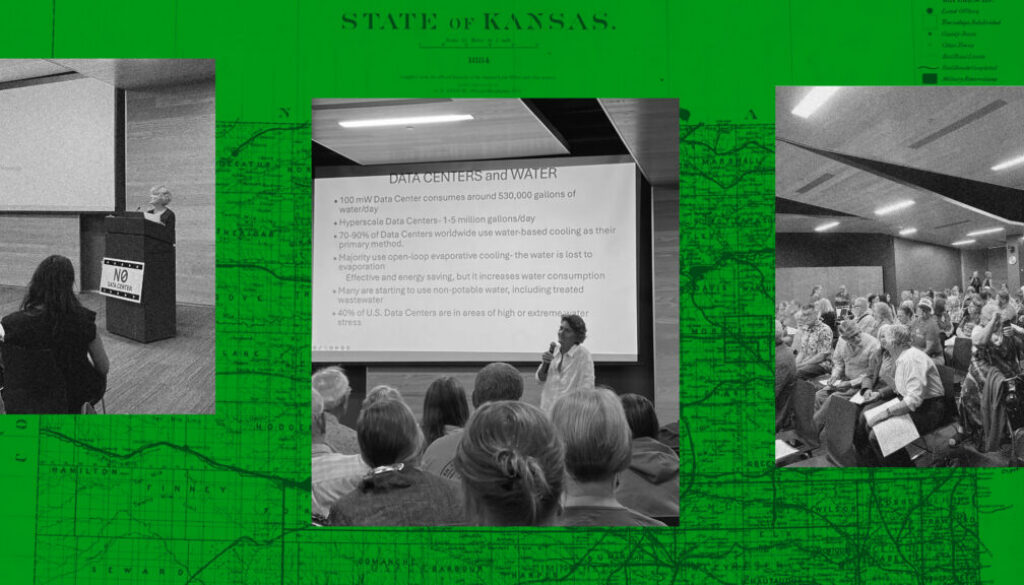
They call themselves “Data Center Watchdogs.” Gathering weekly at their local library in Lawrence, Kansas, a small-but-growing group of residents are preparing to battle against a foe they believe will threaten the way of life in this small college town surrounded by farm fields.
The enemy is a data center the group fears will soon target Lawrence and the larger region of Douglas County, Kansas. There are currently no applications to build a data center in Douglas County — but there are massive proposals in nearby towns. The watchdogs believe that a well-organized opposition, and learning from fellow advocates, could discourage developers from bringing in data center projects in the first place.
“We have a really strong culture of wanting to protect and preserve our prime farmland,” said Nancy Thellman, a former county commissioner who lives on a farm on the outskirts of Lawrence in an agricultural urban edge community in the Kaw River Valley.
Located about an hour outside Kansas City, Kansas, Douglas County has an abundance of farmland and the Kansas River running through it. Nestled along the curves of the river sits a 515 megawatt coal power plant. Data centers rely on ample space, water and energy to power servers.
“We have just about everything a data developer could want,” Thellman said.
Kansas is not alone: As companies like Microsoft and Google increase their AI computing capacities, so has their need for data centers to meet unprecedented electricity demands. In the US there are already over 500 operating data centers, with an additional 159 approved or under construction, and 739 active proposals, according to the FracTracker Alliance’s U.S. Data Centers Tracker.
Data centers are often proposed with a slew of economic upsides — jobs, capital investments and tax revenue. Research from Georgia Tech released in March found that when a data center opens in a county, residents see an estimated 3.5% increase in employment, 5% increase in wages, and around a 2% increase in household income. The study found that metropolitan areas tend to benefit more than rural areas.
Still, the study’s lead author, Daniel Yue, found a slight increase in employment in rural counties, and said that in some cases rural governments can still gain tax revenue or infrastructure investments, depending on the tax exemptions in place.
“One of the main benefits … is just straight up tax revenue from places that are able to tax the ongoing capital expenditures of these companies,” said Yue, an assistant professor of Information Technology Management at Georgia Tech.
As one of the organizers of the Douglas County Data Center Watchdogs, Thellman said many residents are uneasy about the potential problems a data center could bring, including a loss of land and water, and noise pollution — the humming sound that data centers generate from their cooling systems.
Another chief concern is that the energy the facilities require competes with — and can raise the price for — residential and other commercial energy needs.
A typical AI-focused data center can use the equivalent electricity as 100,000 households, according to the International Energy Agency. Multinational investment bank Goldman Sachs forecasts global power demand for the centers will jump 50% by 2027 and as much as 165% by the end of the decade.
The Trump administration is encouraging data center expansion. Last year, President Trump signed an Executive Order aimed at facilitating “the rapid and efficient buildout of this infrastructure by easing Federal regulatory burdens.”
Earlier this month, Trump slammed New York Governor Kathy Hochul for imposing the nation’s first state-wide moratorium on new hyperscale data centers.
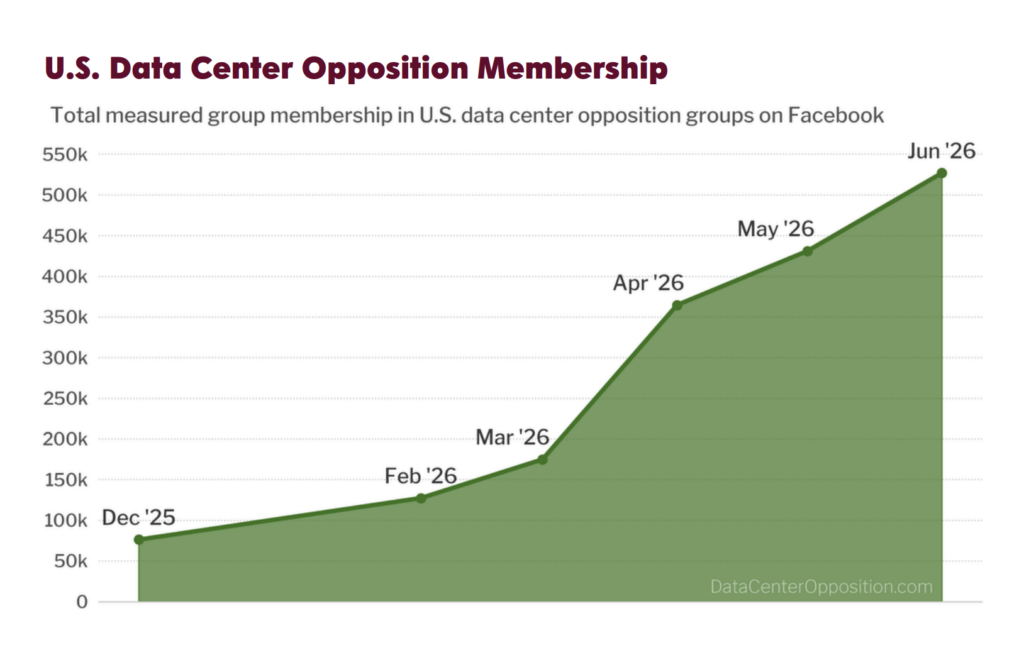
But communities are fighting back. There are at least 430 local Facebook groups — totaling over 525,000 members — in the US opposing data centers, according to Data Center Opposition Report, which tracks data center opposition in the US.
In Kansas, a bill passed in 2025 allows for a 20-year state and local tax exemption for certain data center projects. Many point to Senate Bill 98 as a key reason the state has seen an unprecedented data center boom, with six active proposals in the state, according to data from Cleanview, which tracks U.S. power infrastructure and data center development. It’s why residents in Douglas County believe there will be more.
“If you don’t have an active application filed in your community yet, you probably will, so get ready for it now, and let them know before they get here that they are not wanted,” Thellman said she read in a guidebook written by organizers in the nearby city of De Soto, Kansas, who are mobilizing against a 2.9 million square-foot data center.
“We see those little communities all around us, really in the midst of the fight of their lives now,” Thellman said.
“We see those little communities all around us, really in the midst of the fight of their lives now,” — Nancy Thellman, Douglas County Data Center Watchdogs
Lessons from nearby communities
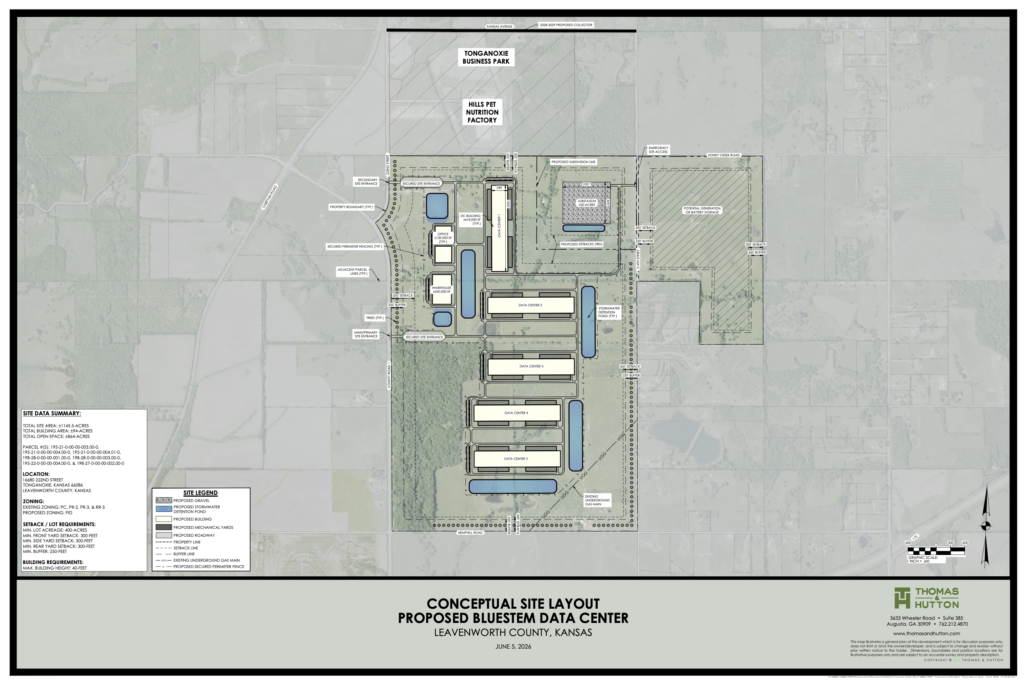
Around 30 minutes northeast of Douglas County, a national developer is proposing one of the biggest data centers in the country. If approved, Cloverleaf’s Project Bluestem would take up nearly 1,000 acres of land in Leavenworth County, Kansas. That’s roughly the size of 750 football fields.
Project Bluestem would be located just south of Tonganoxie. In May, Leavenworth County commissioners passed a 90-day moratorium on data centers, pushed for by the Tongie Data Center WatchDog Group.
“It would destroy the community of Tonganoxie as it is today,” said Jim Karleskint, an organizer with the Tongie Data Center WatchDog Group and former member in the Kansas House of Representatives. He’s particularly concerned about the noise that would disturb nearby schools and nursing homes. “The tone noise from this data center would hurt the people in ways that we can only imagine,” he said.
“It would destroy the community of Tonganoxie as it is today,” — Jim Karleskint, Tongie Data Center WatchDog Group
Jim’s wife Dee is particularly concerned with the impact the noise might have on wildlife.
A University of Michigan study found that noise pollution can affect birds’ behavior, physiology and even reproduction. While the study doesn’t mention data centers specifically, lead author Natalie Madden, a policy analyst at the Defenders of Wildlife, said the impacts are similar. “The noise from data centers could absolutely have impacts on birds and other wildlife in a similar way that any other industrial source would,” Madden said in an email.
Jim and Dee Karleskint have attended meetings in Douglas County, and invited others like Thellman to theirs. “We learn from each other, and that’s the key, because when you’re fighting multi-billion dollar conglomerates, we don’t have the resources they have, and so we have to stick together to glean as much knowledge, support, and information as we can from one another,” Karleskint said.
Nearby in De Soto, Kansas, construction is already underway for a 2.9 million square-foot data center. When the multi-building facility by Beale Infrastructure was first presented last August, it was proposed as a 1.14 million square foot project. Its scope has nearly doubled since then, leaving some residents frustrated.
“I understand why residents have questions when they hear the development is larger than early conceptual illustrations. Those are reasonable questions, and it’s important to distinguish between what was presented conceptually last year and what was actually approved by the City Council,” said De Soto mayor Rick Walker in an email.
Walker said what Beale presented last year was “a preliminary concept,” adding that “the development agreement was not a site plan approval, nor did it establish a maximum building square footage,” he wrote.
Walker also wrote that the project’s “planned electrical capacity remains approximately 600 megawatts, and that capacity has not changed.”
According to the city of De Soto, the project is expected to generate more than $300 million in municipal revenue over a 25-year period through a combination of payments in lieu of taxes, electric franchise fees, local sales taxes on electricity purchases, and property taxes following the expiration of tax abatements.
In an email, a Beale Infrastructure spokesperson said “the project will generate thousands of construction jobs during build out and approximately 50 full-time, on-site roles for each phase, with an average salary expected to exceed $75,000 annually.”
Still, some aren’t convinced the benefits outweigh the risks. “Where are the reports? Where is the information? Where is the data on what these things could potentially do to our community?” Dally Holloway said she’s asked lawmakers during city council meetings in De Soto. Holloway runs the growing national Facebook group “Say NO to data centers,” but is based in De Soto.
Holloway has been organizing against data centers on the municipal, state, and federal level. Her Facebook group has some 175,000 members.
The group started as a way for Holloway to share information with her community. It soon gained traction across the country. “I was hoping it would be a way my community could get involved, but what ended up happening is all of these people from all over the country were like, ‘Dally, I need help. Dally, have you encountered this? Dally, have you done that?’ so I just started listening.”
Dally has created guidebooks, pocketbooks, and even a zine to help others around the country fight data centers. One of Holloway’s guides, “Getting Started: A Quick Guide to Community Coalition Building” breaks down steps to take to build a coalition. “Check minutes, agendas, etc of local zoning and development meetings as well as city councils and mayoral announcements” it reads. “Consider dropping in to a local attorney, introducing yourself, and explaining your group’s goals.” It’s a tip the Tonganoxie group picked up, having held a fundraiser earlier this month to hire an attorney.
Holloway is still focused on her home state, with Kansas holding a governor’s race this November. Holloway’s group wants candidates to sign a pledge, asking them to commit to “ensuring that communities have meaningful input and that appropriate safeguards are in place before projects with significant long term impacts are approved.”
Weighing economic incentives
Thellman acknowledges the potential economic benefits of data centers. “There’s some rural towns that are really struggling.”
“It feels like a lot of these downsides can be mitigated with good regulation and negotiations, and it could bring substantial benefits to the area.” said Yue of Georgia Tech.
Yue said data centers can create jobs through construction and opportunities for electrical and mechanical engineers to keep the computers running, which in some cases can be hired locally.
Residents like Jim Karleskint in Tonganoxie are still skeptical that the 20-something jobs actually required by Senate Bill 98 will be enough. “The construction jobs, there could be some of those, there’ll be very few full-time jobs,” he said, calling it “a joke.”
When asked about the project, Cloverleaf Infrastructure Chief Development Officer Aaron Bilyeu pointed to publicly available numbers on the project’s website, which states that Project Bluestem is “expected to create more than 1,200 construction and permanent jobs over the next three years.”
Yue said many places have spun up training programs aimed at boosting jobs. For example, Microsoft has established several data center academies, partnering with local community colleges — such as Glendale Community College in Arizona and Northwest Vista College in San Antonio, Texas — near their physical data center hubs.
Momentum on moratoriums
Last week, city commissioners in Lawrence approved a two-year moratorium on large-scale data centers.
Previously, land development code in Lawrence allowed data centers in certain industrial areas by right, meaning a proposed project could move forward quickly without public input. Now, any data center development in Lawrence must go through a public process.
The Douglas Data Center Watchdogs believe their fight is still far from over, since there is currently no moratorium in place for Douglas County, meaning a data center could still theoretically be built outside city-limits.
Along with pushing for a moratorium in Douglas County, Thellman said her group is also advocating for a state-wide moratorium such as the one in place in New York, and repealing Senate Bill 98. “Maybe they thought they were doing their states a favor with this kind of aggressive economic development attitude on data centers, but it just really was shortsighted in terms of the kind of downstream effect of it on local communities,” Thellman said.
Thellman, Karleskint and Holloway are fighting their separate battles. Still, Thellman said they continue to keep in touch and support each other, finding more things in common than they had expected. “I know more about other communities across the nation than I ever thought I would, and I feel like I’m bonded with them at the heart and at the pocketbook.”
Featured illustration by Alex Hinton