Groups call on EPA to address “urgent threat” of nitrate water pollution
Sixteen environmental and public health groups filed a legal petition with US regulators on Monday seeking new restrictions on nitrate contamination — a type of water pollution the groups say is driving a “public health crisis across the country.”
The petition calls for the Environmental Protection Agency (EPA) to slash the Maximum Contaminant Level (MCL) for nitrate in drinking water to 1 milligram per liter (mg/L), down from the current federal standard that allows for up to 10 mg/L. The groups are calling for the Maximum Contaminant Level Goal (MCLG) to be set at 0 mg/L, which essentially would acknowledge that no amount of nitrate is considered safe for human health over lifetime exposure.
Such moves are warranted because scientific research shows that current levels of contamination pose “an urgent treat to public health,” including increasing the risk for certain cancers, the petition states.
The petitioners cite analysis showing that surface water levels of nitrate across the nation are increasing while nitrate monitoring is decreasing.
“One of the things we have sought to do here is to do the EPA’s job for it,” said Tyler Lobdell, an attorney with Food & Water Watch, one of the groups leading the petition effort. “One hundred and twenty million on people being serviced by public water systems are told the water is perfectly safe when the science says it is not.”
The petitioners include the Environmental Working Group, the Center for Biological Diversity, the Center for Food Safety, Food & Water Watch, Sierra Club, Natural Resources Defense Council, among others.
The petition blames not only the EPA but also federal, state, and local lawmakers and other public officials for failing to address nitrate pollution, which is linked to cancers and other health problems.
The groups cite excessive application of synthetic fertilizers, the “over-application” of animal waste from concentrated animal feeding operation (CAFO) onto farm fields, inadequately treated sewage and industrial discharges, and failed septic systems as culprits for the nitrate-laden water.
The legal petition for rule making requires a response by the EPA and could set in motion further legal actions, Lobdell noted.
When asked about the petition, the EPA said it would review it and said it is “committed to ensuring all Americans have access to clean drinking water.” However, the agency noted it completed its most recent review of drinking water regulations, including the regulations for nitrate, in July 2024, evaluating available studies and applicable data. And based on that information, there was no need for a revision of the MCL, the agency said. The agency said it will consider new studies for its next review.
A common contaminant
The current standard of 10 mg/L for drinking water was initially set in the 1970s and finalized in 1991 at a level that was set to avoid causing methemoglobinemia, also known as blue baby syndrome. All public water systems are required to monitor for nitrate contamination to determine compliance with that MCL.
But research on nitrate health impacts has grown over the past 35 years and there is now a large and growing body of evidence that consuming even low levels of nitrate-contaminated water is associated with colon and rectal cancers, and ovarian cancer, bladder and kidney cancers, as well as other adverse health impacts such as neural tube defects and low birth weights in babies.
The petitioners said they identified 3,205 community water systems serving roughly 119.7 million people that recorded at least one nitrate sample at or above 1 mg/L between 2021 and 2023.
The petition comes as many US states, including key farming states, wrestle with concerns about nitrates. Iowa, in particular, has drawn national scrutiny for its high levels of nitrate in prominent waterways and climbing rates of cancer.
Scientists point to farm operations as largely to blame for nitrate contamination, both because of the runoff of fertilizer applied to fields of corn and other crops, and the runoff of liquified manure generated by large livestock operations that is also often spread on farm fields. The runoff carries nitrates and phosphorus into surface and groundwaters, and ultimately into drinking water.
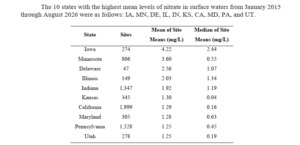
Iowa tops the list of US states with the highest mean levels of nitrate in surface waters from January 2015 through August 2026, according to the petition, which cites analysis of water quality data from multiple national, state, and local monitoring systems. Iowa is followed by Minnesota, Delaware, Illinois, Indiana and Kansas.
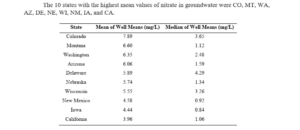
People who get their drinking water from wells are at particular risk as nitrate is commonly found in groundwater.
“For decades EPA has given industrial agriculture a free pass to pollute, and now one in three Americans is drinking water with dangerous levels of nitrates, JP Rose, director of soil health at the Natural Resources Defense Council, said in a statement. “Tackling agricultural pollution at the source and improving treatment will help ensure all Americans have access to safe drinking water.”
One of the primary drivers of agricultural nitrate pollution is overapplication of fertilizer; synthetic nitrogen fertilizer is the largest nitrogen source in 41% of US watersheds, the petition states.
Along with lowering the allowed levels of nitrate in drinking water, the EPA should take new steps to address the source of the nitrate pollution by implementing greater controls at the source point, the petition states. The petitioners point to cover cropping, wetlands protection and restoration, riparian buffers or field border strips, and crop diversification as practices that can help reduce nitrate pollution.
The petitioners noted that stricter regulations on nitrate pollution would also benefit ecosystems and fish and wildlife. Dozens of species listed under the Endangered Species Act are at risk due to the water pollution the petition notes.
Costs and consequences
Lowering the MCL for nitrate in drinking water could prove very costly for water utilities if the sources of the contamination are not significantly restricted. The current cost of nitrate treatment is “a substantial financial burden on water utilities,” according to recent research. Utilities spent up to 9% of their overall operating budgets just on nitrate treatment, according to a 2018 study by the Northeast-Midwest Institute.
The Association of Metropolitan Water Agencies did not respond to a request for comment on the petition. Neither did the the American Water Works Association.
The groups petitioning the EPA argue that their analysis demonstrates that an MCL of 1 mg/L is both “technically achievable and economically justified.”
They also say that the human health benefits of a lower MCL more than justify the costs of compliance. They say their analysis shows a nitrate MCL of 1 mg/L would “conservatively result in approximately $364.1 billion in present-value health benefits, compared with approximately $94.5 billion in compliance costs, yielding approximately $269.7 billion in net benefits over the 50-year analysis period.”
Nancy Stoner of the Environmental Law and Policy Center said in a press conference that the federal government should provide financial support to utilities to help them comply with a lowered standard.
“Americans should not suffer the adverse health outcomes resulting from drinking nitrate contaminated water because funds are not available to ensure safe drinking water, nor should communities be burdened with the full costs of reducing nitrate contamination driven by underregulated industrial agriculture,” the petition states.
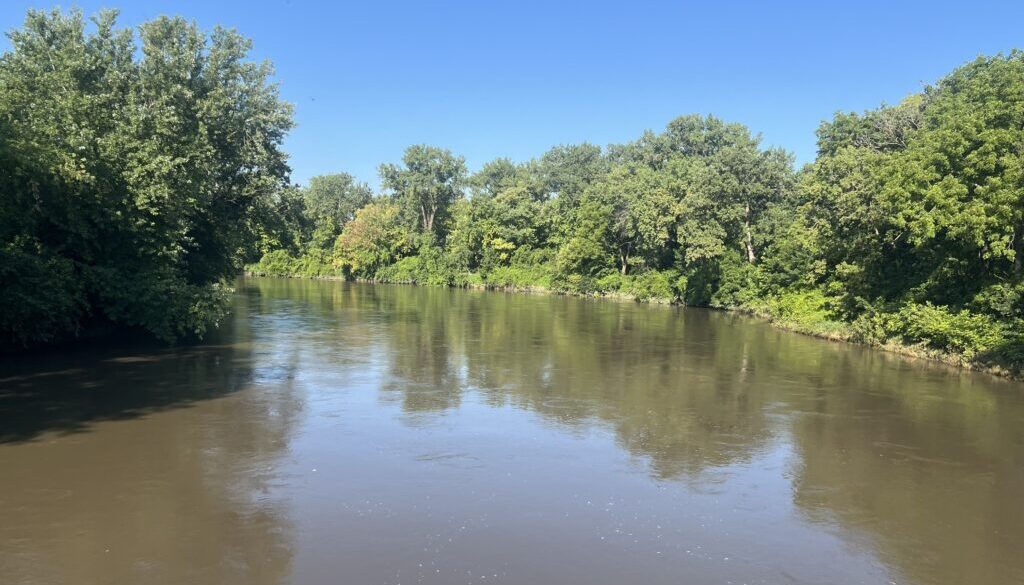
Featured image is by Carey Gillam of the Raccoon River in Iowa.