Ethanol plant pollution costs lives and billions each year. States can fix this.
Listen to the audio version of this article (generated by AI).
As Congress moves to expand year-round ethanol sales, a federal loophole is allowing ethanol plants to release large amounts of air pollution with limited oversight, shifting the health costs onto communities far beyond the facilities themselves.
However, states have the power to close that loophole themselves by holding ethanol plants to the same pollution limit as other chemical plants, and two states have more at stake than any others.
Nearly all gasoline sold in the US already contains ethanol, usually 10%, a blend called E10. E15 raises the ethanol percentage to 15%. The ethanol comes from plants that burn natural gas and ferment corn, releasing nitrogen oxides, fine particles and volatile organic compounds that drift downwind, forming smog. That smog and pollution lead to early deaths, asthma attacks, emergency room visits and lost work days, often far from the plants emitting the pollution.
In any area that meets federal air standards, an ethanol plant can have the capacity to emit up to 250 tons a year of each of those pollutants before it faces full federal review, 2.5 times the threshold of other chemical plants. As such, year-round E15-blended gasoline would expand the market for ethanol under that rule, potentially leading to increased air pollutants.
Despite these dire public health consequences, Congress made two key moves this year to further entrench E15: In May the House voted to make gasoline produced with 15% ethanol legal, year-round, nationwide, lifting a summer limit meant to curb smog. Then, in September, the Senate Agriculture Committee voted to send a Farm Bill to the full Senate that also allows year-round E15 sales. The bill has not yet been brought to the Senate floor.
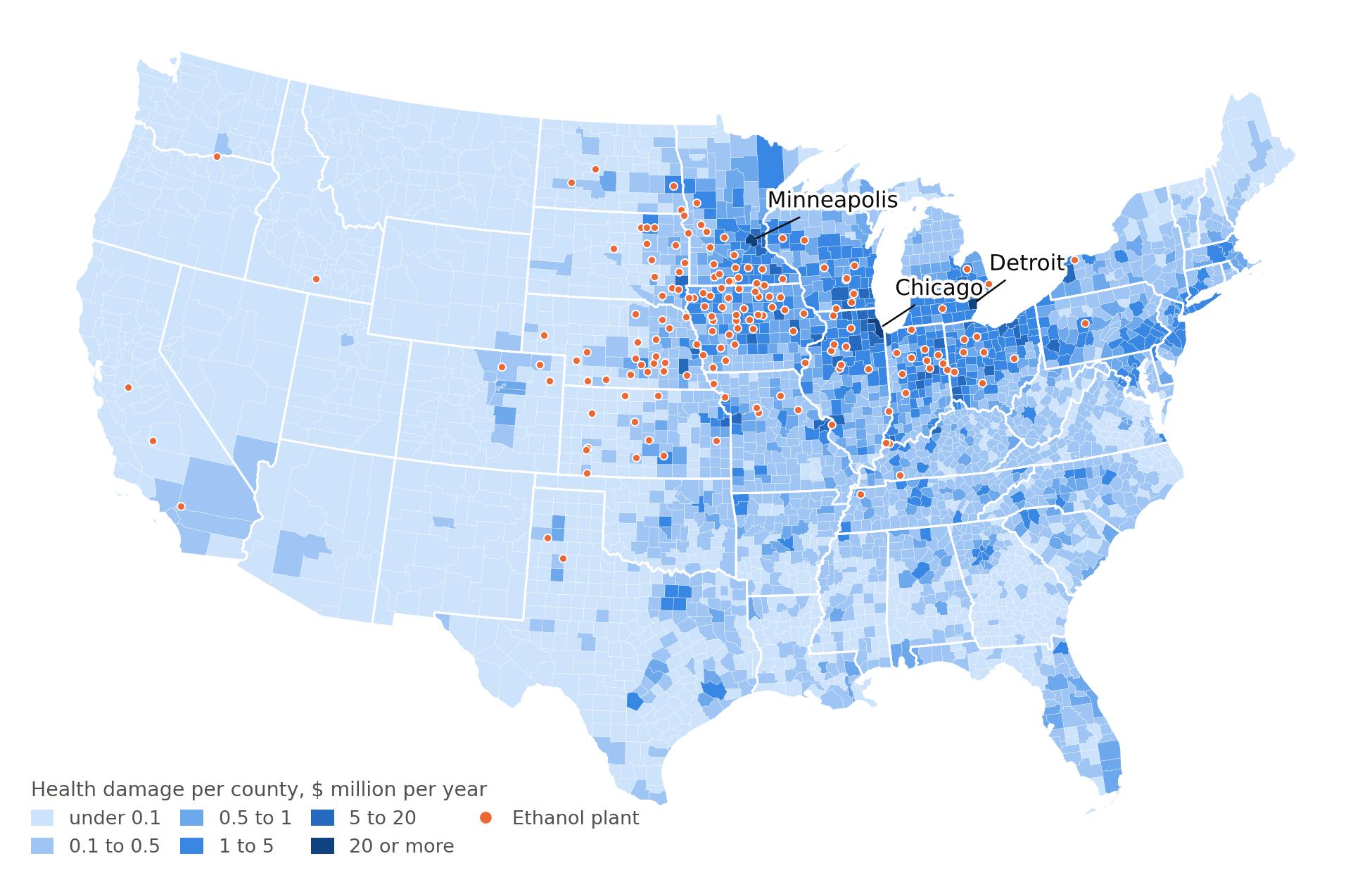
US fuel ethanol comes from about 190 plants, most of them in the corn-abundant states of the Midwest. A 2007 US Environmental Protection Agency (EPA) rule set how much pollution those plants can emit before they need a full federal permit review. I ran the EPA’s free health screening model, COBRA, on emissions from the 167 plants on the Energy Information Administration’s (EIA) 2025 list that I could match to EPA’s emissions inventory, mostly using 2023 records. Each year of emissions at those levels would bring about an estimated 71 to 125 premature deaths and $1.1 billion to $1.9 billion in public health costs.
Cook County, Illinois, which includes the city of Chicago, does not have a single ethanol plant. Yet, it suffers more from these health costs than any other county in the nation. This is common for this type of air pollution. When factories release nitrogen oxides and volatile organic compounds, those chemicals do not cause immediate harm right at the source. Instead, they take hours or days to drift and turn into dangerous fine particles and ozone. Wind can carry the resulting pollution far from its source.
Why do ethanol plants have higher air pollution thresholds than other polluters? Under the Clean Air Act, a new chemical process plant counts as a major source once it has the capacity to emit 100 tons a year of a regulated pollutant. The 2007 rule raised that threshold, by removing ethanol plants that use natural fermentation from the chemical process plant category. The rule also stopped counting fugitive emissions, such as leaks from tanks, valves, pumps and piping, toward the threshold.
The Natural Resources Defense Council petitioned the EPA twice to reverse the rule. In 2019, the EPA agreed to reconsider only the provisions for areas that already fail air standards, promised a public comment period “in the near future,” and has published none in the Federal Register since.
Emissions from the plants
The 167 plants I ran in the EPA health screening model emit about 10,800 tons of nitrogen oxides, 4,700 tons of fine particulate matter and 13,300 tons of volatile organic compounds a year. These pollutants are linked to a host of health issues, including heart attacks and strokes. In addition, nitrogen oxides and volatile organic compounds react in sunlight to form ozone, which can cause asthma attacks.
Of the 154 plants that reported to the EPA’s 2023 inventory, 49 reported actual emissions between 100 tons and 250 tons for their largest pollutant, the range the 2007 rule moved out of major-source review.
The EPA model, COBRA, traces emissions from each county into fine particle and ozone pollution across the lower 48 states and estimates the premature deaths, asthma cases and lost work days that result. A second, independent air quality model, InMAP (built by university researchers and published in a peer-reviewed journal) covers fine particles alone and puts fine-particle deaths from the same emissions at about 41 for each year of emissions, just below the low end of COBRA’s 47 to 101.
None of the 25 counties with the most health costs contains a plant. Counties without a plant receive 90% of the health costs.
The Environmental Integrity Project found in 2024 that ethanol and other biofuel plants release large amounts of hazardous air pollutants, as The New Lede reported. The 167 ethanol plants released 1.3 million pounds of acetaldehyde in 2023, 7.5% of the total from US point sources other than airports. The EPA classifies acetaldehyde as a probable human carcinogen, and acrolein, which the plants also release, irritates the eyes, nose and lungs. COBRA leaves out both, so these estimates count only part of the harm.
What can states and the EPA do?
Congress should not have expanded E15 without first counting these costs, and states should not wait for it to do so.
Minnesota and Illinois have the most at stake. They had 27 of the 167 plants I studied and received about $425 million of the health costs for each year of emissions. Section 116 of the Clean Air Act lets each state set stricter air pollution rules than federal law, so those states, as well as others, should require this health screening for every new ethanol plant or expansion.
States can also set their own 100-ton threshold for ethanol plants, the same one other chemical plants face. A state agency can run the screening with the same public files and EPA’s free model I used, and it shows which counties would end up having the public health costs.
The EPA can open the public comment period it promised in 2019 on the rule’s provisions for areas that already fail air standards. It can also reverse its 2019 denial and return ethanol plants to the chemical process plant category, which the Natural Resources Defense Council argued in its 2009 petition the statute’s meaning requires.
When California’s air board approved E15 rules in September, it found the fuel’s health impacts comparable to E10, the blend already in most gasoline. The health costs of making the ethanol end up affecting counties like Cook, far from the plants. Year-round E15 would expand the market for ethanol and exacerbate the effects of the current rule. States can move to mitigate those impacts before the next permit is issued.
(Opinion columns published in The New Lede represent the views of the individual(s) authoring the columns and not necessarily the perspectives of TNL editors.)