Even Sierra Nevada backcountry isn’t spared from microplastic pollution, finds skiing scientist
Listen to the audio version of this article (generated by AI).
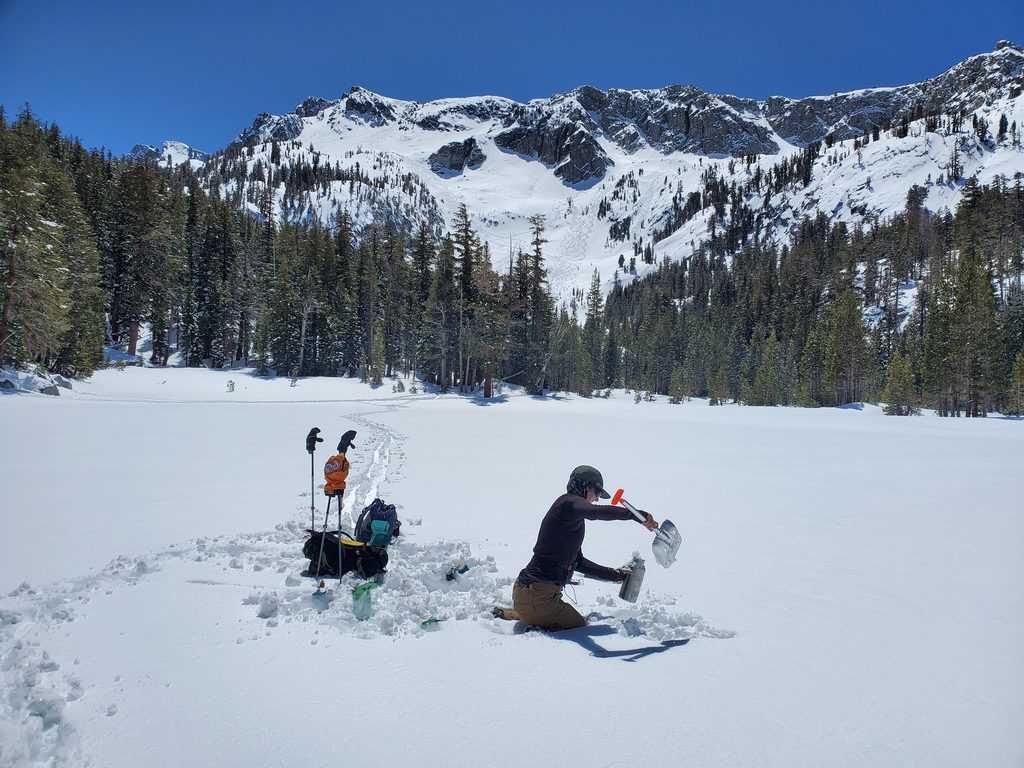
When toxicologist Aleksandra Karapetrova was looking for a Ph.D. topic, she turned to a skill few lab researchers bring to environmental science: backcountry skiing. Knowing the sport could take her far beyond the well-trodden paths of previous atmospheric studies, she skied deep into the Sierra Nevada mountain range.
I was able to go farther than most,” said Karapetrova, a toxicologist affiliated with the University of California, Riverside, currently working at California’s Office of Environmental Health Hazard Assessment.
Karapetrova and colleagues set out to measure how much microplastic pollution falls on the Sierra Nevada during snowstorms. Sampling fresh snowfall, snow pit layers, and dry air fallout across seven locations in the Sierra Nevada in California, they detected microplastics in fresh snow at all locations, including the most isolated backcountry wilderness areas, according to the findings published in Environmental Science and Technology.
The location of the microplastics found in remote areas far from human activity is concerning because the Sierra Nevada supplies around 30% of California’s freshwater.
“We are not isolated from these remote areas,” said Susanne Brander, who directs scientific advancement efforts for The Pew Charitable Trusts’ safer chemicals project. “If microplastics are deposited in a remote snowpack that feeds into drinking water, humans are going to be exposed to those particles eventually.”
Microplastics are pieces of plastic less than 5 millimeters long that form when larger plastic chunks break apart. Microplastics are everywhere, and have pervaded virtually every aspect of human life, including our food, clothing, air, and water. Research suggests up to 83% of tap water worldwide is contaminated with microplastics.
Public concerns over the health effects of microplastics have been growing, though the full extent of their impact on human health is still unknown. Studies in animals and human cells suggest microplastics exposure could be linked to cancer, reproductive problems, and other health issues.
Previous studies have similarly found microplastics in remote snow-filled environments like Antarctica, however, Karapetrova and colleagues looked at individual storm events which allowed researchers to connect microplastic deposition rates directly to specific weather patterns, storm paths, and atmospheric dry periods. Karapetrova skied to most of the collection points during snowstorms.
In these remote collection points, researchers recorded between 270 and 3,200 plastic particles per square meter per day during storms. “I didn’t think I would be able to consistently detect microplastics in these areas,” said Karapetrova.
The study’s authors hypothesize that microplastics are in the atmosphere due to regional and local transport. “The air masses associated with the sampled storms pass over Madera and Fresno counties, which have land use that is agricultural, urban, and suburban. Snowfall scavenges particles from the air, including microplastics, and this snow is deposited into the snowpack,” Karapetrova explained.
The most common microplastics found were polyethylene, polypropylene, and polyester/PET—plastics commonly used in clothing and day-to-day use plastic objects.

Limited regulation
In July, the EPA issued its proposed Sixth Unregulated Contaminant Monitoring Rule (UCMR 6), requiring certain public water systems to collect national data on 30 unregulated contaminants, including certain per- and polyfluoroalkyl substances (PFAS), However, the EPA didn’t include microplastics to UCMR 6, citing the lack of a validated test method.
“[That’s] at least being used as the reason not to regulate the amount of plastic in water at present,” said Aron Stubbins, professor of marine and environmental sciences and co-director of The Plastics Center at Northeastern University. An “inability to measure it cheaply enough, and routinely enough, and accurately enough” are hurdles to establishing such standards for drinking water facilities, he said.
Brander points to states like California that have moved ahead with their own framework. In 2018, California passed Senate Bill No. 1422 requiring state regulators to define microplastics and establish standardized testing protocols, adopting those protocols in 2022.
Karapetrova believes that part of the importance of this study is to provide an understanding of the circular nature of modern waste.
“You put something out there, and it’s going to return back,” she said. “Part of that is seeing emission of microplastics in the atmosphere, and then seeing it in our water cycle, seeing it in the resources that we so deeply depend on and are critical for our well-being.”
Featured Image: Lead researcher Aleksandra Karapetrova on her way out of the Pear Lake Area in Sequoia Kings National Park, carrying 18 liters of snow and equipment. Credit: Sonya Maple/California Fish and Wildlife