

US researchers find new evidence that glyphosate may cause cancer
Listen to the audio version of this article (generated by AI).
New research funded by the US government is strengthening evidence that widely used glyphosate herbicide can cause cancer and other serious health problems, a development that comes as federal regulators say they are giving new scrutiny to the chemical.
The new scientific findings also come as Bayer, which bought glyphosate-maker Monsanto in 2018, is solidifying a class action settlement in litigation over cancer claims tied to sales of glyphosate-based Roundup and other brands.
The US Environmental Protection Agency (EPA) says it is taking a fresh look at scientific studies pertaining to glyphosate safety. The agency announced in September that it was joining with the Department of Health and Human Services (HHS) to “expand the evidence” for the EPA’s ongoing registration review of glyphosate. The agency set Monday as the end of a public comment period on its review.
The new research, involving reviews of animal and human studies, has not yet been finalized and has yet to be peer-reviewed, but three papers were made available last week online.
A “positive association” with cancer
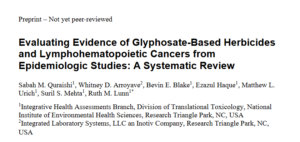
In one of the most significant research findings, scientists from the National Institute of Environmental Health Sciences (NIEHS) conducted a review of epidemiology studies and found that “the current body of epidemiology studies found a positive association between [glyphosate based herbicide] exposure and [lymphohematopoietic cancers],” such as non-Hodgkin lymphoma. The research was requested by the HHS.
 In 2015, the International Agency for Research on Cancer (IARC) classified glyphosate as probably carcinogenic to humans based on a review of a wide body of published studies, and noted a particular association to non-Hodgkin lymphoma.
The EPA has repeatedly discounted IARC’s findings and assured Americans that glyphosate is “not likely” to cause cancer. But the EPA’s position has drawn fire from scientists around the world as well as public health and environmental advocates who accuse the agency of failing to properly evaluate scientific findings and of aligning its position on glyphosate with Bayer and other industry interests profiting from the herbicide.
“Americans would be smart to heed the cancer findings of the nation’s most trusted scientific institution rather than the industry-influenced claims of the EPA,” Nathan Donley, environmental health science director at the Center for Biological Diversity, said in a press release about the new research.
“The EPA’s pesticide office has made a mockery of pesticide science for far too long,” he said. “It’s about time we have a US agency that tells the public the truth and doesn’t just parrot pesticide industry talking points.”
“The EPA’s pesticide office has made a mockery of pesticide science for far too long.” – Nathan Donley, Center for Biological Diversity
The NIEHS researchers also found that an evaluation of six cancer bioassays in mice and nine in rats supported cancer concerns.
“Overall, the evidence from animal studies suggests exposure to glyphosate or GBHs [glyphosate-based herbicides] is associated with carcinogenic effects in human-relevant animal models, based on treatment-related tumor responses observed across multiple studies, organ systems, and rodent species,” that research paper states.
In a third paper, the researchers noted that human exposure to glyphosate is “nearly ubiquitous,” and the chemical is commonly found in human urine. People can be exposed in a variety of ways, including through skin, inhalation, and diet.
“The available human and animal evidence for the carcinogenicity of glyphosate … indicate glyphosate may be a human carcinogen, though observed responses were generally of small magnitude and not uniformly replicated across studies,” the researchers wrote. “Given the widespread nature of human exposure to glyphosate/GBH, even small increases in risk can lead to substantial increases in disease burden at the population level. There is added concern for occupationally exposed individuals who experience exposure more frequently and at higher levels …”
Dave Andrews, chief science officer at the Environmental Working Group, called on the EPA to take “meaningful action to protect Americans from glyphosate.”
“This new research adds to the mounting evidence linking the weedkiller to cancer and further undermines the EPA’s longstanding conclusion that it is not likely to be carcinogenic,” Andrews said in a statement.
Working “hand in hand”
When asked about the NIEHS research, the EPA issued the following statement:
“We will evaluate it the same way we evaluate every study; we’ll screen it against the same criteria we apply to all published literature. If it’s relevant and of sufficient quality, we’ll address it in the registration review record and explain how it informs our conclusions. We want as much high-quality research in the record as possible. Every relevant, quality study gets a seat at the table, and this one is no exception. We’re working hand in hand with our HHS colleagues.”
The EPA said its updated glyphosate assessment will be thorough and will consider exposure, health effects and children’s safety.
The EPA and HHS working group is also “flagging areas where more research could strengthen the evidence base,” the EPA said. “These include formulation and surfactant toxicology, occupational epidemiology, biomonitoring, and emerging areas like the microbiome.”
The new research comes at an important time and should help inform the EPA review, said researcher Daniele Mandrioli, Secretary General of the Collegium Ramazzini who led a years-long Global Glyphosate Study at the Cesare Maltoni Cancer Research Center at the Ramazzini Institute in Italy.
“The systematic reviews published by NIEHS represent a comprehensive, independent and authoritative synthesis of the evidence that the regulators and the public can trust” he said.
Featured image credit: Getty Images/Unsplash+