Rivers downstream of Wisconsin CAFOs are full of antibiotic-resistant bacteria, study finds
Listen to the audio version of this article (generated by AI).
Antibiotic-resistant bacteria are pervasive in streams and rivers downstream of large Wisconsin livestock operations, increasing the risk of superbugs that make people sick and cannot be treated, according to a new study.
The water contamination likely stems from high use of antibiotics in animals housed in concentrated animal feeding operations, or CAFOs, according to the study. While the practice of livestock antibiotic use decreased significantly over the past decade, there was a recent trend reversal in the US: sales and distribution of antibiotics approved for use in food-producing animals increased by 16% between 2023 and 2024 — the highest increase on record, according to a 2024 US Food and Drug Administration (FDA) report.
Wisconsin has an estimated 347 CAFOs — nearly all dairy farms — and is the second-largest dairy producing state. The new study, published in the Journal of Hazardous Materials, adds to evidence that loads of manure from CAFOs are sending harmful bacteria into nearby waterways and contributing to drug-resistance that threatens to render antibiotics ineffective in treating human illness. It is also one of the first studies to analyze the presence of bacteria and drug resistance upstream and downstream of a commercial calf ranch.
Researchers tested water at eight sites in rivers and streams near dairy CAFOs and one site near a calf ranch CAFO. They also took samples from two sites at a lake unaffected by CAFO manure. All of the sites were in eastern Wisconsin, but the study did not identify the waterways or the CAFOs. They looked at Escherichia coli (E. coli), a large group of bacteria that can make people sick, and found that about 70% of E. coli strains near CAFOs were resistant to multiple antibiotic drugs, while just 8% of strains at the sites that were not near CAFOs had multi-drug resistance.
“We found a lot of live, multi-drug resistant bacteria out there,” said lead author Katie Osborn, a University of California, Los Angeles (UCLA) PhD student. “We saw a large increase in antibiotic resistance downstream of the calf ranch … that was our highest multi-drug resistance site.”
“We found a lot of live, multi-drug resistant bacteria out there.” – Katie Osborn, UCLA
Osborn said the calf ranch findings were particularly interesting as the ranch owned all of the drainage area that emptied into the streams they tested, leaving little doubt about the source of the antibiotic resistance. For the sites downstream of the dairy CAFOs, they looked for other potential sources of bacteria and antibiotic resistance, such as human wastewater effluent, but did not find any.
Senior author Jennifer Jay, a researcher and professor in the department of civil and environmental engineering at UCLA, said all sites, including the samples that were not near CAFOs, had E. coli but that the antibiotic resistance was very specific to CAFO proximity.
“You can get E. coli from these unimpaired sites … but we did not see multi-drug antibiotic resistance in the unimpaired sites,” Jay said.
They tested during different seasons and found the highest spikes in the spring. Osborn said such spring spikes could be from manure application but it’s hard to tell from looking at state manure application records, which were “difficult to obtain” and the majority of which “didn’t even have an exact date listed.”
“There were also a lot of incorrect dates. Most of the seasons were off. And there were just a lot of handwritten notes that we had to try and interpret,” Osborn added.
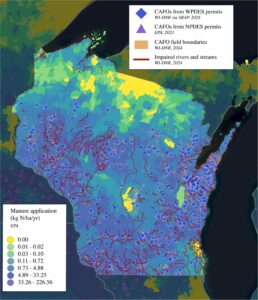
Cole Dickerson, a water rangers program coordinator with the Socially Responsible Agriculture Project (SRAP), which helped Osborn and Jay identify sites, said he works with concerned community members all along eastern Wisconsin as it is full of dairy CAFOs. Kewaunee County alone, for example, has 18 CAFOs and a long history of water contamination.
“We see significant opposition at the community level but one of the big challenges that we see is that it’s often hard to pinpoint a source of water pollution, so there’s limited regulatory action that can be taken,” he said, adding that is one reason the new study is a “significant finding.”
A spokesperson for the Wisconsin DNR, which regulates CAFOs, said the agency hasn’t reviewed the new study so would not comment on its findings, but added that the department routinely inspects CAFOs to ensure compliance with water discharge permits.
“In cases where a CAFO has been shown to be a cause of an exceedance of water quality standards for bacteria such as E.coli, the department may require implementation of management practices to address the cause of the exceedance,” the spokesperson said.
The Wisconsin Farm Bureau did not return requests for comment, and the Dairy Farmers of Wisconsin said questions on the study should be directed to state regulators and researchers.
The study built on previous research Jay and colleagues conducted in Michigan and California that similarly showed antibiotic-resistant E. coli near CAFOs. And earlier this month a study in Nature found evidence of antibiotic drug resistant bacteria in the dust of people’s homes near CAFOs in Iowa — with over a quarter of all samples having at least one antimicrobial-resistant gene.
Jay said all of this spells increasing trouble for human health. “Antibiotics used to be our last resort, but with more and more resistance out there, the less they’re going to work.”
Antibiotic resistance is responsible for an estimated 1.3 million deaths per year, and is on the rise. A 2025 World Health Organization report found cases of antibiotic resistance are increasing up to 15% every year.
Despite the stark data, it’s not a lost cause, Jay said. She pointed to the European Union, which has cut antibiotic use in animals and has seen a corresponding decrease in antibiotic-resistant bacteria in both animals and humans.
“The EU has great data showing medically relevant improvements from them stopping using certain antibiotics in CAFOs,” she said. “That’s the direction that we would like to see here.”
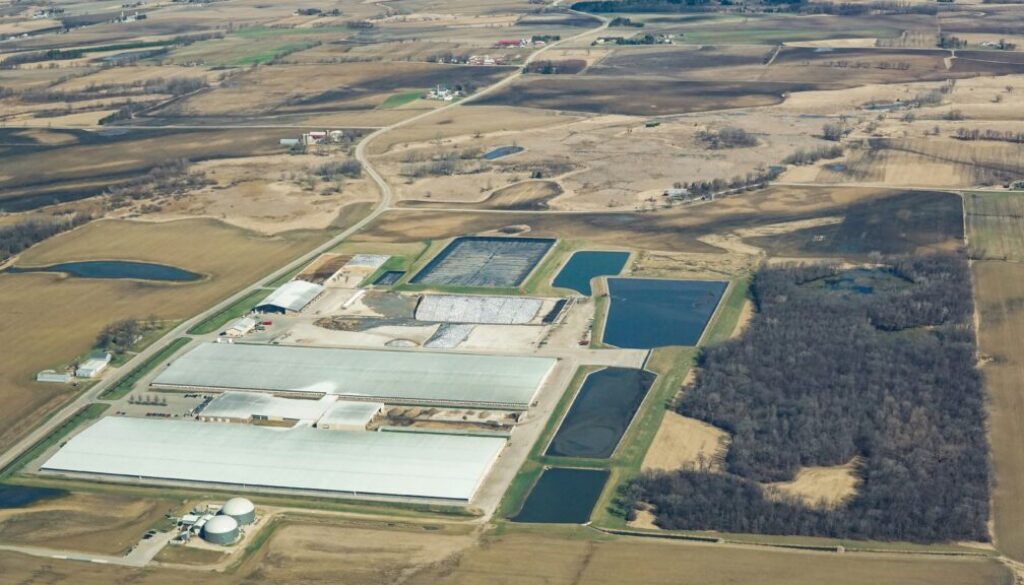
Dairy CAFO in Rosendale, Wisconsin. (Credit: Amelia Bates/Unsplash)