
Maryland fund to deal with CAFO manure wastes taxpayer dollars while pollution persists, report alleges
Listen to the audio version of this article (generated by AI).
Maryland is spending millions in taxpayer dollars on technology designed to protect people and water from animal manure pollution at large-scale livestock farms — but has wasted money on fruitless projects and shown little evidence that the investments are working, according to a new report.
The report alleges that over the past decade the state’s Animal Waste Technology Fund spent taxpayer money on “failed and significantly delayed projects,” and is actually adding to pollution burdens in already heavily contaminated and low-income communities.
“There is almost no evidence, after decades and millions of public dollars spent, that the Animal Waste Technology Fund has met its statutory objective of creating ‘economically feasible technologies’ that reduce nutrients from animal waste in the state,” the report states.
“There is almost no evidence, after decades and millions of public dollars spent, that the Animal Waste Technology Fund has met its statutory objective.”
Regulators estimate the state has 590 concentrated animal feeding operations (CAFOs), which are facilities where animals are grown in concentrated facilities that generate loads of manure. The bulk of Maryland CAFOs raise chickens, and are highly concentrated on the state’s Eastern Shore, with an estimated 95% of the state’s CAFOs in the Chesapeake Bay watershed. Such facilities are linked to air pollution and elevated levels of nitrate in drinking water. The Chesapeake Bay, for example, has suffered from excess nutrients like nitrogen and phosphorus that have spurred algal blooms, dead zones and fish and wildlife die-offs. The state estimates about half of the Bay’s excess nutrients come from animal manure.
The Animal Waste Technology Fund was designed to address these problems, along with reducing greenhouse gas emissions. The state gave grants for projects that proposed several different kinds of technology to treat manure, including pyrolysis, which uses high heat to break down manure into usable fuel and soil amendments, and anaerobic digesters, which use bacteria to break down large amounts of manure and turn it into “biogas,” which is a mix of mostly methane and carbon dioxide and can be refined into renewable natural gas.
However, the fund is not eliminating the pollution, but instead is converting it to a different form and incentivizing the growth and concentration at large farms, according to the report that was authored by Friends of the Earth US, Sentinels of Eastern Shore Health, Concerned Citizens Against Industrial CAFOs, and Wicomico County NAACP. In addition, since the fund was created in 2013, the state has spent $15 million on 14 projects, with five of the projects either already having failed or still “under progress.”
“We found a lack of sufficient oversight from [the Maryland Department of Agriculture] … projects that had stalled and projects that had never been completed despite hundreds of thousands of dollars in taxpayer investments,” said Chloë Waterman, deputy director of food systems & agriculture policy at Friends of the Earth US.
“At the same time, we have Maryland farmers who are struggling to access funding for proven conservation practices,” she added, referring to a “transition to pasture-based practices and other types of agriculture that just don’t have this amount of waste.”
A Maryland Department of Agriculture spokesperson did not address questions related to alleged wasted taxpayer money or environmental justice concerns.
“Through the Animal Waste Technology Fund, the Maryland Department of Agriculture recognizes the value of lessons learned, the importance of partnerships between farmers and businesses with technical expertise, and the need to continue to incorporate the state’s evolving climate and environmental justice priorities in program materials and criteria,” the spokesperson said.
When pressed on state evidence of mitigated pollution through the fund, the spokesperson said there was not “a readily available data source,” instead pointing to a 2023 assessment of the program from the University of Maryland. The assessment did not track any projects’ impact but said there is “a need for state-level reporting and data collection on the use of these technologies.”
“Overburdened communities”
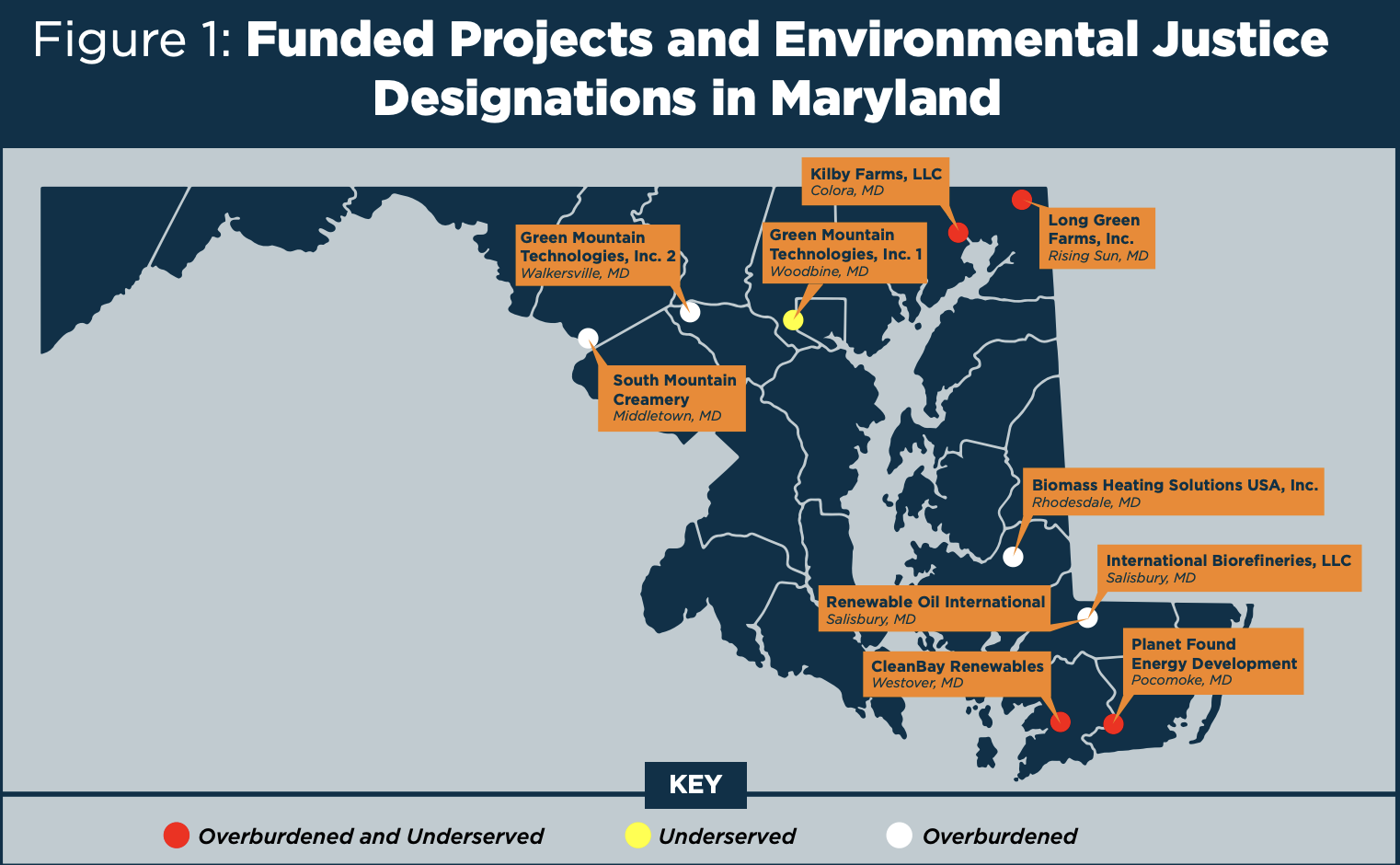
Eight of the funded projects that are operating are in “overburdened” communities, defined by the state as already having multiple environmental health risks, such as air pollution, lead paint, nearby power plants or hazardous waste sites.
Waterman said some of the technologies used to treat manure can worsen pollution in these communities. For example, ammonia emissions, which can harm a person’s ability to breathe, are more than three times higher when emitted from manure that has been through a digester compared to manure that is directed into storage lagoons or sprayed on fields. And a study examining biochar from poultry manure found toxic heavy metals such as arsenic.
“These technologies turn manure into a different form but it still contains the same nutrients that are leading to pollution and you still have a big volume of waste,” she said.
The report included case studies of projects that were awarded grants but didn’t become operational, including Earthcare LLC, which was awarded a $2.24 million grant in 2021 to convert poultry litter into “Ecochar,” a carbon-trapping soil amendment. Amid community opposition, the grant was later revoked by the state.
Mike McGolden, president of Earthcare, LLC, said there is a need for CAFO cleanup technology — while acknowledging some problems with how the state runs the current fund.
“I will agree that the program has been largely ineffective; but I believe it could be very valuable if managed properly,” he said. “The major flaw is that there is no value in a pilot project, because in order to become commercially viable, it must be scaled up and many technologies fail when they try to scale up.”
“I will agree that the program has been largely ineffective; but I believe it could be very valuable if managed properly.” – Mike McGolden, Earthcare, LLC
He said Earthcare’s grant was revoked when they could not get insurance on the facility site. “I tried to explain that we couldn’t maintain insurance on a site we didn’t have, but they had already made their decision.”
The state’s “mistake was allowing politics and protest groups to force them to back down,” he said, adding that Earthcare is operating similar projects in Pennsylvania, Ohio, and Indiana, and is soon expanding in Michigan and Minnesota.
“These are not waste-to-energy projects, but environmental projects,” he said. “It is no longer 1950, so if we think we have a chance to feed our population, we need CAFOs — we just need to provide them with a solution to manage their manure — which is what we do.”
Waterman said she does not want bans on manure treatment technologies, but to stop spending taxpayer money on them.
“Digesters and the other technologies are situated within an industry that is so under-regulated,” she said. “It would be different if these entities had to achieve certain amounts of emissions reduction or were regulated in meaningful ways. But instead they are just being subsidized.”
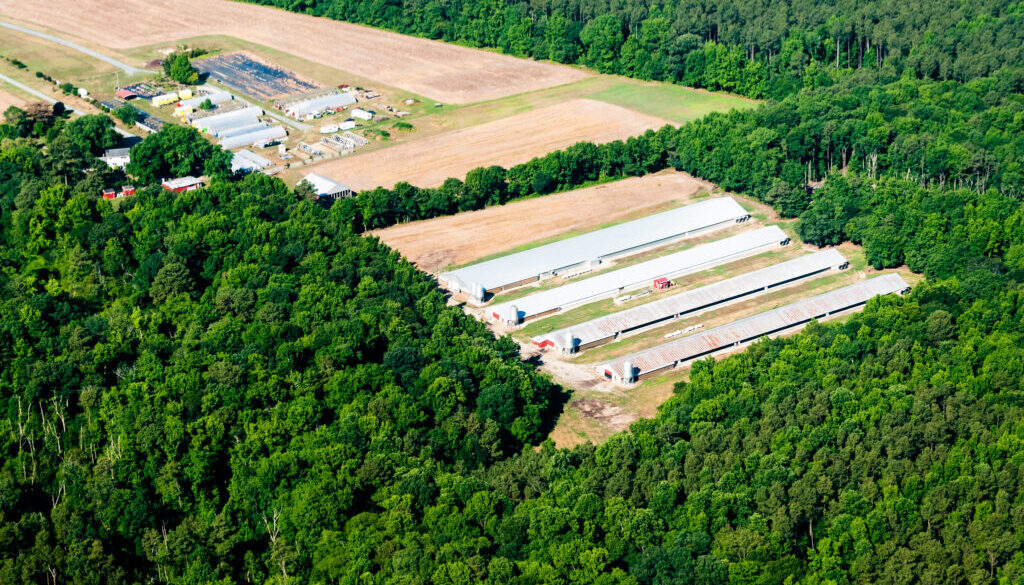
Featured image: Poultry barns in Wicomico County, Maryland. (Credit: Chesapeake Bay Program/flickr)




October 21, 2026 @ 10:14 am
The nitrate issue in the surface and groundwater of the Chesapeake Bay watershed is a legacy issue that started in the 1970’s when commercial artificial fertilizer was introduced and farmers applied excess nitrogen to the fields because the cost of doing so wasn’t breaking the bank. With the current price of nitrogen compared to commodity crops, farmers are less inclined to apply more than what they need and many are seeking technology such as split rate application or AI monitored applications that can estimate the plants nitrogen need and adjust on the fly. The issue that arose from poultry litter was excess phosphorus in the immediate vicinity of the poultry houses. This was because farmers were applying the poultry litter to achieve their nitrogen requirements, which put the phosphorus application well above the required rate. The greatest difficulty in the modern day for poultry litter is that the farms have a legacy excess of phosphate, but the cost of transporting the litter at great distances becomes quickly prohibitive. Manure is heavy, to get the roughly 200 ln-N required for 200 bu of corn, the commercial fertilizer would weigh ~500 lb vs 3 tons of poultry litter, and even more for cow manure. Some of those companies creating biochar from the litter would have been greatly reducing the weight of the litter by remove the water content of the biomass. Allowing it to be distributed further from the facility.
As for anerobic digestion, the paper sited by this article refers to hog manure which is chemically different from cow manure. There is not much of a hog industry in Maryland. The more pressing issue with AD’s is that the utility company refuse to pay farmers for the electricity that they generate, so many farmer throttle their output to cover their electricity bill.
On the arsenic concentration in poultry litter, that was because the poultry industry (not the farmers) was using an arsenic based antibiotic call roxarsone to keep the chickens from getting sick. Maryland has already addressed this by banning the use of roxarsone starting 1/1/2013. In addition to this, poultry farmers in America are more accurately poultry summer camps. The integrator (the company that processes and sells the meet for consumption) owns the birds and provides the feed. The farmer just owns the house and makes sure that as little bird die before pick up day, from there they are paid based off of a competitive rate of how well the birds gain weight.
Lastly, for an article that bashes attempts to innovate and come up with more solutions and says that we should focus on what works, they make little attempt to discuss what practice are currently being used and are known to be effective.