
Hog farmers reject push to undo state animal welfare standards
Listen to the audio version of this article (generated by AI).
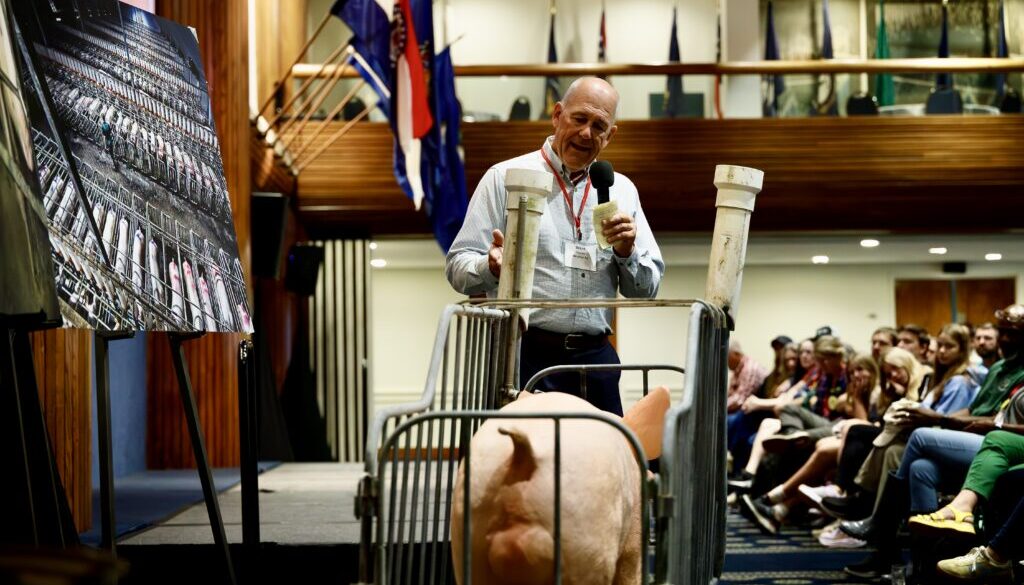
When Brent Hershey got into the hog business more than 40 years ago, he built his operation to industry standards of the time. That meant confining sows to small crates while pregnant and for awhile after giving birth. The crates allowed the sows almost no room to move.
“The argument was that you could put the animal in that crate and you could feed her very specifically, monitor conditions for the animals better and keep them from fighting,” said Hershey, owner of Pennsylvania-based Hershey Ag, which raises 3,000 sows and roughly 78,000 market hogs annually. “And that was just the way to build a sow barn.”
“But I always had a reaction whenever we showed that system to anybody,” he added. “They would ask us, ‘does she get out of that crate?’ And we were like, ‘oh no, no, that’s the way to do it.’”
His own daughter once grilled him. “We were at the dinner table when my youngest daughter looked at me and said, “Dad, you can’t keep doing that. Our generation is not gonna put up with that. You cannot have an animal like that and think that’s okay.’”
“We were at the dinner table when my youngest daughter looked at me and said, “Dad, you can’t keep doing that'” -Brent Hershey, Hershey Ag
His daughter’s matter-of-fact statement coupled with employees that were lost over the years over opposition to the gestation crates kickstarted a change. But when word got out among hog farmers in the mid-2010s that state laws may target the crates, the real overhaul began. Hershey eventually added 40% more square footage to his barns, keeping the same number of hogs. Before, sows couldn’t turn around. They now have at least 24 square feet of space each.
Hershey said the change, completed about three years ago, led to less hog heat stress, better conception rates and fewer deaths. Since he added barn space, sow mortality rates are below 10% (the industry average has been around 15% in recent years) and they’ve seen a 2% increase in conception rates. “It was the right thing to do, but what we didn’t see coming was the production increase,” he said.
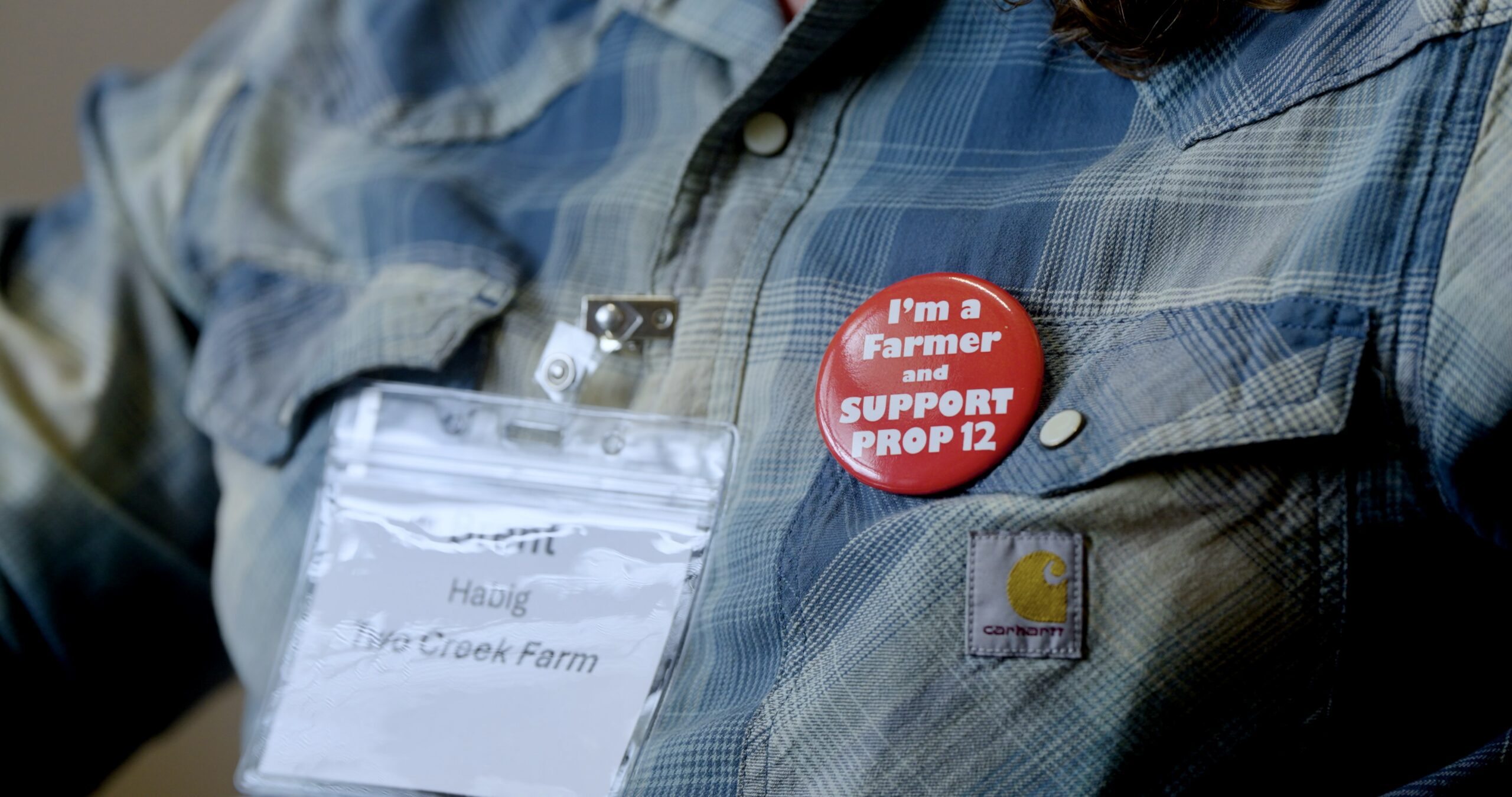
Hershey has become a leading voice in fighting what’s referred to as the “Save Our Bacon Act,” which specifically seeks to overturn two state laws — California’s Proposition 12 and Massachusetts Question 3. Each law requires that hogs, calves and chickens raised or sold in the states have adequate room to turn around, lie down and extend their limbs.
In April the House passed its version of the Farm Bill, which contained a “Save Our Bacon Act” provision that bars state or local governments from having protections for animals at farms – including at concentrated animal feeding operations, or CAFOs – or those sold within the state that differ from other states’ rules. The House version of the Farm Bill – a massive piece of legislation renewed roughly every five years that guides the federal government’s food and farm policy – described the provision as needed to “protect the free movement in interstate commerce of products derived from covered livestock” and to “encourage a national market of such products.”
The provision, and similar bills put forth in the House and Senate, have garnered broad support from meat industry associations that argue such state laws increase consumer costs and hurt farmers. Public health, animal rights and environmental groups say the provision restricts states from offering basic protections for farm animals, and that this is a states’ rights issue.
But Hershey represents a different kind of opposition — a farmer who has seen the market benefits. “We’re getting a market premium for products we’re selling in California and Massachusetts … that would go away immediately,” said Hershey, alluding to the higher prices he can charge in California due to demand for Proposition 12-compliant meat.
Meat producers pushback
Hershey’s story — and others like it — underpin a campaign by the American Meat Producers Association to oppose the Save Our Bacon Act’s inclusion in the Senate version of the Farm Bill. The association, a coalition of family farmers, ranchers, and independent meat companies, launched a $30 million ad campaign to pressure the Senate Agriculture Committee to drop the Save Our Bacon Act provision from its version of the Farm Bill, which is expected over the coming months.
“This legislation would gut the voter-approved protections and important state laws that family farmers depend on, while handing a giveaway to the China-owned pork conglomerates looking to undercut them. We will make sure that people in every targeted state and district have that information,” Holly Bice, president and CEO of the American Meat Producers Association, said in a statement.
The campaign comes as large meat industry groups run campaigns of their own to push for the provision’s inclusion in the final Farm Bill. The National Pork Producers Council (NPPC) has led the fight against California’s Proposition 12, saying in a press release that the Save Our Bacon Act is needed otherwise “pork producers face a patchwork of state animal housing laws that hurts small farmers the hardest, takes away veterinarians’ choices, increases the cost of food, and undermines states’ rights.”
In addition to its public statements and lobbying, NPPC is linked to the Carver Center for Agriculture & Nutrition, which bills itself as a “nonprofit, nonpartisan, research-driven initiative,” but is chaired by Andy Curliss, vice president of strategic engagement for NPPC. The Carver Center has been placing letters to the editor in newspapers and agricultural publications opposing Proposition 12 and not disclosing Curliss’ NPPC affiliation.
A similar campaign from the Center for the Environment and Welfare, an organization formed in 2023 and led by public relations experts from the firm Berman and Company, has been placing op-eds in newspapers across farming states over the past month that take issue with Proposition 12. The columns all say that Congress can fix this through the Farm Bill. The columns, however, do not mention that the author works for an industry-linked public relations firm.
The American Meat Producers Association rejects the premise of the industry campaigns against Proposition 12, saying the law protects state’s rights and helps family farms, as more than a quarter of hog farms in the country are complying with Proposition 12.
“The meat industry is at a crossroads. We can build a future around transparency, higher standards, and consumer trust, or we can retreat to practices that the American public has already rejected,” Phil Gatto, CEO of national pork company True Story Foods, said in a statement in support of California’s Proposition 12.
Cracking support
There are signs of cracks in Republican support for the Save Our Bacon Act. Senate Agriculture Committee Chairman John Boozman, a Republican from Arkansas, has signaled that the provision would likely be removed from the Senate version of the bill, and just last week, Senator Roger Marshall, a Republican from Kansas, withdrew his support for a standalone Save Our Bacon Act bill in the Senate that he previously sponsored.
“With all of the challenges facing farm country right now — Senator Marshall is prioritizing … helping Chairman Boozman get a Farm Bill done,” said Payton Fuller, Senator Marshall’s communications director, when asked about the withdrawn support.
Hershey, an American Meat Producers Association member, said he hopes that Congress recognizes that attempts to undermine Proposition 12 and laws like it threaten to “disrupt an entire market.” He said the benefits of his change are undeniable. But, beyond the improved production, he said the change was just the right move — for his farm and, especially, for the hogs.
“California nailed it. They called out something that really was undefendable,” he said. “You can’t really defend putting any animal in a cage where it can’t walk or turn around.”
Featured image: Brent Hershey, Pennsylvania hog farmer and American Meat Producers Association (AMPA) member, shows politicians the kinds of gestation crates that law like California’s Prop 12 ban. (Credit: AMPA)


June 19, 2026 @ 7:48 pm
Here in the U.S. we annually consume an estimated TEN BILLION animals (not counting fish), most of whom never see the light of day or touch foot to earth, a true “Crime Against Nature.” This needs to change.
x
Eric Mills, coordinator
ACTION FOR ANIMALS
Oakland, CA