Another industry-led campaign targets California’s animal welfare law
Listen to the audio version of this article (generated by AI).
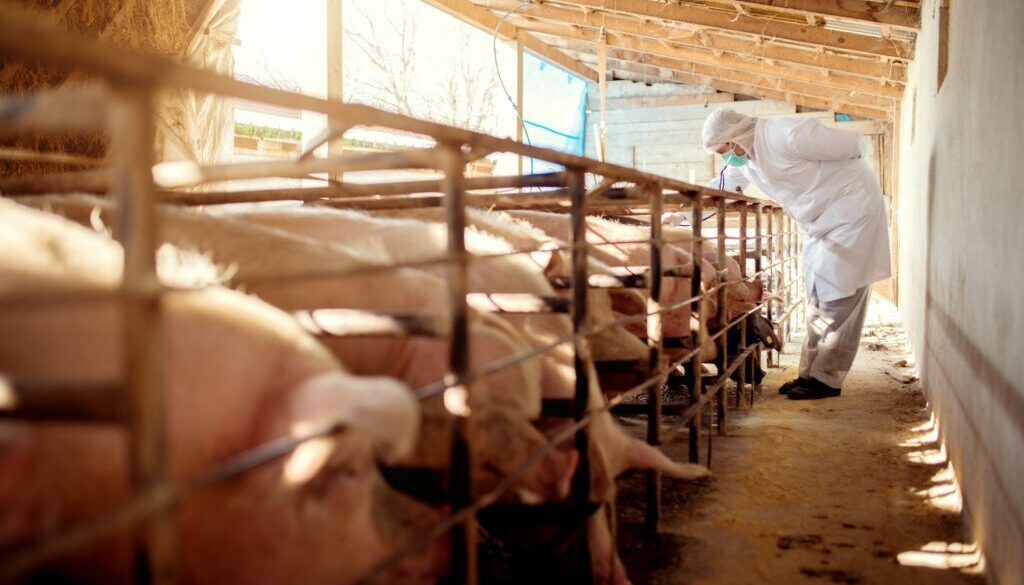
Several newspapers across farming states have run strikingly similar opinion columns over the past month that take issue with a California law requiring farmers to provide hogs, calves and chickens with enough room to turn around, lie down and stretch.
The columns all say the law — Proposition 12 — hurts farmers, makes meat more expensive and that Congress can fix this through the Farm Bill, which it is currently debating.
The columns, however, do not mention that the author works for an industry-linked public relations firm.
The op-ed campaign is spearheaded by the Center for the Environment and Welfare, an organization formed in 2023 and led by public relations experts from the firm Berman and Company.
Putting clients “on offense”
Jack Hubbard, an owner and partner at Berman, is listed as executive director of the Center for the Environment and Welfare. The author of the recent opinion columns pushing against animal welfare laws is Will Coggin. Coggin, listed as the research director at the Center for the Environment and Welfare, is also the vice president of research at Berman, which declares on its website a mission to “Change the debate.”
“We ‘change the debate,’ or if necessary, we start one,” the company states on its site. “We develop and execute wide scale campaigns designed to put our clients on offense.”
The PR firm has created dozens of nonprofits over the past few decades, using names that sound consumer-oriented, including the Center for Consumer Freedom; Humane Watch; and the Center for Accountability in Science.
The organizations promote agendas benefiting powerful corporate interests, including promotion of oil and gas, the meat industry and anti-labor union talking points. The recent columns and letters to the editor advocating against state rules for animal welfare have appeared in newspapers from states around the country, including Alaska, Virginia, Wisconsin, Oklahoma and Maine, as well as the conservative publication Townhall and the DC-based Washington Examiner.
They come as the US Senate debates the latest iteration of the Farm Bill, including a provision — commonly referred to as the “Save Our Bacon Act” — to override Proposition 12 and a similar Massachusetts law known as Question 3.
Neither the Center for the Environment and Welfare nor Berman and Company responded to requests for comment.
The website for the center says it is a “watchdog Americans can trust” and cuts “through the noise to separate fact from fiction.”
“Many of today’s most visible and trusted activist groups promote misinformation in the pursuit of self-interest, leading companies and legislators to implement ineffective — and often counterproductive — policies,” the website states.
Critics, however, say the Center for the Environment and Welfare is a front group set up to mislead voters, parroting industry talking points under the guise of “animal welfare.”
“Efforts to disguise industry-backed advocacy as grassroots concern only make it harder for the public to have an honest conversation about the future of animal welfare, agriculture and consumer choice,” said Sara Amundson, president of Humane World Action Fund.
Berman’s history of PR-focused nonprofits
The Center for the Environment and Welfare is one of many nonprofits linked to Berman and Company. The Center for Union Facts documents purported corruption at labor unions while The Center for Consumer Freedom slams veganism, lab meat and animal “activists,” among other issues.
Berman and Company founder Richard Berman has set up nonprofits on issues important to his clients for decades. A leaked presentation that Berman gave to a roomful of energy executives about combating “big green radicals” in 2014 offered insight into his methods.
“We run all of this stuff through nonprofit organizations that are insulated from having to disclose donors,” he said. “There is total anonymity. People don’t know who supports us. We’ve been doing this for 20-something years in this regard.”
In the presentation, he outlined how he used ads and nonprofits to discredit some animal rights organizations, such as PETA and the Humane Society, noting that “We represent a lot of agriculture interests who are being attacked by the Humane Society of the United States …”
The Center for the Environment and Welfare has continued Berman’s campaign to discredit animal welfare organizations. The website featured “activist profiles” of several organizations.
“Rick Berman and his allies continue to create front groups that masquerade as public-interest organizations while spending their resources attacking highly respected charities working to improve the lives of animals,” said Matthew Dominguez, the US executive director for Compassion in World Farming.
Similar campaign
The Center for the Environment and Welfare media campaign around Proposition 12 is similar to another industry-linked nonprofit, the Carver Center for Agriculture & Nutrition, which bills itself as a “nonprofit, nonpartisan, research-driven initiative,” but is chaired by Andy Curliss.
Curliss is the vice president of strategic engagement for the National Pork Producers Council (NPPC), which has been leading the meat industry’s push against both state laws. The Carver Center, too, has been placing letters to the editor in newspapers and agricultural publications opposing Proposition 12 and not disclosing Curliss’ NPPC affiliation.
Robert Brown, a North Carolina-based public relations consultant and the Carver Center’s strategic advisor, told The New Lede that the Center “is independently governed and responsible for its own research, publications, analysis, and positions” when asked about links to NPPC.
Despite the industry campaign over alleged Proposition 12 overreach, Senate Agriculture Committee Chairman John Boozman, a Republican from Arkansas, has signaled that the provision to override the animal welfare laws in California and Massachusetts — the “Save Our Bacon Act”, which passed in the House version — would likely be removed from the Senate version of the bill.
Featured image: Getty Images/Unsplash +