Facing up to forever chemicals — a spreading problem
Listen to the audio version of this article (generated by AI).
This is an excerpt from Inescapable: Facing Up to Forever Chemicals by Marina F. Schauffler. Copyright 2026. Published with permission of Johns Hopkins University Press.
At Songbird Farm, perched high on a ridge in Unity, Maine, there’s an uncanny stillness as the planting season gets under way. Low buildings rest on an arc of sloping fields, dwarfed by an expanse of sky so wide it’s like being at sea. Grasses nod and willow branches sway in a light breeze, their muted stirring all that breaks the silence.
Songbird Farm was once a hub of activity: a tractor tilling fields for grain crops, customers arriving to pick up salad mix, and a hoophouse brimming with vegetable seedlings. Now the fields lie fallow and the skeletal frame of the abandoned hoophouse is open to the sky. A passerby might think the property neglected, but the truth is far worse.
 Bonding to land with “a complicated, poignant legacy”
Long before establishing Songbird Farm, Johanna Davis and Adam Nordell had a clear vision of growing and processing organic food, nurturing community, and melding the intensive work of farming with the conviviality they enjoyed as musicians, traveling in winter to play fiddle and guitar at contra dances.
They chose to settle in Maine because of its strong farming community and thriving local foods movement, and for several years they leased fields in different communities as they gained skills and grew their customer base. While searching for land of their own, they learned in 2014 that a retired college instructor, Tim Christensen, was selling 44 acres in Unity that he had owned for nearly two decades and farmed organically.
Christensen, having learned that he had terminal cancer, wanted to place his land under an agricultural easement and sell it to young farmers eager to care for it well. After transferring his land to Davis and Nordell, Christensen introduced them to all his vegetable buyers, instantly expanding their business. His generosity “felt like a really big gift,” Nordell recalls, but given the circumstances, it was “a complicated, poignant legacy.” The couple would not learn for another seven years the potential cause of Christensen’s cancer, which took his life at age 64.
The ensuing years were a blur of work as Davis and Nordell began growing and selling not just vegetables but also heirloom grains, learning largely by trial and error. The birth of their son led them to hone their efficiency as they juggled caring for him with farm tasks, deliveries to customers, planning, and maintenance. By the time he was three, their business was thriving, and they felt confident enough to invest more in the place. They added a new irrigation well and began acquiring equipment to establish a bakery at the farm so they could sell goods made from grains they had grown and milled.
Tainted sludge blindsides farmers
Just before Thanksgiving in 2021, a customer called with a question that stunned Nordell and Davis: Did they know that Songbird Farm was on a newly posted map showing properties where the Maine Department of Environmental Protection (DEP) had once granted permits to apply wastewater sludge?
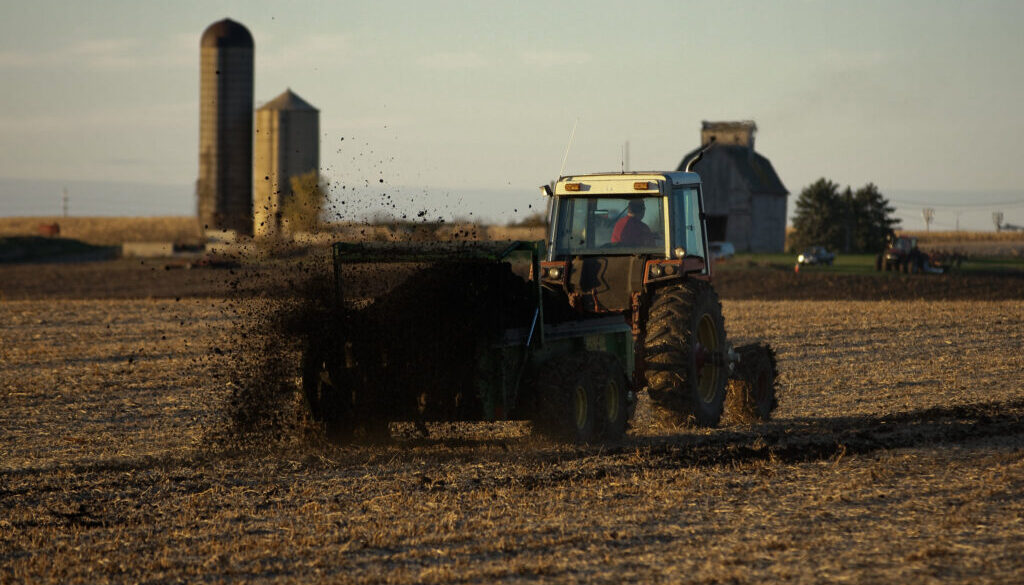
For decades, the Maine DEP and the federal Environmental Protection Agency (EPA) had encouraged “beneficial reuse” of the viscous, nitrogen-rich slurry left behind after wastewater treatment, promoting it as a free fertilizer for agricultural land. Fred and Laura Stone were among hundreds of Maine farmers who had received sludge to spread on their land, and the DEP permit they were granted stated that the material “will not pollute any water of the state; will not contaminate the ambient air; will not constitute a hazard to health or welfare; [and] will not create a nuisance.”
Over 21 years, the Stones applied an estimated 1,300 tons of sludge to their fields from two municipal wastewater treatment plants and a paper mill, unaware that the material contained PFAS. These pernicious chemicals are associated with a wide array of health risks, from depressed immune functioning and elevated cholesterol to developmental and reproductive effects. Their presence in drinking water is associated with a higher incidence of cancers in the mouth and throat as well as in the digestive, endocrine, and respiratory systems. Once in ecosystems, PFAS can persist for centuries.
Nordell and Davis, although aware of the chemical contamination at Stoneridge Farm, assumed that their land was safe since it had been farmed organically for decades. Rules proposed by the US Department of Agriculture that would have allowed the application of sludge in organic food production met strong pushback from environmental groups and organic growers. Consequently, the national organic standards first established in 2002 have never permitted use of wastewater sludge.
Following news of high PFAS levels at Stoneridge Farm and a second dairy, the Maine Legislature mandated in 2021 that the DEP investigate sites permitted to receive sludge and septage (the concentrated waste pumped from septic tanks). The number of sites, initially estimated at 700, eventually rose to over 1,050, and the multiyear investigation had by its rough midpoint run up nearly $20 million in costs, paid in part through added fees on sludge and septage disposal.
Unity was among the municipalities slated for testing early in the state’s investigation, but Nordell and Davis wanted immediate answers. They hired a scientist to measure PFAS levels in their soil and water, as well as in the spinach still growing in their hoophouse.
The test results came back just before Christmas, with every test showing significant levels of PFAS. Reeling from the news, the couple informed their farm customers and asked retailers to pull their products, voluntarily suspending all farm operations.
In an open letter on their website, they wrote that “the one currency we have as local organic growers is our transparency and the trust of our customers.”
Featured image: CityofGeneva/flickr