
Health advocates demand federal action in nitrate “health emergency”
More than 80 health and environmental groups are calling on federal agencies to use emergency powers to protect Americans from a “public health emergency” driven by industrial farming practices that are dangerously polluting drinking water.
The letter, sent by 83 groups to Health and Human Services Secretary (HHS) Robert F. Kennedy Jr. and US Environmental Protection Agency (EPA) administrator Lee Zeldin, comes amid growing evidence of widespread nitrate pollution of US drinking water supplies, especially in prominent farm states such as Iowa.
Agricultural fertilizers and manure from large-scale livestock operations are key sources for nitrates, though they also can occur at low levels in the environment naturally. Nitrate exposure can cause dangerously low oxygen levels in babies’ blood, causing what’s known as “blue baby syndrome” and they’ve been linked to some cancers. The EPA has set a threshold of 10 milligrams per liter (mg/L) for nitrates in drinking water.
The groups say federal standards are woefully inadequate to protect human health from nitrates, and that the agencies need to take “immediate action” to clean up drinking water and stem what many are calling a growing public health crisis.
“It is imperative that EPA and HHS act now to address this public health emergency in Iowa and across the country,” the letter states. “Your agencies should immediately identify and eliminate sources of nitrate pollution in drinking water and provide funds to communities to reduce nitrate to safe levels.”
“It is imperative that EPA and HHS act now to address this public health emergency in Iowa and across the country.”
A call for federal action follows the release of a report about Iowa published last month that nitrates from the state’s concentrated animal feeding operations (CAFOs) and fertilizer runoff were, in part, behind its rising cancer rate. Iowa has the second-highest rate of cancer in the nation and is only one of three states where cancer is rising, according to the National Institutes of Health.
Scientific research shows nitrate exposure is linked to several types of cancer, including kidney cancer — which is rising in Iowa. The contaminant is also linked to bladder and ovarian cancers, which, though not rising in Iowa, are present in the state at much higher levels than the broader US.
Iowa is the nation’s top state for the number of CAFOs. In addition, billions of pounds of synthetic fertilizers are applied to crop fields each year, leading to widespread water pollution problems.
“This report showing the link between nitrate-contaminated tap water and cancer rates in Iowa should be a wake-up call for the whole country,” Nancy Stoner, co-author of the letter sent to the EPA and HHS and a senior attorney at the Environmental Law & Policy Center, said in a statement.
The letter says that Iowa is “at the forefront of the crisis,” but the report shows that people drinking water across the country where fertilizer application and manure from CAFOs result in massive amounts of nitrate entering surface water and groundwater are at substantially higher risk of cancer.
Just weeks after the release of the Iowa report, a Yale study found people living near CAFOs in California, Texas and Iowa suffer from higher rates of cancer, suggesting that nitrates from livestock and dairy farms may be playing a role. And a report from the Environmental Working Group (EWG) found that more than 60 million Americans get their water from sources contaminated with elevated levels of nitrate pollution, which is most likely coming from agricultural manure or fertilizer runoff.
The EWG report used federal drinking water data and found that roughly 6,114 US water systems that serve roughly 62.1 million people had nitrate levels at or above 3 mg/L in at least one test from 2021 to 2023. The EPA says that levels above 3 mg/L are indicative of manure or fertilizer runoff from large-scale farms or, less frequently, wastewater plant discharge.
In response to the EWG report and concerns over nitrates in drinking water, the EPA said it is committed to “gold standard science to ensure all Americans have access to clean and safe drinking water.”
EPA spokesperson Jack Murphy said the agency completed its most recent review of nitrate drinking water regulations in 2024 and “determined that the nitrate rule was not a candidate for revision at that time, which means that the current rules are sufficient to keep water clean and safe for human consumption.”
Research, however, shows health impacts from nitrate exposure at far lower levels than the EPA’s limit.
Tyler Lobell, senior attorney at Food & Water Watch and co-author of the letter sent to HHS and the EPA, said in a statement that the EPA and other “regulators across the country and at the federal level have allowed the agricultural industry to “pollute with impunity.”
“We’re all paying the price,” he added. “The time for emergency action is now.”
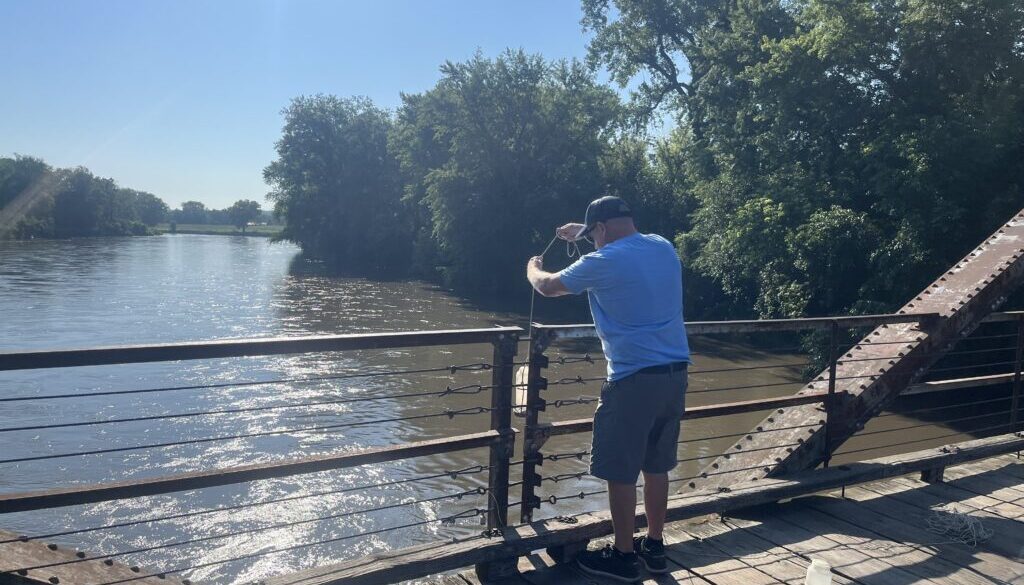
Featured image: Lab technician Bill Blubaugh collected water samples from the Raccoon River, Tuesday, Aug 5, 2025, for testing by Central Iowa Water Works in Des Moines, Iowa. (Credit: Carey Gillam/TNL)




May 6, 2026 @ 4:27 am
I like how straightforward this is.