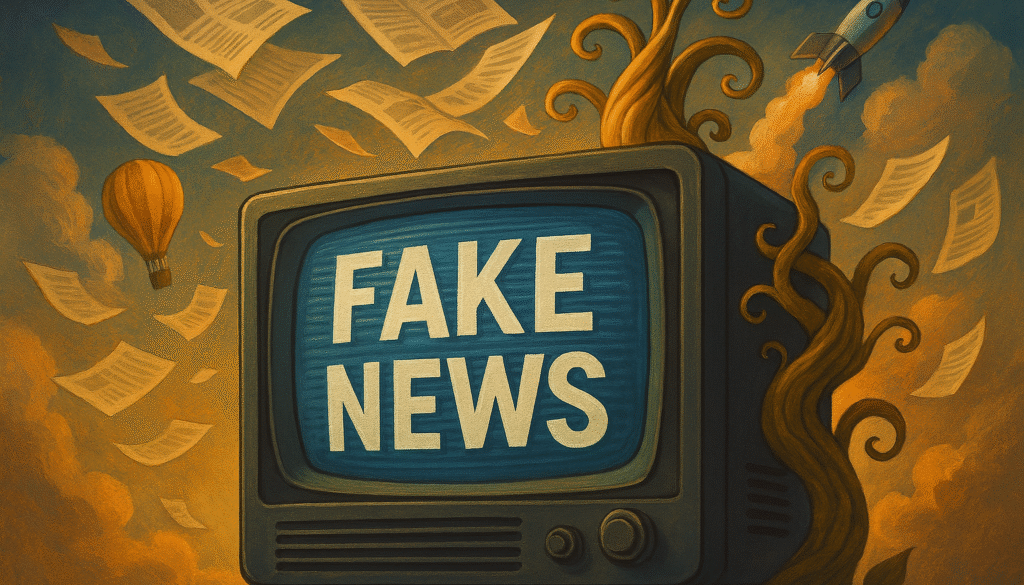
Trump executive order on glyphosate is a “fake news fantasy”

By Bill Freese
Wherever Trump looks, he sees existential threats to America that do not exist. He invents fantasy crises as a pretext to exercise emergency powers, like the emergency tariffs just invalidated by the Supreme Court.
Trump’s bizarre new Executive Order (EO), released February 18th, is still another example. The EO attempts to invoke wartime authorities to expand domestic production of a weedkiller – glyphosate. Under this authority, the federal government claims it could compel private firms to manufacture the herbicide, and then purports to shield those firms from liability for injuries caused by it.
The EO comes as the US Supreme Court is poised to decide this summer whether Bayer should be shielded from liability for failing to warn users of scientific evidence linking glyphosate and glyphosate herbicides such as Roundup to cancer.
Multiple juries have found the company’s herbicides responsible for causing non-Hodgkin lymphoma in Roundup-using plaintiffs, matching epidemiology and other studies that find the same. And it also comes in the wake of threats by Bayer to end production of glyphosate unless it is granted that liability shield.
The Trump Administration is likely trying to influence the Supreme Court to reach a decision that would protect the German pesticide behemoth while denying the opportunity for Roundup-injured Americans fooled by Monsanto-Bayer’s propaganda about the supposed safety of Roundup to obtain some degree of compensation.
Indeed, the EO was released the week before Monsanto’s brief to the court was due, which then repeatedly quoted and relied on the order. If granted, immunity from damages from glyphosate would then almost certainly be cited as precedent by other firms to evade liability for their own harmful pesticides.
One timely example is Chinese-owned Syngenta, which is now fighting in court to avoid accountability for its Parkinson’s disease-causing pesticide, paraquat.
But how on earth does Trump’s order magically transform a weedkiller into a “national security” issue? It doesn’t.
First, as a basic legal – and common sense – matter this law intended for national security exigencies simply does not apply at all to the context of an industrial agriculture pesticide. Second, Trump is well known for issuing far more executive orders than any other president, but that mis-reliance does not change the fact that EOs do not have the force and effect of law and cannot alter legal rights without an empowering act of Congress.
But more fundamentally, this fake news fantasy is based on two basic lies: American farmers are in danger of losing access to glyphosate; and glyphosate is such a precious, irreplaceable herbicide that Americans would then go hungry because farmers can’t farm without it.
Trump and Bayer are banking on Americans, including justices (Supreme or otherwise), knowing so little about agriculture that they swallow these fictions. Let’s take each in turn.
Are farmers in danger of losing access to glyphosate?
From about one-third to 40% of the world’s glyphosate is produced by Bayer in the US, while a number of companies in China supply most of the rest. Bayer owns and operates mines in Idaho that supply elemental phosphorous, an ingredient of glyphosate. (The Environmental Protection Agency designated the mine property a Superfund site in 1990 due to contamination of soil and groundwater with hazardous chemicals and radioactive materials, and cleanup is still underway.)
Bayer plants in Iowa and Louisiana formulate finished glyphosate products; the Louisiana plant is the largest glyphosate manufacturing facility in the world.
It is difficult to take Bayer’s threats to exit the glyphosate production business seriously, because it would involve a huge loss of revenue as well as a wasted investment.
Bayer is the largest seed-pesticide conglomerate in the world. Among the hundreds of pesticides it produces and the even more profitable genetically engineered seeds it sells, glyphosate alone still accounts for a substantial 12% of the CropScience division’s revenue.
Glyphosate product
Just months ago Bayer obtained a permit for a new phosphorous mine on federal lands in Idaho to produce more glyphosate. The CropScience division recently invested $96.6 million (82 million euros) to this end, its largest capital expenditure project of 2024.
The investment in “a new phosphate mine” was made because “phosphorous is needed for glyphosate”. Would Bayer invest in major new production capacity if it were seriously planning to exit the glyphosate business?
Another consideration is that Bayer has already taken a huge step to shield itself from liability by replacing glyphosate with other herbicide active ingredients in Roundup brands marketed to the home and garden sector, the products most frequently implicated in cancer lawsuits. Successful plaintiffs have most often been residential and garden users.
Farmers in any case are not going to run out of glyphosate, both because Chinese manufacturers have excess capacity to produce more of it, and glyphosate demand has slipped among US farmers since 2016, likely due to rampant glyphosate resistance in weeds making it ever more ineffective (see below).
The phaseout of glyphosate in residential Roundup formulations, as noted above, also reduces demand.
Considering all of these facts, the EO’s warning of glyphosate “shortages” sounds a lot like the fake news the Trump Administration is so infamous for, designed to scare SCOTUS into doing the German company’s will. And if there is any question why Trump would do Bayer’s bidding, one need only look at the extraordinary number of Bayer-linked personnel in Trump’s inner circle and in high-level agency positions.
A matter of “national security”?
The EO paints a cartoonish picture of hapless farmers no longer able to grow crops if they lose access to this single weed-killer. But there are many herbicides available to farmers besides glyphosate – at least 100 that kill weeds in over 20 different ways.
The US Department of Agriculture lists 66 and 52 distinct herbicide active ingredients used on corn alone (2018 and 2021, respectively). And a host of others are registered for use on soybeans, wheat and many other crops. It’s an insult to America’s farmers to suggest they are helplessly dependent on glyphosate.
Neither is Roundup God’s gift to farmers. The vast majority is sprayed on genetically engineered (GE) corn, soybeans, and cotton, and this has generated an epidemic of glyphosate-resistant weeds, just as an overused antibiotic fosters drug-resistant bacteria.
These weeds are among the worst plaguing farmers (e.g. Palmer amaranth, waterhemp), they infest at least 120 million acres of U.S. cropland, and glyphosate is powerless against them.
Farmers now mix glyphosate with herbicides like dicamba or 2,4-D that can kill weeds immune to glyphosate. Volatile dicamba – also sold by Bayer – has drifted rampantly to damage millions of acres of soybeans, fruit trees, vegetable farms, wild plants and trees.
Dicamba has spurred lawsuits against Bayer by farmers and beekeepers who have suffered huge losses from dicamba drift damage. This damage has pitted dicamba users against dicamba drift victims, tearing apart the fabric of rural communities, and instigating vandalism and even murder.
Federal courts have twice banned dicamba, only for a spineless EPA to approve them once again, again now under renewed legal challenge. This dicamba debacle is a direct consequence of the glyphosate-resistant weed epidemic spawned by GE crop-enabled overuse of glyphosate.
Trump’s war on farmers
The EO makes a feeble show of supporting farmers, but in reality it’s all about shielding a German pesticide-seed conglomerate from liability for harming Americans who contract cancer from using its hazardous herbicide. The EO also obscures one of many ways Trumpian initiatives have harmed farmers’ economic interests.
While it pretends to protect access to glyphosate as well as the “elemental phosphorous” used in its manufacture, the EO has not a single word to say about the far more important use of phosphorous in fertilizers. The amount of phosphorous used for glyphosate is just 1.2% of that devoted to phosphate fertilizers in the US. And while most is produced domestically, the US imports 10-15% of its phosphate fertilizer needs from abroad, chiefly Morocco and Russia.
Tariffs on Morocco, imposed in March 2021 and ranging up to 47%, spiked the cost of phosphate fertilizers for farmers of corn, soybeans, wheat, cotton and sorghum by 34%. This increased farmer costs by $10.8 billion while also generating a $23 billion windfall for the domestic fertilizer industry that petitioned the government for the tariffs.
This financial hit to farmers piles on to others. Soybean farmers virtually lost their largest export market, China, in 2025 as the nation retaliated against Trump tariffs by avoiding US soybeans and importing them from South America instead. Trump’s campaign to deport immigrants has left countless farmers with lack of the skilled labor they need to harvest their crops.
A Supreme Court decision in favor of Bayer would strike still another blow against farmers and others by denying them the opportunity for just compensation when harmed by glyphosate and other hazardous pesticides.
This EO underscores the true loyalties of the Trump Administration. Under a veneer of concern for rural communities, its real aim is to protect rich corporations at the expense of everyday Americans.
(Opinion columns published in The New Lede represent the views of the individual(s) authoring the columns and not necessarily the perspectives of TNL editors.)