
EPA’s atrazine clean up plan is “utterly worthless,” study finds
Listen to the audio version of this article (generated by AI).
(UPDATE: On Oct. 14, the Center for Biological Diversity, the Center for Environmental Health, and the Pesticide Action & Agroecology Network filed a lawsuit against US regulators to demand they develop required water quality standards for atrazine.)
A US Environmental Protection Agency (EPA) plan to reduce the amount of atrazine running off into US rivers, lakes and streams would leave 99% of watersheds contaminated at levels that exceed the agency’s threshold for harm to plants, fish and other species, according to a new study.
The study by the Center for Biological Diversity, published Tuesday in the Journal of Environmental Quality, finds that an EPA strategy to clean up atrazine — a cancer-linked pesticide banned in more than 60 countries around the world — will barely make a dent in the pesticide’s widespread pollution, which has plagued waterways in US farming states for decades.
The study comes on the heels of a separate Center for Biological Diversity report last month that found atrazine contaminates an estimated 25% of river and stream miles in the lower 48 US states, including many waterways used for drinking water.
The researchers say the federal cleanup plan will leave fish and other aquatic life — as well as humans — at continued risk of health problems due to atrazine exposure.
“We found that there were only about 120 watersheds out of over 11,000 that would actually see a reduction in atrazine below … the level EPA has identified would harm aquatic ecosystems,” said Nathan Donley, the environmental health science director at the Center for Biological Diversity. “It’s terrible to see how utterly worthless this plan is.”
Atrazine is the second-most widely used herbicide in the US after glyphosate. US farmers apply roughly 70 million pounds of atrazine to their fields every year, according to EPA estimates, and the herbicide has polluted US waterways — especially in Midwest farming states – for decades.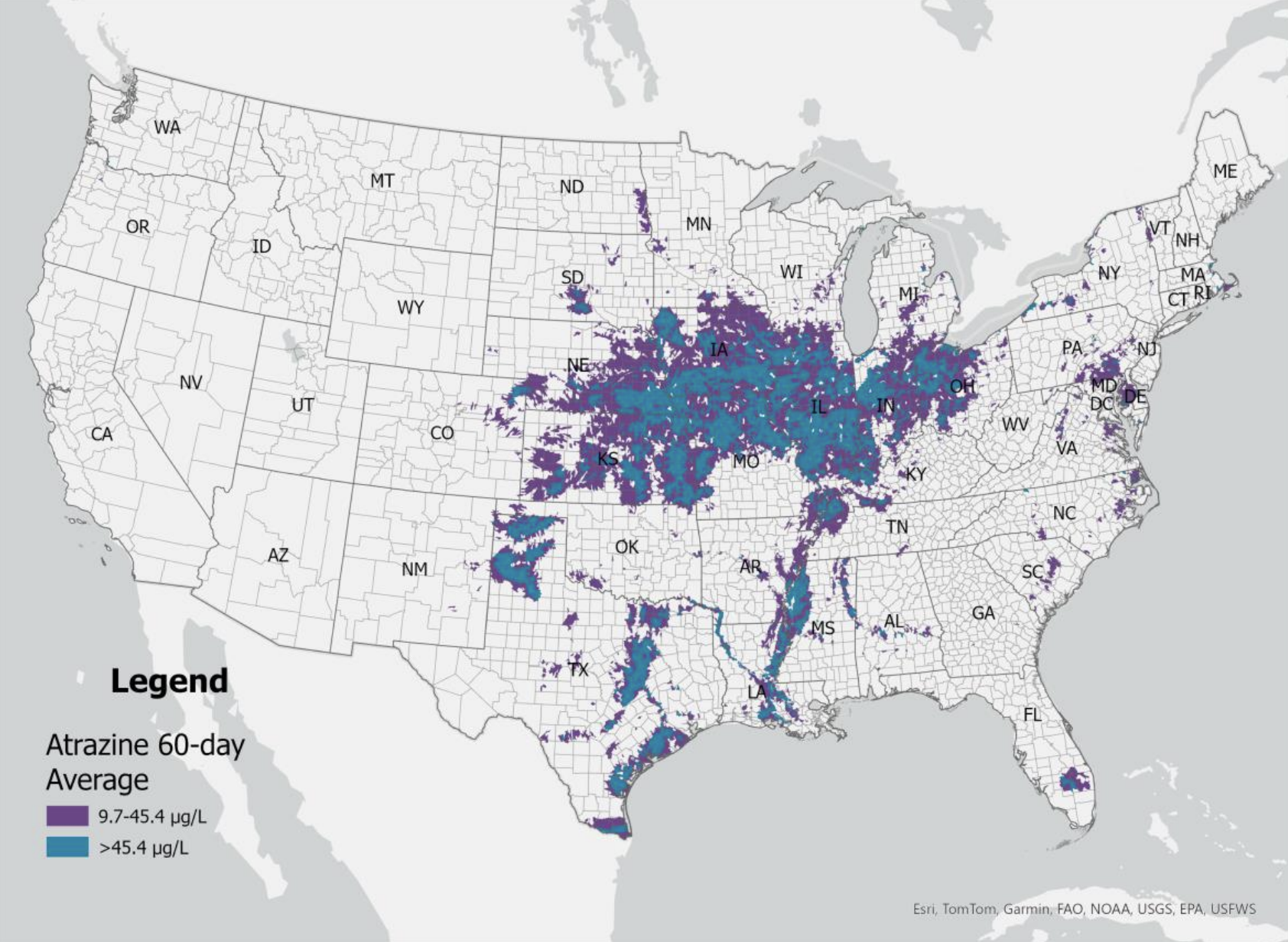
In humans, exposure has been linked to birth defects, low birth weights, some cancers and immune system problems. It is also considered an endocrine disruptor, meaning it can interfere with the human hormone system. It’s also toxic to aquatic wildlife, harming growth and development, reproduction and behavior of fish and amphibians, and disrupting photosynthesis in aquatic plants, which can kill them.
In December 2024 the EPA released a plan to reduce atrazine in watersheds that have levels of the herbicide exceeding the agency’s threshold for harm to river ecosystems, which is 9.7 parts per billion (ppb). The plan calls for lowering the maximum annual atrazine application rates for field corn, sweet corn, sorghum and sugarcane by 20%, and establishing a “mitigation menu” that gives farmers points for certain farm attributes or practices that reduce runoff. Farmers could achieve these points in order to keep applying atrazine in watersheds polluted with the herbicide.
For example, points are awarded for having sandy soils, flat fields, a reduction in soil tilling, using cover crops, buffers and other measures.
Donley and colleagues first used EPA data on how many farmers apply the maximum amount of atrazine to calculate the impact of the 20% reduction in maximum application rates. The study found very few farms currently apply the maximum amount of atrazine, so this would have a small impact on reducing runoff.
They then looked at data on current farms that apply atrazine and how many points they would already have from current practices, and estimated how many points they would need to attain via new practices.
The study found the point system is largely rewarding farms for practices already in place, said Jason Rohr, a professor and researcher at the University of Notre Dame.
“If a watershed already has problematic atrazine contamination, a successful mitigation program needs to cause farmers to do something differently. The authors show that EPA’s proposed system often doesn’t do that,” Rohr said. “More than 90% of the relevant agricultural acreage can either be exempted or satisfy the requirements based largely on existing conditions and practices. So you can have regulatory compliance without much additional mitigation.”
“If a watershed already has problematic atrazine contamination, a successful mitigation program needs to cause farmers to do something differently. The authors show that EPA’s proposed system often doesn’t do that.” – Jason Rohr, University of Notre Dame
Donley said it is “absolutely bonkers” that the EPA did not do an analysis similar to the new study before proposing the mitigation plan.
“These are all data sets that are publicly available … most of them are government-curated data sets,” he said. “Either they didn’t want to do it or they didn’t know how. Both options are worrisome.”
The EPA did not comment on the new study.
In a December 2024 announcement, the agency said the mitigation plan “is targeted to provide maximum flexibility (recognizing atrazine’s high benefits) while addressing the need for mitigation.”
Even if the EPA plan reduced atrazine in some watersheds below the current threshold, the herbicide still harms creatures at much lower levels, said Tyrone Hayes, a professor and researcher at University of California, Berkeley.
“If the mitigation was effective and got [atrazine] levels down to 5 ppb, that’s still 50 times higher than what we know to be biologically active in aquatic organisms,” said Hayes, who published a landmark study in 2002 that showed very low levels of atrazine altered male frogs sex organs and turned some into hermaphrodites. A similar 2010 study from Hayes and colleagues showed atrazine exposure turned some male frogs into “functional females.”
The Trump administration is currently re-evaluating atrazine’s registration but has signaled its support for continued use, including by dismissing research by international cancer experts on links between cancer and atrazine late last year.
In April the US Fish and Wildlife Service (FWS) issued an opinion that atrazine does not pose an extinction risk to threatened or endangered wildlife. The opinion was issued as part of the EPA’s legal requirement to consult with the FWS in its atrazine registration to ensure the pesticide would not violate the Endangered Species Act.
“The EPA is just not regulating atrazine in a way that keeps aquatic ecosystems safe,” Hayes said.
The study does note a conflict of interest in that the Center for Biological Diversity “is a petitioner in litigation against the EPA for failure to comply with federal pesticide law when it initially reapproved atrazine in 2020.”
Featured image: Getty Images/Unsplash+