Federal clean fuel tax credit extends to gas from animal manure
Listen to the audio version of this article (generated by AI).
New Internal Revenue Service (IRS) guidance released last week confirms that gas extracted from livestock manure qualifies for a federal clean fuel tax credit, paving the way for increased investment in biogas projects.
The move comes as farms increasingly turn to anaerobic digestion to deal with massive amounts of manure. Proponents say the tax credits will bolster an industry that provides a solution to excess waste and turns otherwise emitted methane into a usable fuel. Critics, however, say the IRS is rewarding large, polluting farms for a practice that incentivizes packing more animals into already highly concentrated operations.
Anaerobic digesters use bacteria to break down large amounts of manure and turn it into “biogas,” which is a mix of mostly methane and carbon dioxide and can be refined into RNG and used in some vehicles and as a natural gas substitute. There are an estimated 394 manure-based digesters operating in the US, with more than 70 under construction, representing a 55% increase over the past decade. 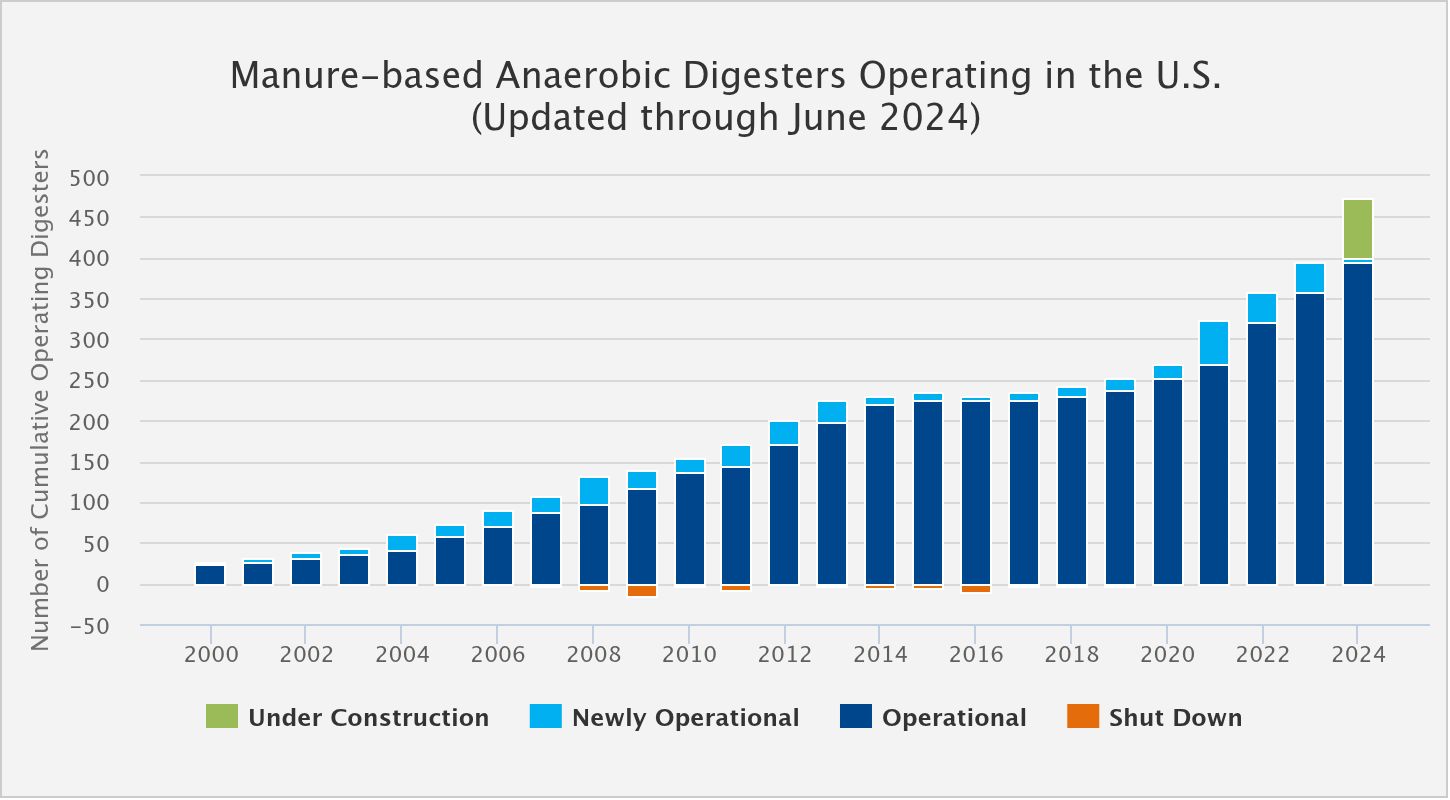
Such digesters can also break down other farm waste like food scraps and crop residues — sources that were also included in the new guidance. In addition to RNG from manure and farm waste, the credit also pertains to ethanol, biodiesel, hydrogen and sustainable aviation fuel.
Biogas advocates lauded the guidance, saying it provided much needed clarity, will kickstart more biogas investment, and that it supports farmers and rural communities. Such proponents say manure digesters are a climate-win, reducing methane emissions from manure generated at concentrated animal feeding operations (CAFOs) and spread on land as fertilizer.
“With this clarity, there are going to be biogas projects that are developed because there’s lots of organic waste that needs to be recycled,” said Patrick Serfass, executive director of the American Biogas Council. A report from the council in February found massive potential for extracting gas from farm waste — including the potential for more than 11,000 additional systems on farms. The report estimates there are currently 631 biogas capture systems at farms in the US, accounting for 25% of all RNG produced last year.
“With this clarity, there are going to be biogas projects that are developed because there’s lots of organic waste that needs to be recycled.” – Patrick Serfass, American Biogas Council
Serfass said only about 10% to 20% of the organic material from farms is currently recycled.
“There’s just tons, literally millions of tons, of organic waste that need to be recycled. And so the tax credit helps projects that could provide a valuable community service,” he said.
The IRS guidance established emissions rates for renewable natural gas (RNG) produced from animal manure, along with other non-fossil fuels, under the Clean Fuel Production Tax Credit, known as 45Z. The amount of the credit depends on how carbon-intensive the fuel is, based on calculations from a model the US Department of Agriculture (USDA) developed. Since 45Z was passed as part of the Inflation Reduction Act in 2022 biogas producers have been unclear as to whether such projects qualify for the credit.
“Today’s guidance helps America’s farmers, ranchers, and fuel producers access growing opportunities in the domestic biofuels market,” said IRS Chief Executive Officer Frank J. Bisignano in a statement.
Given that the 45Z credits are set to expire in 2029 — and it’s unclear what will become of them beyond that — Serfass said the new guidance will likely spur along biogas “projects that are already in the pipeline, already in development, or ones that can be built quickly.”
However, critics of manure-to-gas projects say such facilities are prone to leaks, incentivize adding more animals to already packed farming operations, and are too reliant on federal and state loans and subsidies. In California, which leads the nation in gas produced from manure digesters, researchers estimate that expansion that takes place at dairy farms that build digesters wipes out an estimated 9% of the farms’ purported greenhouse gas reductions.
Food & Water Watch senior staff attorney Tyler Lobdell said with the new guidance “the IRS is now putting their thumb on the scale in favor of large, industrial, polluting factory farms.”
“The program prioritizes dirty fuels over clean ones,” he said.
“The program prioritizes dirty fuels over clean ones.” -Tyler Lobdell, Food & Water Watch
The clean fuel credit for manure digester gas will be calculated against how the farm previously handled its waste — including open lagoons, deep pits, solid storage and other methods. The IRS said it will provide different carbon intensity rates for different types of manure sometime later this year.
“Since liquid manure storage is among the highest-emitting management methods, comparing against it, rather than an average, is likely going to produce a bigger credit,” said Andrew deCoriolis, executive director of Farm Forward. “Biogas proponents will argue this just makes the accounting more accurate, but good accounting isn’t the same as good policy.”
He added that the credit won’t help smaller, pasture-based operations that never relied on liquid manure storage because there’s no high-emitting baseline for them to be measured against.
The credit “operates as a revenue source for whoever runs the biggest, dirtiest, most liquid-manure-intensive operations, and the tax code doesn’t distinguish ‘a bad actor cleaning up’ from ‘a bad actor being rewarded for having been bad for decades,’” he said.
The Trump administration has sent mixed signals on manure digester biogas since taking office. Last year’s One Big Beautiful Bill Act preserved clean energy status for manure-derived biogas, while stripping away subsidies for solar and wind.
However, the US Department of Agriculture currently has a moratorium on loan guarantees for anaerobic digesters — many of which are issued for manure digesters — through the end of 2026 due to “persistent and escalating concerns” about performance and financial solvency. The New Lede, however, reported that a February loan transfer removed the bulk of USDA digester delinquencies.
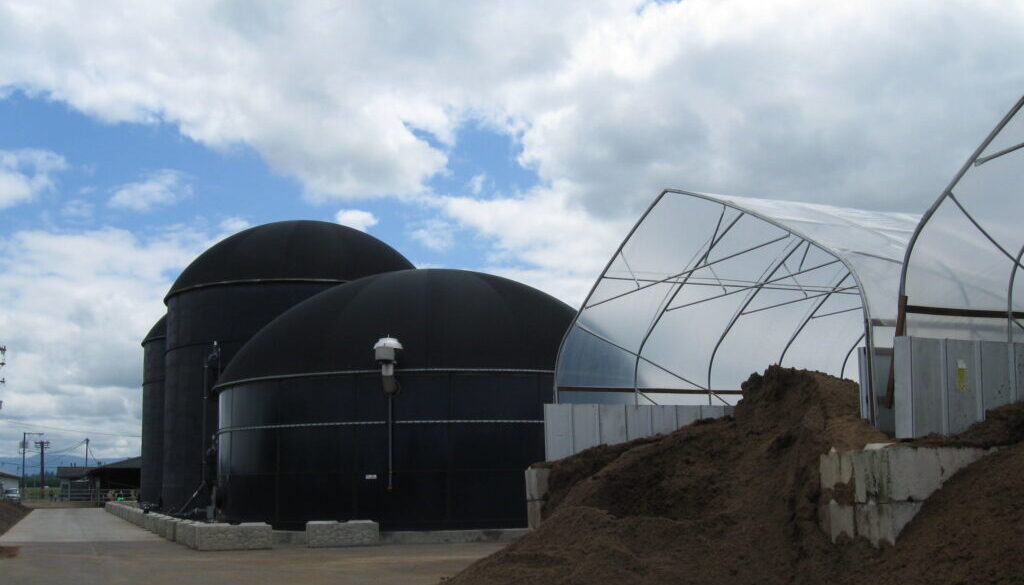
Featured image: Manure digester in Oregon. (Credit: Oregon Department of Agriculture/flickr)