Manure digesters spur dairy farm expansion in California, study finds
Listen to the audio version of this article (generated by AI).
Expansion at California dairy farms that tap into state and federal incentives to build digesters that turn manure into gas wipes out an estimated 9% of the farms’ purported greenhouse gas reductions, according to a new pre-print study.
The study, which is in pre-print form and is not yet published, adds to evidence that anaerobic digesters increasingly used to turn loads of manure from large-scale dairy farms and other concentrated animal feeding operations (CAFOs) across the US into usable gas incentivize expansion at already large and concentrated farms, and lead to more of the climate-warming emissions the digesters aim to mitigate.
It also comes as the US Department of Agriculture has issued a moratorium on loan guarantees for anaerobic digesters — many of which are issued for manure digesters — through the end of 2026 due to “persistent and escalating concerns” about performance and financial solvency.
The researchers used federal, state and satellite data to analyze barn size and herd expansion at California dairy farms that received financial incentives to build a manure digester over the past decade. They found that within three years of when farms anticipated or started digester construction, barn sizes grew an average of 19,644 square feet, which means each farm could house an estimated 243 additional mature dairy cows.
Varun Magesh, lead author of the study and a nonresident affiliate with Stanford’s RegLab and a student at Harvard Law School, stressed that the study does not really measure the number of new cows at farms but the number of cows the new facilities could hold. “And we’re taking that as a proxy for how many cows a facility is processing each year,” he said.
The study adds to evidence that the addition of a digester creates a “skewed economic incentive,” said Brent Kim, an assistant scientist at the Johns Hopkins Bloomberg School of Public Health who studies digesters but was not involved in the new study.
“The value of the manure starts to compete with the value of the milk. So if you’re a producer, that is going to push the logic that if there’s additional kickbacks for manure, and they made this big investment, they’re going to get bigger,” he said.
Magesh said California’s dairy farms, like most farms nationwide, are increasingly consolidating.
“The largest farms get larger, the smallest farms shrink and go away,” he said. “This is hard to untangle from the effect of digesters because the large farms adding digesters are also the most profitable.”
“The largest farms get larger, the smallest farms shrink and go away.” -Varun Magesh, Stanford’s RegLab
State officials, however, said that California herd sizes fluctuate for a variety of reasons and that the addition of manure digesters across the state has reduced the industry’s methane emissions.
“Decisions about herd size are made by individual dairy producers based on a wide range of market and economic factors that are outside [of state authority],” said Jay Van Rein, a spokesperson for the California Department of Food and Agriculture.
Van Rein said manure digesters remain an “important tool for reducing methane emissions from California’s dairy sector.”
Manure digester incentives
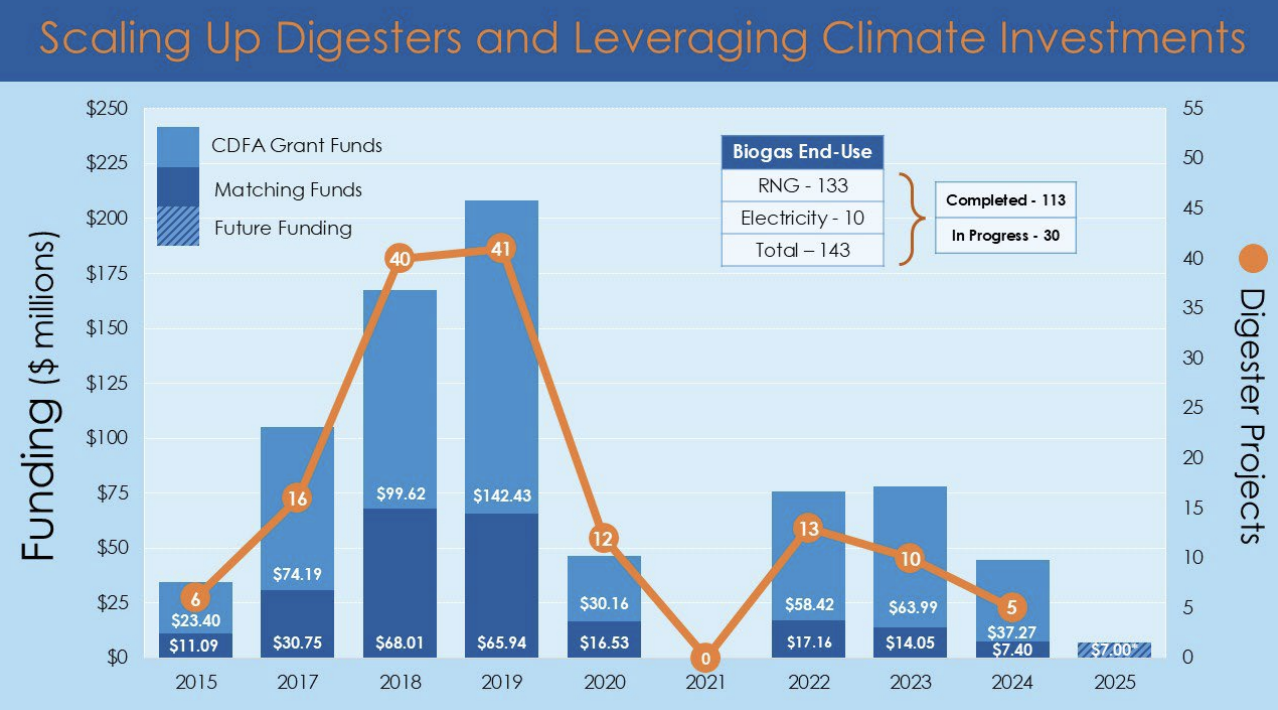
There are an estimated 394 manure-based digesters operating in the US, with more than 70 under construction, representing a 55% increase over the past decade. California leads the nation in manure digesters — it has an estimated 123 dairy farm waste digesters alone — in large part because of two incentive programs.
The state’s Dairy Digester Research and Development Program, run by the California Department of Food & Agriculture, provides grants for dairy farms to install manure digesters. In addition California’s Low Carbon Fuel Standard (LCFS) gives credits to digesters in California and beyond for captured methane.
Proponents of manure digesters point to reductions in climate-warming emissions — especially methane — from animal waste. Manure digesters reduced greenhouse gases by more than 13 million metric tons in 2023, according to the most recent data available from the Environmental Protection Agency (EPA).
In California, researchers estimate manure digesters decrease methane emissions by 80% over farms that use open air lagoons and storage pits. The California Department of Food and Agriculture estimates that dairy digester projects that the agency has helped fund reduce total methane emissions from manure management in California by nearly 30% — which is more than 8% percent of the state’s total agricultural greenhouse gas emissions.
Digesters “also generate renewable energy — such as biogas, renewable natural gas, and hydrogen — that can displace diesel and other fossil fuels, contributing to cleaner air in the Central Valley and statewide,” Van Rein said.
Digesters “generate renewable energy … that can displace diesel and other fossil fuels, contributing to cleaner air in the Central Valley and statewide.”- Jay Van Rein, a spokesperson for the California Department of Food and Agriculture
Magesh, however, said the study shows the state may be miscalculating the emissions savings from manure digesters and underperforming on the LCFS policy goal. Herd expansion increases the amount of methane — a much more potent greenhouse gas than carbon dioxide — from farms. Methane is often converted to a “carbon dioxide equivalent” to measure its climate impact. Magesh and colleagues estimate the additional cows that would fill the new barn space would lead to approximately 1,658 additional metric tons of CO2-equivalent methane emissions per year at each farm.
California’s Dairy Digester Research & Development Program estimates the average emissions reductions from manure digesters is 17,563 metric CO2-equivalent methane emissions per year, meaning the expanded herd size could wipe out approximately 9% of claimed emissions reductions.
“Industry can argue all they want about how digesters are going to solve all of these problems but many of these problems stem from the core problem of having thousands of animals concentrated in one place,” Kim said.
“So if it’s making these operations bigger — and the evidence certainly seems to suggest it is — that’s going to exacerbate all of the potential public health concerns of living next to these farms,” he added.
Methane leaks
In addition to expanded herds, manure digester leaks can wipe out methane emission reductions, according to a separate study published by University of California, Riverside researchers in March. They used satellite and airborne observations of 98 manure digesters in the state and tracked emissions.
They saw some leaks that were emitting methane at 10 times higher rates than open manure lagoons.
“For the most part, the digesters are working well,” Alyssa Valdez, a University of California, Riverside climate scientist and lead study author, said in a statement. “But the few leaks that happen, they make a huge impact.”
Featured image credit: Adam Fagen/flickr