More dangerous, drug-resistant salmonella rising in US poultry
Listen to the audio version of this article (generated by AI).
Amid a busy season of summer food recalls and illnesses, sustainable farming advocates are warning that salmonella bacteria found in poultry is increasing strains most likely to cause illness, hospitalization and death, and that such bacteria are also increasingly resistant to antibiotic medicine.
The report from Farm Forward comes a year after the US Department of Agriculture (USDA) withdrew a rule proposed during the Biden administration aimed at preventing poultry contaminated with salmonella from making it to grocery store shelves and poisoning people.
The USDA maintains that the overall rate of salmonella in tested poultry has decreased over the past decade. But critics say the agency continues to have lax regulations on salmonella in poultry and that the new report shows that Americans are increasingly in danger of getting sick from tainted chicken and turkey.
“We have a poultry industry in America that has become dominated by a single production system of giant animal factories, cramming thousands of birds together in filthy conditions that make foodborne illnesses like salmonella extremely likely,” said Andrew deCoriolis, executive director of Farm Forward.
“And we’re doing nothing on the regulatory side to protect consumers when the inevitable contamination happens,” he said.
Dangerous strains increase
Foodborne illnesses are dominating US headlines this summer — from the cyclosporiasis outbreak linked to bagged iceberg lettuce to tainted jalapenos, eggs, sprouts and berries.
The outbreaks, which can cause serious gastrointestinal distress, bring plenty of poop jokes, but there’s nothing funny about it. Foodborne illness sends more than 128,000 Americans to the hospital each year and kills roughly 3,000.
“We’re doing nothing on the regulatory side to protect consumers when the inevitable contamination happens.” -Andrew deCoriolis, Farm Forward
Salmonella bacteria are the second leading cause of foodborne illness in the US, and can contaminate undercooked meat, eggs, unpasteurized dairy and fruits and vegetables. There are more than 2,500 known types of salmonella bacteria, which collectively cause an estimated 26,500 hospitalizations and 420 deaths in the US each year, according to the US Food and Drug Administration (FDA). For most people it causes bad diarrhea, vomiting, stomach pain and fever, but for some the bacteria can get into the bloodstream and cause organ problems or death.
Poultry — chicken and turkey — account for about a quarter of all salmonella contamination cases in the US. The Food Safety and Inspection Service (FSIS) within the USDA tracks salmonella and reported that the number of tested chicken samples that had salmonella decreased 50% from 2017 to 2021, and then held steady over recent years.
However, Farm Forward’s analysis of FSIS data from 2014 to 2025 shows that three strains — salmonella infantis, salmonella enteritidis, and salmonella typhimurium — accounted for about 68% of salmonella in the poultry industry in 2025, up from just 25% in 2014. These strains are the three most commonly found to make people sick.
And the salmonella on poultry is increasingly resistant to antibiotic drugs: more than 73% of salmonella-contaminated poultry in 2025 was resistant to at least one antibiotic important for human use. In 2014, only 48% of samples had such resistance.
“You’re much more likely to get a strain that is going to make you very sick,” deCoriolis said. “And if you become sick, it’s very likely that the strain that you’ve gotten is going to be drug-resistant and hard to treat.”
The Farm Forward report did not examine why the harmful strains are on the rise, said deCoriolis.
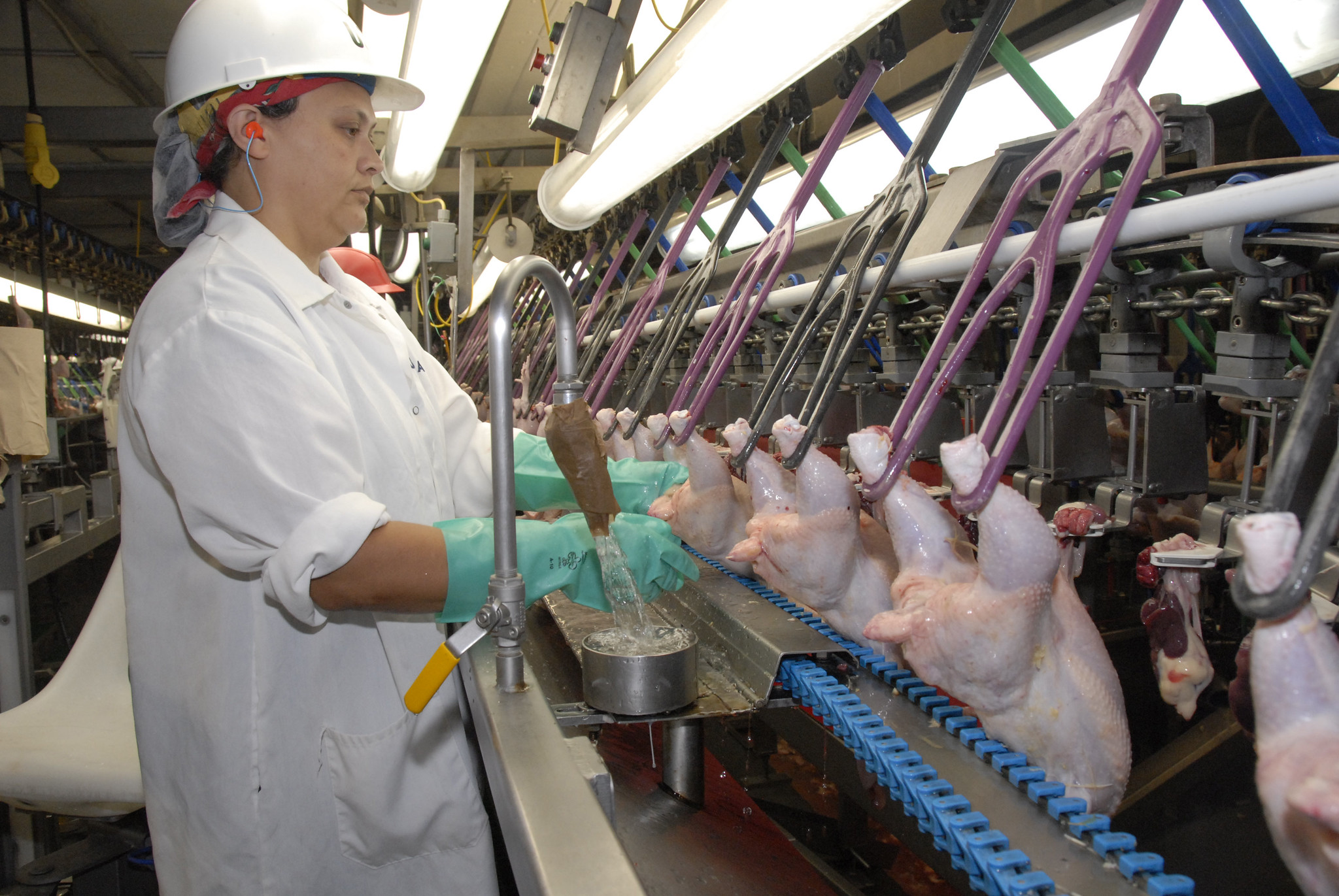
“But we do know that the scale and genetic uniformity of the poultry industry, and the conditions that they are raised in, makes disease, like salmonella, very likely,” he said. Roughly 99% of chickens and turkeys raised for food in the US are raised in confined animal feeding operations, or CAFOs, where the birds live in massive indoor buildings in crowded conditions.
In addition, the poultry industry focused a lot of effort on getting rid of the salmonella strains that sicken chickens, said Gail Hansen, a veterinary public health consultant and a former state epidemiologist and state public health veterinarian in Kansas.
“The salmonella types that cause illness in people are not the same ones that cause illness in chickens,” she said. “The industry focused on getting rid of the salmonella types that cause illness in chickens. So the salmonella types that sort of took their place were the types that make us ill.”
The US Poultry and Egg Association and National Chicken Council did not return requests for comment. However, in March the National Chicken Council submitted comments to the USDA offering suggestions on reducing salmonella in poultry. The council recommended looking at how much salmonella is in a product rather than just the presence of the bacteria, and bolstering consumer education on safe cooking.
“We support regulations to further reduce salmonella in poultry products that are science-based, data-driven, implementable by establishments of all sizes, and impactful to public health,” wrote Ashley Peterson, the council’s senior vice president for scientific and regulatory affairs. “Further, it is important that regulatory updates keep poultry products affordable to all consumers.”
The industry has touted overall reductions in antibiotic use over the past decade. A 2025 report from the US Poultry and Egg Association, for example, found that only 1% of hatchery chickens being raised for food were given antibiotics while in 2024, down from 90% in 2013.
But “the damage is already done,” Hansen said.
“The antibiotic resistance increase [in the new report] is likely because of the amount of antibiotics that we have used historically in agriculture … since the 1950s and 60s,” she said. “Once you start getting antibiotic resistance, there’s no reason for that bacteria to give that up.”
“We’ve been creating this antibiotic resistance for a number of years and we’re not going to be able to just uncreate it,” she added.
Lax regulations
Both Hansen and deCoriolis said the USDA’s authority over limiting salmonella in poultry is lacking.
“If you have an egg product or a pet food product that is regulated by the FDA and is found to be contaminated with salmonella, the FDA can recall them, can stop the sale, and can issue fines against companies who have contaminated products,” deCoriolis said. “But that’s not true for chicken meat.”
The USDA assumes that raw chicken and turkey may have some levels of bacteria like salmonella and only issues recalls if it traces a food illness outbreak to a specific batch of poultry. In 2024, the USDA under the Biden administration proposed a rule that would have changed this and required the poultry industry to keep levels of salmonella under certain thresholds and test for six strains most likely to cause illness. If thresholds were breached or the dangerous strains were found, the poultry wouldn’t be sold or would be recalled.
“We’ve been creating this antibiotic resistance for a number of years and we’re not going to be able to just uncreate it.” – Gail Hansen, veterinary public health consultant
However, the USDA withdrew the rule in April, saying it would “further assess its approach for addressing salmonella illnesses associated with poultry products.” The National Chicken Council and other industry groups had pressed the agency to withdraw the rule.
“The salmonella framework that was withdrawn was not a rule, had not been implemented, and thus did not have an impact,” said a USDA spokesperson, who added the agency is “working to develop controls in the Salmonella space that will be implemented and have an impact over the next couple of years.”
The spokesperson added that the agency is already “modernizing sampling and testing, strengthening collaboration with research partners, ensuring establishments maintain effective process controls, and supporting industry in implementing practical food safety measures.”
Hansen said federal agencies, including the USDA, have largely focused on outreach around proper handling, cooking and storage methods in combatting salmonella illness, which puts the onus on people rather than the poultry industry.
“The FDA and USDA have basically been saying, ‘well, this is the consumer’s issue,’” she said. “So it’s up to the consumer to make sure that they do everything they can to get rid of the problem that the industry has largely created.”
Featured image: Getty Images/Unsplash +