

Michigan regulators approve dairy CAFO in pollution hotspot
Listen to the audio version of this article (generated by AI).
Michigan is giving a green light to a large new concentrated dairy farm that would add millions of gallons of animal waste to a region where water quality is already suffering from manure saturation.
The decision from Michigan’s Environment, Great Lakes, and Energy (EGLE) department is the latest to highlight the uphill battle that communities around the US face in trying to slow or stop the expansion of concentrated animal feeding operations (CAFOs). New facilities are being approved even in areas where watersheds are already heavily impaired from massive amounts of animal manure and other pollutants associated with CAFOs.
“At some point the state needs the authority to say ‘enough is enough’ — no more CAFOs or CAFO expansions in CAFO hotspots,” said Cheryl Ruble, who is on the committee of Michiganders for a Just Farming System.
“At some point the state needs the authority to say ‘enough is enough’ — no more CAFOs or CAFO expansions in CAFO hotspots.” Cheryl Ruble, Michiganders for a Just Farming System
In approving the permit EGLE acknowledged pollution concerns but wrote “the permit applicant met the permit application requirements and EGLE is required to issue a permit.”
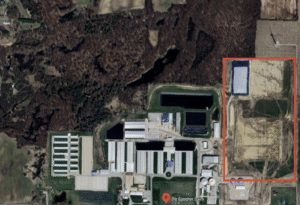
The CAFO in question, KB Dairy LLC, plans to house up to 3,450 dairy cows in mid-Michigan’s Gratiot County, and is forecast to generate between 16 million and 34 million liquid gallons of manure annually. The CAFO’s application for a National Pollutant Discharge Elimination System (NPDES) permit under the federal Clean Water Act was contested by neighbors and environmental groups as it sits adjacent to an existing CAFO, De Saegher Dairy, which is owned by the same family. In its original application to the state KB Dairy had the same address as De Saegher Dairy.
Opponents said that KB Dairy is not a new CAFO, but rather should be considered an expansion of De Saegher Dairy, which already houses 8,000 cows and generates more than 41 million gallons of manure each year.
“We are disappointed that EGLE has issued a permit to KB Dairy that, if not for some paperwork sleight of hand regarding its relationship to the adjacent De Saegher Dairy, should not have been approved under state and federal rules,” said Liz Kirkwood, executive director of Flow Water Advocate, a Michigan environmental nonprofit that lobbied the state to deny the permit.
“Adjacent operations under common ownership, using shared waste systems and infrastructure, must be considered and permitted together,” Kirkwood added.
In its response announcing the approved permit, EGLE wrote “these entities do not appear to share common ownership, therefore EGLE did not consider the entities to be a single CAFO and permitted them separately.”
Owners of KB Dairy said in a February public hearing that it is a separate operation, and that they are committed to providing local food and protecting water quality.
“We care deeply about the environment and being good neighbors,” said Kelsey De Saegher, who is a co-owner along with her husband Bram De Saegher of KB Dairy. Bram’s parents own De Saegher Dairy.
Gratiot County allows manure disposal on roughly 55,000 acres — which is the second highest among counties in Michigan. And the two main receiving river systems by KB Dairy — the Pine River and the Maple River — already suffer from excess nutrients, harmful bacteria and other contaminants.
De Saegher Dairy has a history of water quality violations documented by the state, including that it put CAFO waste directly into streams in 2020, and a 2023 notice that alleged the farm failed to update its nutrient management plan, which is supposed to include up-to-date herd numbers, waste storage status and mapping water flow on the farm.
EGLE did take pollution concerns into account and stated in the permit that KB Dairy’s “CAFO waste shall not be sold, given away, or otherwise transferred to a recipient where it will be land applied in a watershed” that fail to meet water standards for E. coli, phosphorus, nitrogen and other contaminants. These conditions are stricter than the state’s usual general CAFO permit.
Kirkwood said “powerful citizen comments and testimony … were able to influence stronger conditions.”
Ruble said that the permit’s banning KB Dairy’s waste from being land applied in impaired watersheds “seems like a good thing at first glance — but are we just kicking the agricultural pollution can down the road to neighboring watersheds?”
Part of the plan for KB Dairy involves the use of anaerobic digesters operating at De Saegher Dairy that will treat the animal waste while also creating biogas, a mix of mostly methane and carbon dioxide that can be sold for use as a natural gas substitute. Advocates of biogas and farm digesters say the technology mitigates agricultural pollution while also creating a usable source of energy. But critics say the use of farm digesters incentivizes the addition of animals to already large farms without actually providing significant environmental benefits.
Midwest dairy expansion
KB Dairy is part of an industry trend — fewer dairy farms with more cows. US milk production increased 32% over the past 20 years, while the number of licensed dairy herds decreased 63% over the same time period, according to the US Department of Agriculture (USDA). The agency also reports the number of dairy farms with 1,000 or more cows increased by 60% from 2002 to 2022.
The Midwest has had several high profile recent dairy expansions in the face of community and legal opposition.
Last month Wisconsin regulators approved a NPDES permit for an expansion at Gilbert Farms, a dairy CAFO in Door County. The permit faced stiff opposition from nearby communities and environmental groups over pollution concerns from the estimated 21 million gallons of manure annually the farm will generate after expansion.
And in Minnesota, Food & Water Watch and the Land Stewardship Project sued the state last week over its decision to allow the dairy CAFO West River Dairy to expand from 7,855 cows to almost 19,000 cows. “It is hard to overstate the environmental destruction threatened by Riverview’s proposed West River factory farm expansion,” said Food & Water Watch legal director Tarah Heinzen in a statement.
Food & Water Watch is also suing the North Dakota Department of Environmental Quality over its permitting for a 25,000-cow dairy CAFO in the Red River Valley owned by Riverview LLP.
Featured image: Gratiot County residents gathered on Feb. 3 at Alma College to listen in to a public hearing on KB Dairy. (Credit: Brian Bienkowski/The New Lede)



August 7, 2026 @ 2:49 pm
Have some thoughts on the CAFO PERMIT…you said that the farm would create between 16 and 34 million gallons of liquid manure per year. How do you know this…does the farm have real-time well monitoring, counting the gallons used each day..? If not, you’re relying on the farmers numbers…right..? Ask the farmer if they would accept counters on their wells…and WHY NOT..! If we use 28 million for this discussion, we would end up with about 252,000,000 pounds of liquid manure per year…or about 126,000 tonnes per year. Moving that amount of liquid in tankers carrying about 6000 gallons each would require about 4,666 tankers leaving the farm and then returning…lots of TRAFFIC moving in a very short spreading window…do some math here! I’ve been around this issue for over 10+ years now and have watched our EPA…DNR…ELECTED OFFICIALS all come up SHORT on solving this…I believe there is only ONE way to win…STOP RENTING YOUR LAND FOR THEIR SHIT…STOP IT..! LAND is our secret weapon…take away the land and your DNR will take away the animals…it’s really that simple..! The people will decide the future of their county…it’s time people…MAN-UP..!