
Congress members move to override Supreme Court ruling on pesticide protections
Some US lawmakers are rushing to introduce legislation to reverse the impact of a US Supreme Court ruling handed down last week that overturned years of precedent by limiting consumer lawsuits against pesticide companies.
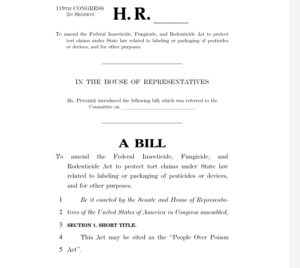
US Rep Chellie Pingree, a Democrat from Maine, and Rep. Thomas Massie, a Republican from Kentucky, on Monday introduced an amendment to the Federal Insecticide, Fungicide and Rodenticide Act (FIFRA) – the key law for regulating pesticides. Under their proposed amendment to FIFRA, people who are exposed to pesticides they blame for causing health problems would once again be able to sue companies for failing to warn them of health risks.
The Supreme Court’s decision most immediately benefitted Bayer and Syngenta, global agrochemical companies that are currently facing thousands of lawsuits brought by users of their weed killing products, but other pesticide companies also benefit from the protections provided in the court ruling.
“People are so angry,” Pingree said in an interview. “People want to see us take action. And I no longer want to just sit on the sidelines and say, ‘oh, well, you can’t beat the chemical companies,’ … I think people expect more of us than that.”
The amendment, called the People Over Poison Act, states that language within FIFRA “shall not be construed to prohibit or otherwise limit a claim related to the labeling or packaging of pesticides or devices under the tort law of any State.”
 It comes alongside a promise made last week by Sen. Cory Booker, a Democrat from New Jersey, to introduce an amendment to the Farm Bill, which is currently pending in the Senate, that would similarly undo the impact of the Supreme Court decision.
US Rep. Anna Paulina Luna, a Republican also said last week she would be introducing a bill to strip pesticides companies of liability protections.
The Supreme Court decision came in an appeal brought by Bayer, the owner of Monsanto and the maker of glyphosate-based herbicides such as Roundup. More than 100,000 people have sued Monsanto alleging the weed killers cause cancer, and Bayer has paid more than $11 billion in settlements and jury verdict awards since buying Monsanto in 2018.
Bayer asked the Supreme Court to rule that language within FIFRA preempts a key claim contained in the lawsuits, which is that the company failed to warn users of the risk of cancer. Bayer maintains that research linking its products to cancer is not valid, and argued to the Supreme Court that under FIFRA, only the Environmental Protection Agency (EPA) can require a cancer warning on a product label. Because the EPA has not required such a warning, the company cannot be held liable for failing to issue that warning, Bayer maintains. The Supreme Court agreed in a 7-2 ruling, effectively barring those types of claims in current and future lawsuits.
Also impacted is Syngenta, currently facing thousands of lawsuits alleging it failed to warn users of a risk of Parkinson’s disease associated in scientific research with exposure to paraquat weed killers, such as Syngenta’s Gramoxone, and other products.
The Trump administration supported Bayer before the Supreme Court, arguing side-by-side with the Bayer attorney before the justices in an April hearing. The court’s ruling marked a new interpretation of the language within FIFRA, contrasting with a prior Supreme Court decision on the issue and numerous lower court and appellate court findings.
In introducing the new legislation, Pingree noted that the Supreme Court decision would protect the makers of thousands of types of pesticides from the failure-to-warn claims associated with pesticides that are widely used in farm fields, public parks and playgrounds, golf courses and elsewhere.
“There’s just a broad concern that there’s a lack of regulation in this administration and people are giving the chemical companies a free for all, and … you’ve got more and more Americans worrying about the … high incidents of cancer or just what toxics are in our food,” Pingree said.
It is unclear how much support she can garner for the amendment, but Pingree said she’ll be looking to the Make America Healthy Again (MAHA) movement for backing.
MAHA leaders have expressed outrage over the Supreme Court ruling, and have called on Congress to take action.
“If federal law is now being interpreted to shield manufacturers from accountability when their products harm people, then Congress must fix the law immediately. This is one of the most consequential moments for corporate accountability in a generation,” said Vani Hari, a food activist, a food activist, author and one of the grass roots leaders of the MAHA coalition.
“If Congress fails to act, it will send a message that powerful corporations can avoid responsibility while Americans get sick from their harmful chemicals. That’s unacceptable,” Hari said. “Congress must move swiftly to restore the rights that people believed they had and ensure accountability under the law.”
Kelly Ryerson, another prominent voice in the MAHA movement, said the coalition will fight for changes in the law.
“The grassroots behind MAHA is geared up to support all legislation to undo the SCOTUS decision. We are not accepting this outrageous decision from the court, and will put full weight behind making sure it does not stick,” she said.
Featured image by Ian Hutchinson on Unsplash.


July 4, 2026 @ 7:30 am
Thank you for your sound investigative reporting. We need many members of Congress to regain their moral fiber and represent their constituents and not corporate interests.
June 30, 2026 @ 3:07 pm
No more poisonous toxins!
June 30, 2026 @ 2:20 pm
I have read the studies done on glyphosate; they are extensive and conservative. I think people should read the studies before just assuming negligence.