Supreme Court decision on Roundup lawsuits not a “silver bullet” for pesticide makers, legal experts say
A day after landmark ruling from the US Supreme Court stripped consumers of a key pathway for suing pesticide companies, legal experts said while the decision is a blow for people who blame injuries on pesticide exposure, it’s not a knock-out punch.
Even as Bayer and other pesticide makers celebrated the ruling in the case of Monsanto v. Durnell, plaintiffs’ lawyers, state and federal lawmakers and public health advocates were vowing to keep fighting for what they describe as corporate accountability for dangerous products.
On the one hand, lawsuits can and will continue alleging Bayer’s glyphosate-based herbicides such as Roundup cause cancer, just as will cases alleging Syngenta’s paraquat weed killers cause Parkinson’s disease, many lawyers said.
At the same time, legislators from both parties said they would introduce measures to reverse the impact of the Supreme Court decision. And consumer advocacy and watchdog groups said they would be ramping up pressure on regulators to be more diligent in overseeing pesticide products.
“The war is far from over,” said George Kimbrell, legal director and co-executive director of the Center for Food Safety, which has sued the EPA over pesticide assessments. The court decision, he said, is a “galvanizing call to continued action.”
A common thread
In the court’s 7-2 ruling, a majority of the justices found that federal law protects pesticide companies from lawsuits accusing them of failing to warn of risks allegedly associated with their products if the Environmental Protection Agency (EPA) has not required such a warning.
Failure-to-warn claims have been a common thread in lawsuits brought against Bayer and Syngenta, costing Bayer over $11 billion in settlements and jury awards and costing Syngenta well more than $100 million so far.
Bayer, which sought the ruling from the Supreme Court as a means to end the litigation it inherited in its 2018 purchase of Monsanto, said the decision should lead to the dismissal of current failure-to-warn lawsuits and head off future litigation.
But several leading lawyers and analysts noted the ruling was narrow and left the door open for several other types of claims that already are being pursued.
“There is no question that failure-to-warn claims based on the EPA-approved label are over. However, the Court’s ruling was limited to just those claims,” said Brent Wisner, a leading plaintiffs’ attorney who helped win the first Roundup trial to take place against Monsanto.
“Cases will become even more difficult against pesticide manufacturers. But if they claim this is the silver bullet to end all litigation, they are just blowing sunshine,” Wisner said.
Robin Greenwald, another prominent mass torts plaintiffs’ attorney involved in the Roundup litigation since its inception more than a decade ago, agreed.
“There should be no reason that you wouldn’t do these cases,” Greenwald said. “Monsanto’s conduct is so much deeper than what they might do with a label. They mislead the public in numerous ways. I don’t think at all that this is the end of Roundup litigation.”
Gibbs Henderson, another plaintiffs’ attorney active in the pesticide litigation said the lawsuits will continue “unabated.”
“The language of the decision makes clear that its scope is limited to failure to warn claims,” Henderson said. Other types of claims will continue to provide a “strong mechanism to hold Monsanto accountable,” he said.
Many plaintiffs’ attorneys acknowledged, however, that the failure-to-warn claim has been a key element of swaying juries to find in favor of plaintiffs, and with the restriction against making that claim, some mass tort attorneys pay be reluctant to take cases to trial. Several plaintiffs’ firms have spent the last few months directing their clients to agree to settlements with Bayer in advance of the Supreme Court ruling in fear of a decision favoring the company.
A “narrow scope”
In addition to the failure-to-warn claims, typical lawsuits brought against Monsanto also claim “negligence,” alleging that the company had a duty to assure users would not suffer from unreasonable and dangerous effects due to exposure to the company’s glyphosate herbicides.
The also include a product liability claim of “design defect”, in which plaintiffs allege the company’s herbicides were defective in their formulation because they were more dangerous than a consumer would expect, posing a “grave risk of cancer”.
Another claim common to the thousands of lawsuits is “breach of implied warranties”. Plaintiffs allege that the company falsely represented that its herbicides were safe, misleading users about risks of exposure.
Juries presented with all of the claims have in some Roundup trials awarded hefty punitive damages, including jury awards for hundreds of millions of dollars in multiple cases, and some awards totaling over $1 billion.
Bayer and Syngenta have been pushing to settle all outstanding claims, with both currently offering mass settlements to plaintiffs. Bayer faces a July 9 hearing on its proposed $7.25 billion class action settlement proposal. Syngenta likewise is trying to entice plaintiffs to settle but a large number have been opting out.
Both will benefit if plaintiffs decide settlements are more advantageous than taking lawsuits to trial with limited claims. But it remains to be seen if the Supreme Court ruling acts as a lever to increase settlement participation.
“I do not believe that we shall see mass settlements in the Roundup litigation, because a critical facet of the SCOTUS ruling is its narrow scope,” said Carl Tobias, William Chair in Law at the University of Richmond School of Law. “The decision only applies to warning defect cases. The opinion does not apply to thousands of pending lawsuits or future litigation that proceeds on other grounds.”
“These other theories of recovery mean that many mass tort lawyers will continue pursuing thousands of these cases and taking a significant number to trial,” Tobias said.
Will Congress act?
Critics of the Supreme Court ruling noted that the decision was based entirely on an interpretation of certain language within FIFRA that deals with labeling authority held by the EPA, and does not address the weight of science connecting pesticides such as glyphosate and paraquat to health harms.
Litigation against corporations over product safety has helped uncover a history of misconduct and hidden product dangers with pesticides and other chemicals, and ensuring that can continue requires congressional action, some lawmakers said.
US Sen. Cory Booker, a Democrat, said on Thursday that the Supreme Court has a history of “unjust” decisions and the “power of the people” is needed to overcome its ruling in the Monsanto case.
“I’m going to lead an amendment to strip away this preemptive authority and return it to the people. We now need to rally around both sides of the of the aisle … to undo what the Supreme Court did,” Booker said.
Similarly, US Rep. Anna Paulina Luna, a Republican, said she would be introducing a bill to strip pesticides companies of liability protections.
“These companies purposefully omit labeling information knowing their products cause cancer and other health problems,” she wrote in a post on the social media platform X. “It is time they are held accountable. Enough is enough.”
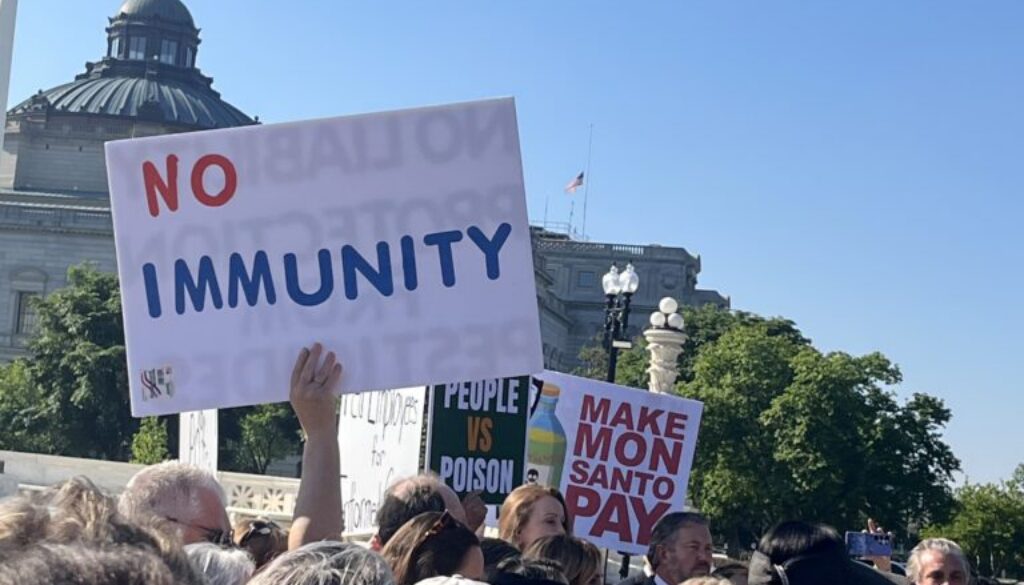
Featured image of protesters outside the US Supreme Court, April 27, 2026, by Carey Gillam.