
Senate GOP backs speedier chemical reviews; Dems cite health risks
Listen to the audio version of this article (generated by AI).
Proposed changes to the nation’s premier chemical safety law are necessary for American competitiveness, Senate Republicans said in a hearing on Wednesday, as Democrats warned the changes will harm public health.
The hearing comes a week after Republicans on the Senate Environment and Public Works Committee released a draft discussion bill aimed at loosening the Toxic Substances Control Act (TSCA) with the goal of faster federal chemical reviews.
The Senate draft bill comes a little more than a month after House Republicans released a draft discussion bill that similarly seeks to roll back several provisions of TSCA, a federal law under which the US Environmental Protection Agency (EPA) evaluates chemicals to make sure human and environmental health are protected before chemicals are put into the marketplace. TSCA was updated in 2016 with bipartisan support, and has since drawn the ire of the chemical industry.
“Companies delay or abandon developing safer alternatives in America while shifting investment and production overseas to places like Europe and China,” said Senator Kevin Cramer, a Republican from North Dakota. “The EPA’s onerous requirements simply mean that leading-edge materials are not sent to the United States market.”
Richard Engler, director of chemistry at Bergeson & Campbell and hearing witness, said predictable timelines for chemical reviews are crucial to bring such chemical manufacturing back to the US.
“While it may seem intuitive to want all hazards addressed by a restriction, that is neither desirable nor good federal policy,” Engler said. “Not all hazards present actual risk and as a society we do not insist on or benefit from this level of risk mitigation.”
“Companies delay or abandon developing safer alternatives in America while shifting investment and production overseas to places like Europe and China.” – Senator Kevin Cramer, a Republican from North Dakota
The Senate draft bill targets the EPA’s new chemical program, in many instances by changing definitions and language to reduce the evidence burden for chemical manufacturers to prove chemicals won’t harm people.
For example, it changes the requirement that a chemical ‘‘will not present any unreasonable risk’’ to ‘‘is not likely to present an unreasonable risk.’’ The draft bill also narrows what’s considered a chemical’s “conditions of use,” which, critics say, prevents the EPA from considering potential unforeseen impacts of a chemical.
The draft bill also would create a tiered system for approval to seemingly fast-track certain chemicals, but the draft doesn’t give updated timelines for each tier. And it carves out exemptions for chemicals that are produced in lower volumes, have low expected environmental releases or are less toxic — even marginally — than a chemical currently on the market.
Several Democrats signaled a willingness to find ways to make chemical reviews more efficient and predictable, but said the current draft bill would allow industry to override EPA authority.
“The fossil fuel, tobacco, and pharmaceutical industries demonstrate time and again that the profits matter more to them than truth or the public interest,” Sheldon Whitehouse, a Democrat from Rhode Island, said in the hearing. “The chemical sector in America has yet to prove itself any better.”
“The fossil fuel, tobacco, and pharmaceutical industries demonstrate time and again that the profits matter more to them than truth or the public interest. The chemical sector in America has yet to prove itself any better.” -Sheldon Whitehouse, a Democrat from Rhode Island
Hearing witness Michal Freedhoff, a senior policy advisor at Holland & Knight LLP and former EPA chemical safety assistant administrator, said the changes would allow some chemicals to enter the market without EPA reviews.
“I don’t believe that Congress should remove the requirement that EPA formally review new chemicals before they go into commerce,” Freedhoff said in the hearing. “There are some provisions in the draft that result in that outcome.”
She added that EPA remains understaffed and the proposed changes mandate that “EPA stand up new programs, functions, processes, rules, guidance documents, and other requirements, generally in one year or less.”
“This isn’t implementable and would likely slow things down, rather than speed them up,” she added, saying if Congress wanted to speed up reviews that “the biggest thing” they could do is “provide the EPA resources sufficient to do the job.”
Whitehouse echoed the EPA staffing concerns of Freedhoff, adding that under President Trump the agency is “captured” by the chemical industry and is politicizing science.
“High ranking operatives of the chemical industry run the chemicals office,” Whitehouse said.
“And [the Trump administration’s] so-called gold standard science executive order makes agency appointees beholden to Trump’s industry donors — not scientists with objective expertise.”
The EPA’s Office of Chemical Safety and Pollution Prevention has numerous former chemical lobbyists in leadership positions: Nancy Beck, a former chemical industry executive with the American Chemistry Council (ACC), as the principal deputy assistant administrator; Lynn Ann Dekleva, formerly with DuPont and the ACC, as deputy assistant administrator for new chemicals; Kyle Kunkler, most recently with the American Soybean Association, as deputy assistant administrator for pesticides; and Douglas Troutman, former CEO and lobbyist at the American Cleaning Institute, as the office’s assistant administrator.
At a keynote address to chemical industry executives last week, Troutman placed blame for the chemical backlog on the Biden administration, saying “we’re going to build a chemical safety program that supports the great American comeback.”
Environmental and health groups have pleaded with Congress not to weaken TSCA, saying the proposed changes under both draft bills will create loopholes and fast-track potentially dangerous chemicals.
“Instead of creating a glide path for increased toxic pollution, the Senate should be rejecting the chemical industry’s bid to make America more contaminated so it can further line its pockets,” Avi Kar, director of toxics at the Natural Resources Defense Council, said in a statement.
Senators have until March 18 to submit questions and further comment on the draft discussion bill.
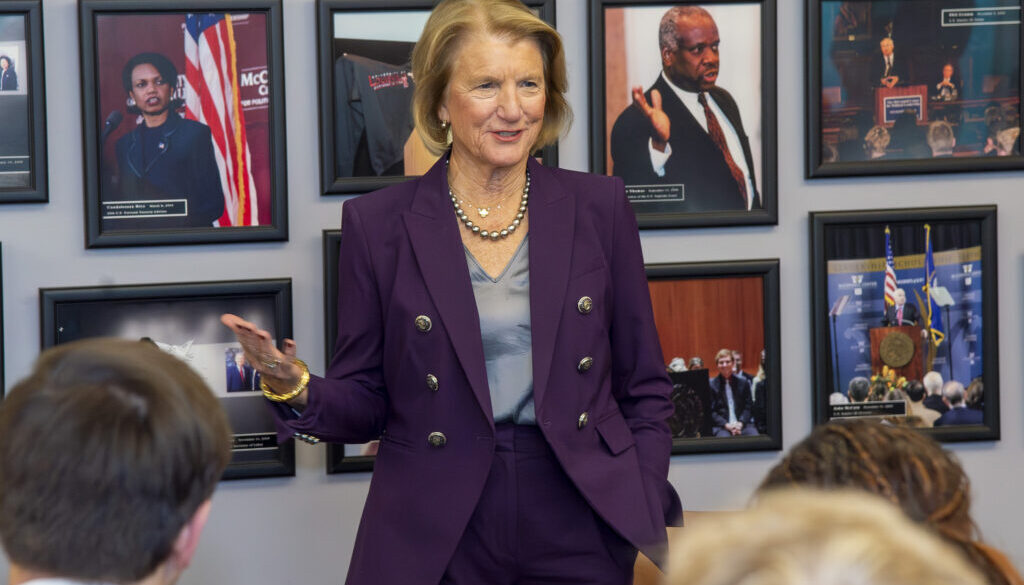
Featured image: Senator Shelley Moore Capito, who chairs the Senate Environment and Public Works Committee and has led efforts to revamp TSCA, at an October 2025 event. (Credit: McConnell Center/flickr)