
Senate Republicans draft bill aimed to speed up new chemical reviews
Listen to the audio version of this article (generated by AI).
Senate Republicans released a draft discussion bill on Thursday aimed at loosening the nation’s premier chemical safety law with the goal of reducing chemical review delays.
The draft bill, released by the Republican majority on the Senate Environment and Public Works Committee, would amend the Toxic Substances Control Act (TSCA), a federal law under which the US Environmental Protection Agency (EPA) evaluates chemicals to make sure human and environmental health are protected before chemicals are put into the marketplace.
The Senate Environment and Public Works Committee will hold a legislative hearing on March 4 to discuss the draft bill.
The Senate bill comes a little more than a month after House Republicans released a draft discussion bill that similarly seeks to roll back several provisions in the nation’s premier chemical safety law.
The bills follow a year of congressional Republicans signaling that they want to revisit the law. Environmental and health groups have pleaded with Congress not to weaken TSCA, saying the proposed changes under both draft bills will create loopholes and fast-track potentially dangerous chemicals.
TSCA was updated in 2016 with bipartisan support, and has since drawn the ire of the chemical industry, which says it is unnecessarily slow and unreliable, and is stifling US innovation. Federal data suggest that reviews are lengthy, with the EPA conducting new chemical reviews within its 90-day deadline less than 10% of the time, according to a 2023 report from the Government Accountability Office (GAO).
Despite past bipartisanship around TSCA, support for the current law now falls along party lines — with Democrats expressing a desire to leave it intact or strengthening it, and Republicans echoing industry talking points that TSCA in its current form is harming US competitiveness in the chemical marketplace.
The Senate draft bill targets the EPA’s new chemical program, in many instances by changing definitions and language to reduce the evidence burden for chemical manufacturers to prove chemicals won’t harm people.
For example, it changes the requirement that a chemical ‘‘will not present any unreasonable risk’’ to ‘‘is not likely to present an unreasonable risk.’’ The draft bill also narrows what’s considered a chemical’s “conditions of use,” which, critics say, prevents the EPA from considering potential unforeseen impacts of a chemical.
“They’re really limiting the EPA’s ability to review the full breadth of what impacts the chemical could have so that it is easier for them to move things along,” said Suhani Chitalia, a senior manager of federal affairs at the Environmental Defense Fund. “This limits the science and the potential risks that are associated with a chemical from the get-go.”
The draft bill also would create a tiered system for approval to seemingly fast-track certain chemicals, but the draft doesn’t give the updated timelines for each tier. And it carves out certain regulatory exemptions for chemicals that are produced in lower volumes or that have low expected environmental releases.
The Senate draft bill comes as earlier this week a top EPA official — and former industry lobbyist — blamed the Biden administration for a “backlog” of chemical reviews and signaled his support for TSCA reform at American Chemistry Council (ACC)’s conference in Washington, DC. The ACC has led the chemical industry’s push to reform TSCA.
“We’re going to build a chemical safety program that supports the great American comeback,” Douglas Troutman, assistant administrator of the EPA’s Office of Chemical Safety and Pollution Prevention, said in a keynote speech. Troutman served as an interim CEO and lobbyist at the American Cleaning Institute, which represents cleaning product producers and has a track record of pushing back against chemical regulations, prior to his EPA appointment.
“Regardless of political party, the American public has been clear: it does not want to be poisoned by toxic chemicals,” Earthjustice Action vice president of policy and legislation Raúl García said in a statement. “Still, Republican congressional leadership insists on weakening the most significant tool we have to protect our families from toxics.”
House draft bill
The House also released a draft discussion bill in mid-January that mandates faster chemical reviews and for chemicals approved in certain other countries to be fast-tracked by the EPA, which would also be required to prioritize chemicals that are designed to be substitutes for more harmful ones or chemicals aimed at easing supply-chain risks for critical materials.
The House draft bill also prohibits the EPA from restricting any chemicals used in aerospace fire suppression that have been certified by the Federal Aviation Administration or the Department of Defense. Such firefighting foams were previously a major source of per- and polyfluoroalkyl substances (PFAS).
“This important law is still not working as Congress intended,” Rep. Gary Palmer, a Republican from Alabama, chairman of the Subcommittee on Environment, and co-author of the draft bill, said during a legislative hearing.
The lone witness who was critical of the House draft bill during the hearing, Tracey Woodruff, director of the Program on Reproductive Health and the Environment at the University of California, San Francisco, said the changes would “significantly weaken the law” and is an industry wishlist.
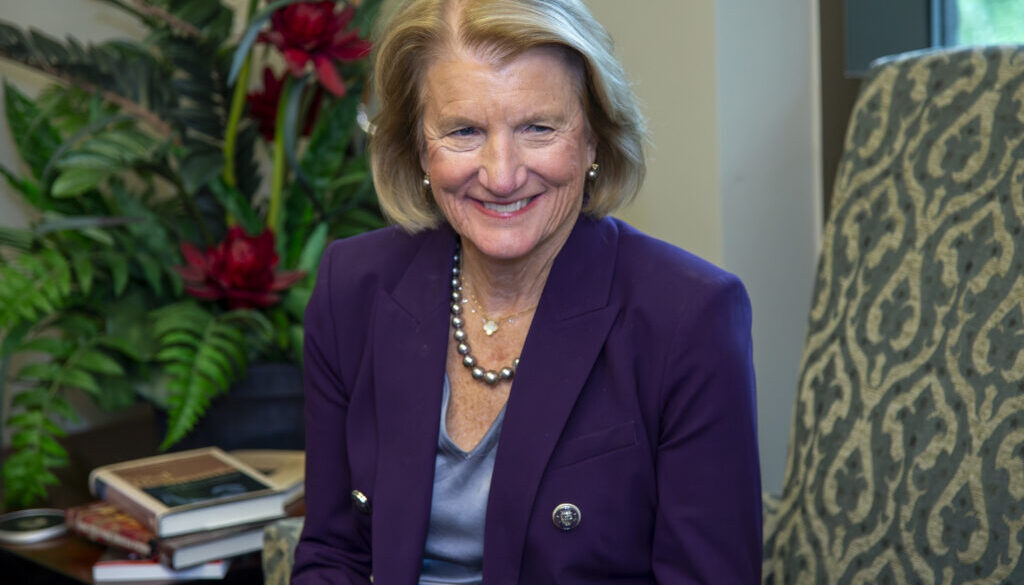
Featured image: Senate Environment and Public Works Chairperson Shelley Moore Capito, a Republican from West Virginia, who has advocated for TSCA reform. (Credit:McConnell Center/flickr)