
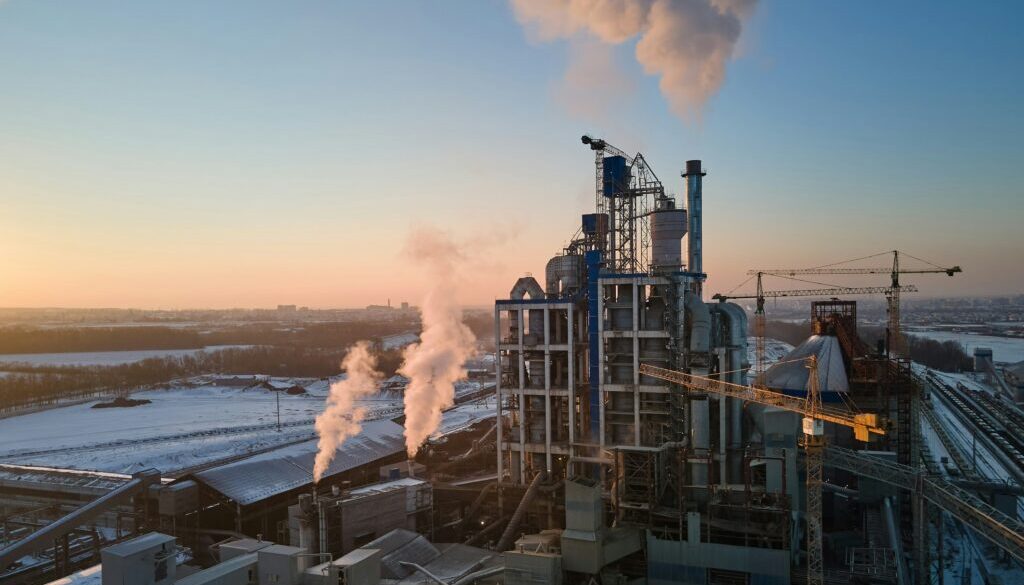
As chemical accidents surge, watchdog warns of looming safety rollbacks
Listen to the audio version of this article (generated by AI).
Plans by the Trump administration to roll back regulations on chemical facility safety will allow for the continued rise in industrial chemical accidents, which are already up by 50% since 2021, a watchdog group warned this week.
The administration is making an “appalling” divestment in chemical safety, according to Public Employees for Environmental Responsibility (PEER), and the risk is heightened by the country’s aging industrial infrastructure.
“There doesn’t appear to be any concerted federal effort to either help industry or to monitor what’s going on,” said Jeff Ruch, senior counsel to PEER.
There were 131 industrial accidents resulting in chemical releases last year, up from 83 in 2021, according to reports filed with the Chemical Safety and Hazard Investigation Board (CSB).
Further, accidents involving injuries or fatalities rose from 60 incidents to 89 during the same period, and were up more than 20% in the last year. The statistics were gathered after a lawsuit filed by PEER and others forced the federal government to implement a mandatory reporting system for industrial chemical disasters.
According to the nonprofit Coming Clean, which helps track chemical incidents in the US, there have been at least 1,463 hazardous chemical incidents since January 2021, an average of approximately five incidents every week.
The warning from PEER comes after the Environmental Protection Agency (EPA) in February proposed the Common Sense Approach to Chemical Accident Prevention rule. The rule aims to reverse previously adopted EPA safety requirements, such as a third-party audit after a serious chemical incident.
The rule also proposes to remove or modify many of the provisions currently in place to make facility information more publicly available.
The EPA’s website states the proposed amendments seek to improve chemical process safety by “avoiding duplicative requirements,” realigning program requirements with the Occupational Safety and Health Administration (OSHA) Process Safety Management requirements, and eliminating unnecessary burdens.
But some observers say that OSHA requirements aren’t as stringent as the EPA’s.
“It’s very common in this administration. They talk about realigning with OSHA requirements. Well, the OSHA requirements are always weaker than the EPA requirements,” said Adam Finkel, an environmental health sciences professor at the University of Michigan, who was the director of health standards for OSHA from 1995 to 2000.
“Under the guise of harmonization, it’s always in the direction of ‘let’s pick the weaker one and make the stronger agency do worse,’” Finkel said.
Ruch agreed. “The idea that OSHA provides a meaningful safeguard is somewhat fanciful,” he said.
More high-profile incidents
Advocates at PEER point to recent high-profile incidents as another reason not to further repeal current chemical safety regulations.
In May, a chemical tank at a GKN Aerospace facility in Garden Grove, California overheated and risked exploding, forcing thousands of residents to flee their homes. That same week, a chemical tank rupture at the Nippon Dynawave Packaging mill in Longview, Washington, killed 11 people.
“Not all these incidents make the national news,” said Ruch. “In the case of Washington, 11 workers died, so those situations where occupational safety and health remains sort of … unexplored territory, and that nobody’s paying attention to it in an affirmative way,” he said.
“Not all these incidents make the national news.” – Jeff Ruch, Public Employees for Environmental Responsibility
In the face of federal rollbacks, some experts said individual states also play a role when it comes to safety.
“It’s true there might be rollbacks at the federal level, but that doesn’t mean the state of New York and the state of New Jersey, or whatever state across the country, doesn’t have its own rules and regulations on handling toxic chemicals,” said Jeffrey Laskin, professor of environmental & occupational health at Rutgers University. “It’s not like everything is abandoned. Much of it falls upon the states, which often have very strong regulations.”
According to the EPA, the proposed rule would result in annualized cost savings of between $234.7 million to 241.9 million.
However, observers say cost is only part of the equation. “There’s no question every time you have federal regulation, in particular, but state, too, that there’s a cost to it, and there’s always a balance between, is it really going to be harmful? Versus how expensive it might be,” Laskin said.
“Usually in the past it’s erred on the side of trying to protect the worker as well as the local community as much as possible,” he said.
In a statement, the EPA said it’s “reviewing and considering comments submitted during the public comment period,” adding that “EPA continues to work towards completing the final rule in late 2026.”
Photo by Getty Images For Unsplash+