Q&A: Former EPA official weighs in on critical Supreme Court hearing on pesticide law
Listen to the audio version of this article (generated by AI).
A US Supreme Court hearing that will take up the thorny question of pesticide regulation on Monday is sparking heated debate over the role of the Environmental Protection Agency (EPA) when it comes to protecting consumers from harm.
The key question before the court in the case of Monsanto v. Durnell is whether or not federal law – the Federal Insecticide, Fungicide, and Rodenticide Act (FIFRA) – preempts states labeling requirements for products that could cause harm.
Monsanto, owned by the German conglomerate Bayer since 2018, brought the case to the Supreme Court because it believes a ruling in its favor would help put an end to lawsuits brought by people who claim they developed cancer from using Roundup herbicide and other glyphosate-based weed killing products, and allege Monsanto should have warned them of the cancer risk.
A ruling in Monsanto’s favor could lock in the EPA as the ultimate arbiter of whether or not pesticide makers should warn consumers of risks of cancer, Parkinson’s disease or other harms linked to certain pesticides, while a ruling against the company would reinforce previous rulings that have determined the EPA does not have total power when it comes to state warning requirements.
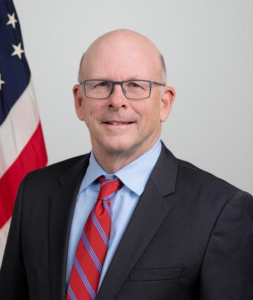
Jim Jones is among a group of former senior EPA officials who have weighed in on the debate, filing an amicus curiae brief to the Supreme Court arguing against Monsanto’s position. Jones joined the EPA in 1987 and served as Assistant Administrator, Office of Chemical Safety and Pollution Prevention from 2013 to 2017. He then served as Deputy Commissioner for Human Foods at the US Food and Drug Administration from September 2023 until resigning in February 2025.
Jones and the seven other EPA officials represented in the court filing do not take a position on glyphosate safety. But they are challenging the premise that lies at the heart of Monsanto’s case, including objecting to the Trump administration’s Solicitor General, who is supporting Monsanto in arguing that once a pesticide is registered, “EPA has the final word on precautionary warnings, which registrants may not supplement or amend without EPA’s review and approval.”
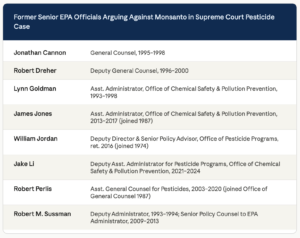 Under the correct interpretation of the statute, “EPA and states can work together to regulate pesticides in a way that provides needed pest control both effectively and safely, and state failure-to-warn cases are a valuable component of FIFRA’s scheme,” Jones and his fellow former regulatory officials state in their brief. “The United States’ recent change in position is contrary to the facts and the law.”
The New Lede talked with former administrator Jones about his position on the case and related matters. The interview has been edited for clarity and length.
Q: Is it surprising that we saw the Solicitor General D. John Sauer come in with an interpretation of FIFRA that differs from prior administrations? Is this politicized or has this part of FIFRA always been a bit controversial and something that is argued over and interpreted in different ways?
A: In my whole time at EPA and in the pesticides world, which spans almost 30 years this has been a controversy. In my experience, and I was a career employee for many years, Republican administrations tended to take the interpretation that [Monsanto] has, and Democratic administrations tended to take the interpretation that we did in our brief. That was consistent throughout my time at EPA.
Q: So it’s not surprising that partisanship may play a role here?
A: No.
Q: In your filing to the Supreme Court, you and the other former EPA officials say that states play an important and complementary role in regulating pesticides and determining what types of warnings are warranted. Why was it important to make this argument to the Supreme Court?
A: It’s the perspective I’ve held throughout my career at EPA. I think it is the correct one.
Q: In litigation against companies such as Monsanto and other pesticide or chemical companies, we’ve learned a lot about potential public health harms that we don’t learn about through regulatory actions. So it seems like there is a real important role for court cases in helping us learn about risks to public health. Do you agree?
A: I wouldn’t disagree with that.
Q: Are companies just not disclosing adequately to our regulators then? I mean, it doesn’t seem like a good system to have to be suing to get information?
A: That was not my experience in the EPA pesticides, toxics program. There certainly were some examples of that. But as a general matter, they were the exception, not the rule.
Q: With respect to glyphosate, the chemical at the heart of the litigation that led to this hearing before the Supreme Court, do you have a position on whether or not it causes cancer? The EPA maintains that it is unlikely to be carcinogenic to humans.
A: During my tenure – I left in 2017 – the scientists were very confident in the finding that glyphosate was not carcinogenic. I have not stayed current with the science but several of my former colleagues who have say the evidence is getting more concerning. It will be interesting to hear what EPA says when they ultimately do finalize the glyphosate registration review. I can’t speculate. I’m not close enough to it.
Q: What do you see as the ramifications if Monsanto/Bayer prevails with this Supreme Court bid?
A: It will take away the ability of an individual to sue under similar circumstances. And so someone who feels like they have been harmed, and there was a failure to warn on the pesticide label … that venue will be closed to them. There are many such lawsuits right now … that just won’t be able to go forward.
Q: Syngenta, which is being sued by people alleging they developed Parkinson’s disease from exposure to the company’s paraquat weedkiller, is closely watching this case. You recently co-authored a letter with another group of former EPA officials calling for a ban on paraquat in the US. How do you square the fact that you all worked for EPA for years and paraquat was within the purview of the agency to be banned long before now?
A: All of the major points we raise in our letter are pretty recent developments. Paraquat is perhaps now the most restricted pesticide in the United States, requiring many different restrictions, but we’re still seeing accidental exposure. There is new data showing greater volatility than previously relied on studies showed and that is obviously new. And the epidemiology is quite evolved.
Q: The volatilization data potentially means unexpected exposure to people, correct?
A: Yes, people and animals.
Q: The Trump administration has taken an axe to staffing with the EPA’s Office of Research and Development (ORD). How do you feel now about where the EPA is in terms of science?
A: The elimination of ORD … degrades the agency’s ability to use the best available science. They do a lot of work advancing the science across the agency – air, chemicals, water, drinking water, waste-related issues. The science won’t be developed. So you’ll have regulatory programs using not the best information in their decision making.
Featured image by Jon Tyson on Unsplash.