

Researchers call for urgent new policies to rein in ultra-processed foods
Listen to the audio version of this article (generated by AI).
Wide consumption of ultra-processed foods is the product of a corporate playbook drawn up by “Big Tobacco” decades ago that is contributing to a rising tide of health problems, according to a collection of papers published Wednesday by the American Journal of Public Health.
The authors argue that urgent policy changes are needed to address consumption of foods tied to chronic disease that trace back to the acquisition of food businesses by large tobacco industry players. Those companies used tactics perfected in developing addictive tobacco products to manipulate food contents in ways that may encourage addictive patterns of overconsumption, the authors of the papers assert.
The “addictive potential of food” is seen in ultra-processed foods that promote compulsive intake, according to an article in the collection by Nicholas Chartres, a researcher from the University of Sydney, Australia.
“The evidence on the health harms of ultra-processed food (UPF) is unequivocal, and there is extensive evidence that processed junk food has been reformulated to promote over consumption and patterns of intake similar to those observed in nicotine dependence,” wrote Chartres, who also is affiliated with the Center to End Corporate Harm at the University of California – San Francisco. The university maintains a database of thousands of pages of confidential internal tobacco industry documents.
Chartres asserts that the UPF industry downplays the harm of such foods, saying individuals must be responsible for their own health and food choices, and failing to address a “cocktail of chemicals” in their products.
“These are the same tactics the tobacco industry used in their fight to delay regulation,” Chartres wrote.
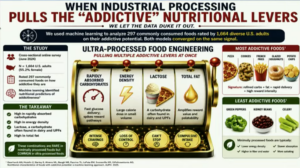
New research contained in the papers adds to evidence showing that higher consumption of ultra-processed foods is associated with increased risk of cancer, diabetes, dementia, metabolic syndrome and other health problems. The researchers reiterate in an editorial overview that 2.3 million deaths globally can be linked to ultra-processed food consumption.
The papers, which are included in the special feature section of the journal, specifically call for implementing warning labels, marketing restrictions and bans, and taxes to reduce consumption, particularly with foods aimed at children.
To “really help people reduce intake of ultra-processed foods, we need a wide range of policy options … aimed at making healthier foods more available, accessible, and affordable,” nutrition expert and New York University professor Marion Nestle writes in one of the newly published articles.
“Fed Up!”
The publication of the papers was coordinated with the launch by scientists, researchers, and public health advocates of a “science-first consumer education movement” called Fed UP!, which is “dedicated to exposing the harms of ultra-processed food and empowering Americans with clear, evidence-based information about how the modern food system impacts health.”
“The food environment has been engineered to prioritize corporate profits over public health,” Laura Schmidt, a professor in health policy studies at the University of California – San Francisco said in a statement. “People deserve honest information about how these products are designed, marketed, and made so difficult to avoid.”
Schmidt is among the group of scientists backing Fed UP! and contributing to the series of papers published Wednesday.
Along with articles exploring the links of processed foods to the tobacco industries, one article describes how major ultra-processed food corporations have influenced what the public and policymakers know about UPFs, and explores funding of nutrition research, academic institutions and scientific conferences, and leading nutrition scientists and professional bodies. Another presents evidence that production of ultra-processed foods creates pollution, biodiversity loss and greenhouse gas emissions.
Overall, the collection includes five studies examining UPF consumption and health, two studies analyzing the role of tobacco-owned food companies in shaping the UPF food system, four studies calling for immediate policy actions and six editorials discussing structural changes needed to address UPF harms.
The papers meld data from prior studies and observations about UPF and impacts on health and aim to be a timely catalyst for policy changes, publishing as the Make America Healthy Again (MAHA) movement demands food policy moves from the Trump administration.
Savory snacks and sweets
Those calling for change have an apparent ally in Trump’s Health and Human Services Secretary, Robert F. Kennedy Jr., who has long railed against ultra-processed foods and has pushed for reduction in artificial dyes and other chemicals in foods.
In January, Kennedy and US Department of Agriculture Secretary Brooke Rollins released new dietary guidelines that called for “dramatically” reducing highly processed foods.
And last year, the Centers for Disease Control and Prevention published a study examining food consumption from 2021-2023 and finding that about 55% of total calories consumed by Americans 1 and older came from ultra-processed foods. For children, it was nearly 62%.
Sandwiches, sweet bakery products, savory snacks, and sweetened beverages were among the top sources of calories from ultra-processed foods among youth and adults, according to the study.
The publications and push for new policies comes as various states also work to tackle unhealthy food consumption.
Last month, the California State Assembly passed a measure that would establish a first-in-the-nation “Non-Ultraprocessed Certified” seal that food makers could use to market foods that meet the standards. The bill also would require grocery stores across California to feature products that carry the seal.
Last year, California banned ultra-processed foods from school meals, requiring compliance by 2035.
Lawmakers in states across the country have introduced more than 100 bills aimed at cracking down on sugary beverages, synthetic food dyes and/or chemicals found in ultra-processed foods, according to a POLITICO analysis.
In response, food industry leaders are fighting back, arguing that new state-by-state restrictions will make foods more expensive for consumers, limit choices and lead to job losses.
The Consumer Brands Association said in a statement on behalf of the packaged goods industry that companies “welcome fact-based conversations around nutrition”. The association has created Food Processing Facts and Truth About Ingredients websites as transparency tools for consumers regarding product ingredients and nutrition information. The Truth About Ingredients site states that it is a “myth” to say that “food processing is harmful.” The Food Processing Facts site states that “misconceptions around processed food could lead to decreased diet quality, causing consumers to miss out on vital nutrients, an increased risk of food-borne illness, greater food waste, stigmatization of cultural or critical foods such as fortified grains, dietary supplements, plant-based proteins or infant formula, and exacerbate health disparities.”
“Companies adhere to the rigorous evidence-based safety standards and nutrition policy established by the FDA [Food & Drug Administration] to deliver safe, affordable and convenient products that consumers depend on every day,” the association said.
Featured image by Andrej Lišakov for Unsplash+.