
EPA coordinated with Bayer on reapproval for controversial herbicide dicamba
Listen to the audio version of this article (generated by AI).
The US Environmental Protection Agency (EPA) worked directly with pesticide maker Bayer in approving the controversial herbicide dicamba earlier this year, presenting the company with different options for how to reduce drift and runoff and then aligning on those options in the final decision, according to internal agency records.
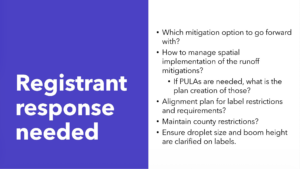
The records show that the EPA gave a presentation to Bayer in May 2025 — two months before the agency proposed to reapprove the herbicide — and put forth two options for how to mitigate dicamba drift when it’s applied at higher temperatures.
Dicamba is notorious for its ability to drift far from where it is sprayed and to thus damage other crops and landscapes. In its presentation, the EPA proposed one option that would have not allowed dicamba applications above 85 degrees Fahrenheit, while another option allowed applications at temperatures up to 95 degrees Fahrenheit as long as treatments take place on 50% or less of a farmer’s untreated dicamba-tolerant cotton and soybean acres.
Bayer chose the second option — which critics say is less protective than the first option. The EPA then cited Bayer’s chosen option in the agency’s final rule released in February 2026.
The presentation made it clear that the EPA wanted Bayer’s buy-in on tackling drift as the agency developed the dicamba reapproval. One slide in the presentation titled “Registrant response needed” asked “Which mitigation option to go forward with?”
In an internal EPA email, Lindsay Roe, a branch chief from the agency’s Office of Pesticide Programs, wrote that “the next step in the process beyond the [presentation] is getting feedback from the registrants on what mitigation and mitigation implementation option they would like to move forward with.”
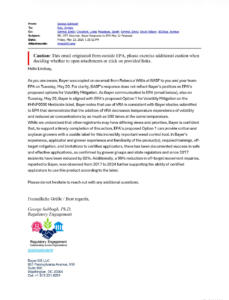 A week after the presentation, George Sabbagh, a regulatory engagement lead at Bayer, wrote back to Roe and others at EPA that “Bayer is aligned with EPA’s proposed Option 1 for Volatility Mitigation” for the dicamba label.
Bayer was also given three options for how to decrease the amount of dicamba runoff, and the option chosen by Sabbagh was also reflected in the final rule.
It is not uncommon for the EPA to work with pesticide companies while developing regulations and via advisory committees, and the documents don’t prove that Bayer’s choices drove the final rulemaking.
“EPA routinely meets with industry not only in developing these types of more informal arrangements but in drafting binding rules,” said Wendy Wagner, the Richard Dale Endowed Chair in Law and professor at the University of Texas. “Some of this interaction involves information gathering and analysis — industry often knows more about the nature of its activities and resulting risks than the agency.”
However, Wagner added that “several studies show that some of these communications between industry and EPA do influence EPA’s choices in a way that make them less protective,” though she could not say whether that was the case with Bayer’s input on dicamba.
Critics say the records do show a federal agency giving deference and working hand-in-hand with the companies that it is supposed to be regulating, and further call into question the reapproval of dicamba — which in addition to drift concerns, has been linked to certain cancers.
There have been “a lot of problems with dicamba over the last decade” when it comes to drift and runoff, said Nathan Donley, environmental health science director at the Center for Biological Diversity. “And the EPA is basically allowing industry to pick the ways that those problems are mitigated moving forward. EPA is offering ‘choose your own regulation’, where pesticide companies get to tell the EPA how to regulate their products.”
The Center for Biological Diversity is part of a group of farming and environmental organizations suing the Trump administration alleging the “EPA violated its statutory duties under the Federal Insecticide, Fungicide and Rodenticide Act (FIFRA) and the Endangered Species Act (ESA) in the new use registration order” of dicamba. The agency emails and records of the presentations the EPA gave to Bayer were obtained during that litigation, which is still ongoing.
A Bayer spokesman said in a statement that the company regularly meets with agencies as part of the regulatory process – “including the EPA, USDA, FDA or any other agency that regulates our products, and some of these meetings are required by law.”
“Such interactions are not limited to registrant companies and many other groups including NGOs similarly interface with regulatory agencies,” the statement added.
The EPA did not return requests for comment on the presentation or what role Bayer played in the final decision. In its announcement for reapproval the agency wrote “this decision reflects a careful balance between protecting ecological health and community well-being and supporting farmers’ pressing need for effective weed-control tools.”
Dicamba regulatory whiplash
The February approval was yet another regulatory reversal for the controversial herbicide that has spurred lawsuits over crop and landscape damage. Dicamba has twice faced federal court-ordered bans: most recently in 2024, when the EPA was found to have violated public input requirements required by FIFRA, when the agency re-approved the herbicide in 2020.
Dicamba has been used in the US since 1967, but was largely avoided in warm months because it is volatile and drifts long distances. However, about a decade ago Monsanto and BASF developed dicamba-tolerant genetically modified crops and new dicamba herbicides, following widespread resistance to another herbicide, glyphosate, caused by heavy use on GMO crops. Previously farmers couldn’t use dicamba via over-the-top spraying on mature crops because it would kill them. The change allowed much broader use. After a few years of use on genetically modified crops, federal courts found in 2020 the EPA broke the law in approving the new dicamba products and had “substantially understated” their risks.
“EPA is offering ‘choose your own regulation’, where pesticide companies get to tell the EPA how to regulate their products.” – Nathan Donley, Center for Biological Diversity
Internal documents also showed Monsanto (acquired by Bayer in 2018) and BASF knew the system would likely damage neighboring farms and worked to block third-party testing that could alarm regulators.
Bayer and BASF have faced more than a hundred lawsuits, including a $265 million verdict in 2020 in favor of Missouri peach farmers Bill and Denise Bader, who alleged nearby dicamba spraying wiped out tens of thousands of their peach trees and ruined their farm.
Donley pointed out that some states — including Minnesota and Illinois — do not allow dicamba application when it is over 85 degrees Fahrenheit. “This has become the cutoff. When it gets hot enough out, this stuff just volatilizes. There’s no way to keep it on the field,” he said.
The second option — not chosen by Bayer for the federal reapproval — would have similarly disallowed application when temperatures were over 85 degrees Fahrenheit.
“It’s not mitigation based off of the science, it’s mitigation based off of what is palatable to the industry,” Donley said.
When announcing the approval for dicamba in February, the EPA called it the “strongest protections in agency history” for dicamba while acknowledging concerns over the herbicide’s drift and putting forth measures to curb such risks.
“Throughout the review process, farmers, workers, environmental organizations, and the public submitted thousands of comments, all of which EPA carefully considered,” the agency wrote.
The reapproval statement included several restrictions including limiting how much could be sprayed during high temperatures, cutting the annual usage amount in half, and requiring conservation measures to protect endangered species.
Trump administration working with Bayer behind-the-scenes
The records showing Bayer’s influence on dicamba reapproval are the latest evidence the EPA is working with Bayer behind the scenes on regulatory and legal issues. In June 2025, officials at EPA and top Bayer executives met to discuss “litigation” issues – including “Supreme Court Action” over its glyphosate weed killer – just months before the Trump administration took a series of steps to boost Bayer’s case at the high court, The New Lede reported.
A year later Bayer was handed a big win when the Supreme Court determined that FIFRA preempts state-law failure-to-warn claims on pesticide labels, a verdict that will have far-reaching impacts on the more than 100,000 lawsuits filed by people who developed non-Hodgkin lymphoma they blamed on exposure to Bayer’s glyphosate weedkillers.
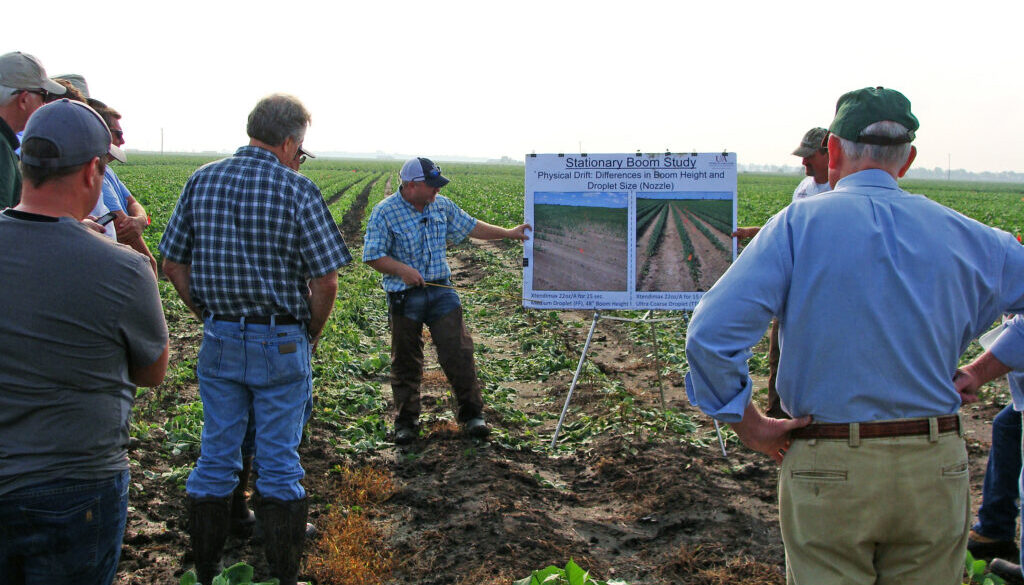
Featured image: Scientists and farmers discuss the findings from a dicamba application study in 2017. (Credit: uacescomm/flickr)




September 10, 2026 @ 7:59 pm
You don’t understand that the EPA works with organizations aiming to release a product to ensure they are safe. That means they discuss how to do things. How to develop the data to see if it is safe and what dose is safe. The EPA get annoyed when people who don’t understand the science try to cause confusion in the public. The companies have to make sure the EPA can defend their decisions. The EPA pushes back against companies but they don’t have a process to deal with the multitude of people who try to use non science against them.
September 11, 2026 @ 11:34 am
Hi Michael, Thanks for the note and for reading. I’m not sure if you saw this part:
“It is not uncommon for the EPA to work with pesticide companies while developing regulations and via advisory committees, and the documents don’t prove that Bayer’s choices drove the final rulemaking.”
I do understand that the EPA works with companies in proving safety. What these documents show is the EPA presented Bayer with options on how to deal with volatility — a major issue with dicamba — and the company’s choice became the rule. And, as I noted, they chose the less protective option. Critics say this amounts to a company being able to dictate the regulations designed to protect us.