
No safe bets – Supreme Court glyphosate case seen too close to call
Listen to the audio version of this article (generated by AI).
Monday’s Supreme Court hearing over a federal law governing pesticide regulations left observers largely unsure how the court will rule in the case involving the former Monsanto company and the herbicide glyphosate, with many seeing the ultimate decision as too close to call.
The hearing featured a barrage of questions from the justices primarily targeting the lawyer representing Monsanto and a representative from the Department of Justice, which is siding with Monsanto in the case.
Justices pressed the lawyers on many fronts, including asking how new science indicating harm associated with a pesticide should be handled after a pesticide was already approved and on the market by federal regulators. Justices also cited prior rulings that could contradict the company’s arguments.
The scope and type of questions led some who had thought the odds were strongly in favor of Monsanto and its German owner Bayer to back off those predictions following the hearing.
Tom Claps, managing director of legal and regulatory analysis at the Gordon Haskett advisory firm, sent a note to Bayer investors following the hearing lowering the company’s “odds of success” from 70% to 55%, saying the hearing “was a closer call than expected.”
“Our view is that Bayer is likely feeling somewhat less confident in its position after today’s oral argument than it was entering the courtroom,” Claps told investors in his advisory note. He noted that the justices “pushed back” on the company’s position and arguments more strongly than they did with the other side.
Consumer lawsuits at issue
Bayer has spent the last decade fighting more than 100,000 lawsuits by people who developed non-Hodgkin lymphoma they blame on exposure to Monsanto’s glyphosate-based weed killers such as the Roundup brand. The lawsuits came after the International Agency for Research on Cancer classified glyphosate as probably carcinogenic to humans in 2015.
Since then, the company has paid out billions of dollars in jury awards and settlements to plaintiffs who claim the company should have warned them and other Roundup users of a cancer risk. An estimated 60,000 cases are still pending.
In the case before the Supreme Court this week, Monsanto v. Durnell, the company asked the court to rule that under the Federal Insecticide, Fungicide, and Rodenticide Act (FIFRA), juries in state courts cannot hold the company liable for failing to warn of a cancer risk if the Environmental Protection Agency (EPA) has not found such a risk exists and has not required such a warning. The EPA’s position is that glyphosate is “unlikely” to be carcinogenic.
If the high court agrees that FIFRA preempts state actions on failure to warn, then it would make it harder for consumers to file such lawsuits, not just against Monsanto, but against other pesticide makers as well.
“Crystal clear”
In presenting the company’s argument to the court, lawyer Paul Clement told the justices that failure-to-warn claims are “preempted twice over” in FIFRA and the law is “crystal-clear that a registrant cannot change the safety warnings on a pesticide label” without EPA approval.
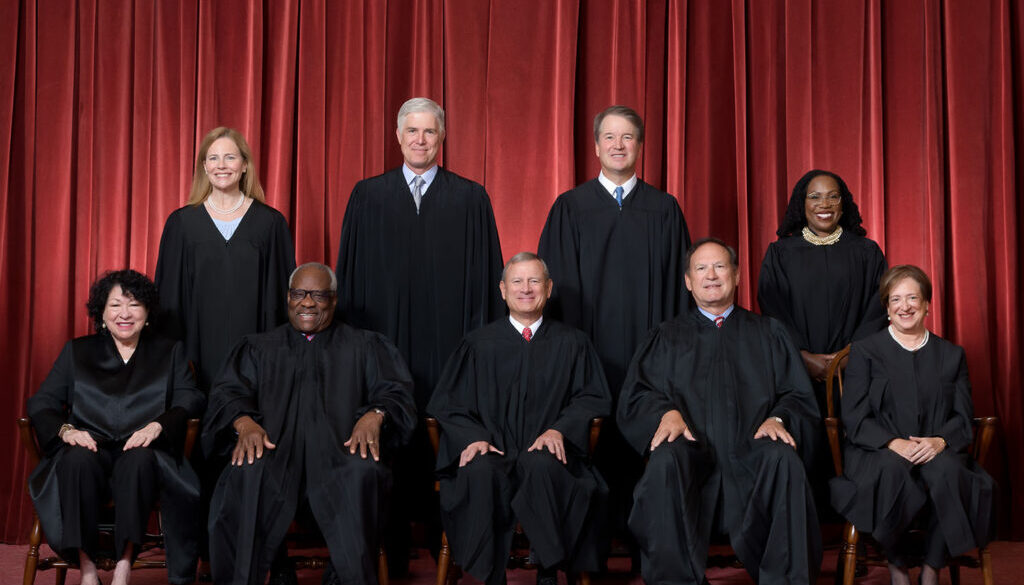
Several analysts noted that Justices Sonia Sotomayor and Ketanji Brown Jackson seemed very skeptical of Monsanto’s arguments, while Justice Neil Gorsuch and Chief Justice John Roberts also appeared reluctant to agree with the company.
In one exchange Chief Justice John Roberts pressed Principal Deputy Solicitor General Sarah Harris, who argued on behalf of the federal government in support of Monsanto’s position, about what should be done when evidence of risk arises and the EPA is bogged down in a “long process” of review.
“If it turns out that they were right, it might have been good if they had an opportunity to do something to call this danger to the attention of the people while the federal government was going through its … process,” he said to Harris.
Justice Gorsuch raised a question as to why states could legally ban a pesticide the EPA approves, but not require a warning.
In contrast, Justice Brett Kavanaugh appeared supportive of the company’s arguments, asking about needs for “uniformity” in labeling, while the leanings of the others were less clear.
Many thought Ashley Keller, lawyer for Durnell, scored well in the hearing, opening with the declaration that:
“After two briefs and a lot of podium time, Monsanto still hasn’t pointed to one word in FIFRA’s text that says the agency’s factual findings at registration create a requirement for labeling. That’s because the text repudiates that proposition in no uncertain terms. There is nothing in, by, under, or next to FIFRA that makes the registration decisions that EPA makes binding labeling requirements with preemptive force,” Keller told the justices.
No safe bets
Ricky Le Blanc, managing attorney at Sokolove Law, a firm that represents Roundup plaintiffs against Monsanto, said trying to guess how the Supreme Court will rule is a “dangerous game.”
“Based on the arguments made and the questions asked by the Justices, the only safe bet is to say that this could be a close decision,” Le Blanc said.
Erin Wood, a partner at Nachawati Law Group, which represents more than 5,000 Roundup plaintiffs, said based on the lines of questioning, the justices did not appear to already have their minds made up.
“I did not find that the totality of the questioning overwhelmingly favored either side,” she said. “I think the ultimate ruling could go either way and that the justices still likely have a bit of work to do to get to a decision.”
Prediction markets, including the popular Kalshi platform, were favoring a Monsanto win, though odds in the company’s favor slipped since the hearing.
Some observers were predicting a win for Durnell. After attending the hearing, Charles Benbrook, a longtime agricultural industry analyst and consultant to plaintiffs in Roundup litigation, said he expects the decision to be divided, but predicts a 5-4 or 6-3 decision in favor of Durnell, with Roberts, Gorsuch, Jackson, Sotomayor, and Justice Elena Kagan ruling against Monsanto.
Similarly, attorney David Wool, who attended the oral arguments in person, said while the court was clearly divided, he also expects a ruling against Monsanto.
“I think a majority of the justices will concur that, through FIFRA, congress intended that pesticide manufacturers like Monsanto are always responsible for the adequacy of their labels,” said Wool, who represents several hundred Roundup plaintiffs.
Stanford law professor Nora Freeman Engstrom, who serves as co-director of the Deborah L. Rhode Center on the Legal Profession, said that regardless of how the court rules, the litigation could continue.
“Even if Bayer convinces the majority of the court that [FIFRA] preempts plaintiffs’ failure-to-warn claims … plaintiffs have several other claims they can assert, including claims for negligence, design defect, negligent misrepresentation, and fraud,’” Engstrom said. “So a victory for Bayer may narrow the litigation; it won’t end it.”
A ruling is expected by late June.
Read the full transcript of the April 27 hearing.
Featured image: Fred Schilling, Collection of the Supreme Court of the United States


May 5, 2026 @ 7:29 am
As a client I know first hand the damage Round up causes. Suffering from stage 4 lymphoma and going through treatments for the past 4 plus years is no laughing matter. I only pray that the Justices find in our favor. My treatments have run over 1 million dollars with lifetime treatments to continue as a preventive measure. Looking at the side effects I wish I’d never used this poison.
April 30, 2026 @ 1:01 pm
Just don’t understand why Roundup hasn’t been removed. All the damage and it’s still being sold. Roundup is dangerous, and nobody seems to give a rodent’s rear. Thanks to Carey Gillam and her efforts to get all this out in the open.