Proposed EPA rollbacks would put communities at greater risk for chemical disasters, workers and advocates warn
WASHINGTON — Workers, lawmakers and environmental advocates gathered this week to speak out against a proposed federal rule that would roll back protections for people who live near hazardous facilities across the country.
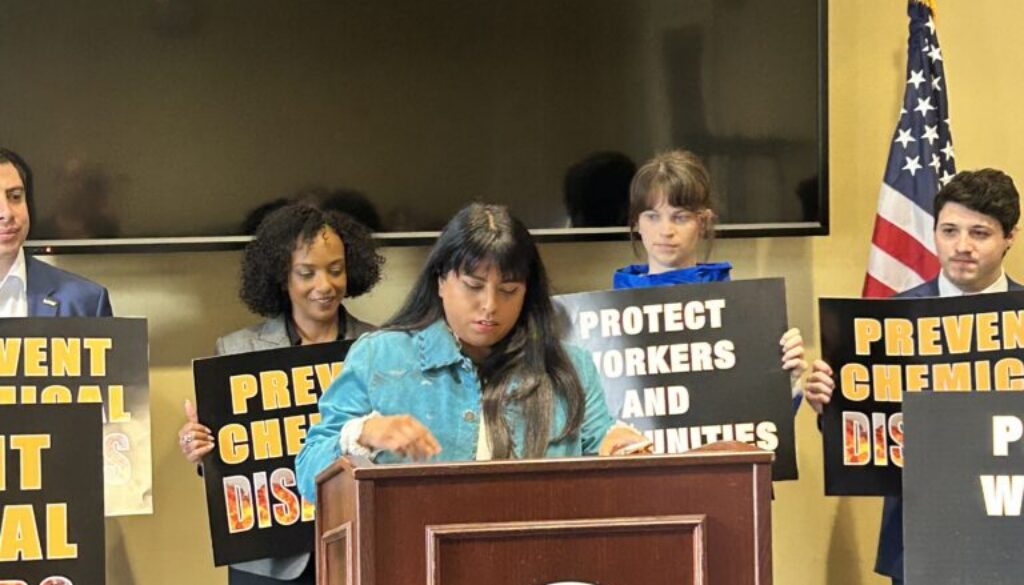
“This is just the latest example of how this administration will do whatever it can to put industry profit over the health and safety of workers, first responders and communities that allow those companies to exist in the first place,” US Rep. Paul Tonko, a Democrat from New York, said during a March 25 press event on Capitol Hill in Washington, DC. The event was organized by the Coalition to Prevent Chemical Disasters, an alliance of community, environmental, and labor organizations working to strengthen federal regulations to prevent chemical disasters.
In 2024, the US Environmental Protection Agency (EPA) published the Safer Communities by Chemical Accident Prevention rule, which revises the agency’s Risk Management Program (RMP), established in 1996, to better protect communities from catastrophic chemical releases and explosions by requiring facilities to identify safer technologies and chemical alternatives, put in place safeguards, investigate incidents more thoroughly and conduct third-party audits.
It also called for notification systems to warn communities about toxic chemical releases, evaluating natural hazard risks and increasing transparency by giving local communities access to facility information.
Most of the rule’s new safety measures, which would apply to over 11,000 facilities across the US, would go into effect in 2027.
But in February the Trump EPA instead proposed the Common Sense Approach to Chemical Accident Prevention rule, which would rescind or modify most of the accident prevention changes finalized in 2024 and roll back most of the provisions to make facility information more publicly available, among other changes. The EPA’s website says the proposed rollbacks would reduce the regulatory burden for facilities, provide clarity and remove regulatory requirements it considers redundant or unnecessary.
“The proposed revisions would ensure long-term information access to the public to promote community response planning and preparedness while balancing site security concerns,” says the agency’s website.
If finalized, the EPA estimates the rollbacks would cut annual costs by over $200 million. The agency has extended the comment period for the proposed rule to May 11.
Industry has expressed support for the rollbacks. Rebecca O’Donnell, the associate director for process safety & occupational health at the American Chemistry Council (ACC), said at a March 10 public hearing that in 2024, ACC members reported a record low number of unplanned chemical releases, with a 22% decrease since 2017.
However, critics point to the millions of Americans living near hazardous facilities and recent accidents as evidence that the US needs more — not less — protections.
An estimated 177 million Americans – over half the US population – live in the “vulnerability zones” of high-risk industrial facilities, putting them at risk in the event of a chemical accident. Between 2004 and 2020, over 19,000 people were injured and 90 died from incidents at these facilities, according to the group Earthjustice. A 2014 report by the Center for Effective Government found that one in three US children attend a school located in a vulnerability zone. That report came on the heels of a 2013 fertilizer facility explosion in West Texas that killed 15 people, injured over 200, and destroyed more than 150 buildings, including three schools.
More than a decade later, many communities continue to live in the shadow of industrial plants they say lack adequate safeguards.
Nalleli Hidalgo, a community outreach organizer for the group Texas Environmental Justice Advocacy Services (T.e.j.a.s), said at the press event Wednesday that there are over 200 facilities that work with hazardous chemicals in Harris County, Texas, where she lives.
Recent accidents in other communities have spotlighted many residents’ ongoing concerns as the proposed rollbacks loom.
Earlier this month, the Silfab Solar facility in Fort Mill, South Carolina, experienced two leaks in a single week – first, potassium hydroxide solution, which can cause severe burns, and later hydrofluoric acid, which can cause serious tissue damage and extreme respiratory tract irritation.
Both the company and county officials say the spills do not pose a threat to the public, and Silfab Solar resumed operations after assessments by the state’s environmental services department and the EPA, although state regulators say the facility will cease operations that use the two leaked chemicals until the company enters an agreement to work with an engineer who will keep regulators informed of any future leaks.
The facility sits just a few hundred yards from an elementary school, which was closed for two days after the second leak.
And just this week, on the evening of March 23, an explosion at a Valero refinery in Port Arthur, Texas rattled community members and allegedly injured a worker who filed a lawsuit in a state district court Wednesday alleging the company has not properly maintained the facility.
Phillip Stagg, a process safety specialist and vice president of a local chapter of the United Steelworkers trade union, said at the press event that he was home at the time of the explosion and felt his house shake. Stagg said he worries about how insufficient regulations for hazardous chemical plants impact communities – his child attends a school 2,000 feet away from another facility in the area, he said.
“When an explosion happens, or a chemical release, that gate is not some magic barrier that stops everything,” said Stagg. “We feel that transparency is what these companies need to be showing. It’s not like we’re asking for trade secrets. If a safer alternative was put on the table and the company declines it, I feel like people have a right to know that.”
Featured image: Environmental justice advocate Nalleli Hidalgo speaks at a press event in Washington, DC. (Credit: Shannon Kelleher/The New Lede)