
Hundreds of groups urge Congress not to weaken chemical safety law
Listen to the audio version of this article (generated by AI).
Hundreds of environmental and health groups are urging Congress not to weaken the nation’s premier chemical safety law as Republican lawmakers signal a willingness to reopen the Toxic Substances Control Act (TSCA).
For months, environmental and health advocates have braced for a congressional bill that would weaken health protections in favor of quicker regulatory risk assessments of chemicals. More than 250 groups recently sent a letter to congressional leaders pleading with them to reconsider any such action, which they say would be a “historic step backward in protecting Americans.”
“We understand that the chemical lobby is pressuring members to reopen TSCA and weaken the protections it provides,” the letter states. “Doing so would directly undermine public health protections and erase much of the progress our nation has made to shield people from dangerous chemicals.”
TSCA is the federal law under which the US Environmental Protection Agency (EPA) evaluates chemicals to make sure human and environmental health will be protected before chemicals are put into the marketplace.
“We understand that the chemical lobby is pressuring members to reopen TSCA and weaken the protections it provides.”
The bill was updated in 2016 with bipartisan support. However, since President Donald Trump took office, Senate and House Republicans have consistently echoed industry concerns that TSCA requirements stifle chemical innovation and American competitiveness, citing lengthy delays in chemical reviews. In October, House Republicans said they were working on draft TSCA legislation, which has yet to be released.
The letter — signed by a mix of state, local and national groups — said “there is more need than ever for strong protections from toxic chemicals” and points out that the 2016 amendments to the law came after decades of “inaction” on toxic chemicals, including the greenlighting of chemicals that were later shown to have serious health concerns such as per- and polyfluoroalkyl substances (PFAS).
“In 2016, one of the public health advancements that Congress made was to change the way that new chemicals were treated when they came before the EPA for review,” said Liz Hitchcock, director of Safer Chemicals Healthy Families at Toxic-Free Future, which signed the letter.
Before 2016, if the EPA didn’t act on a submitted chemical within 90 days then the chemical could go on the market, Hitchcock said.
“We had thousands of chemicals on the market with very little review and that led us to the proliferation of PFAS chemicals, for example,” she said. “Congress recognized in 2016 that the process did not protect public health and so they moved forward to a system where the EPA had to take an action on a chemical to say if it was harmful to public health.”
Labor, industry groups weigh in
The letter echoed concerns that were in a separate letter sent from labor groups, including the American Federation of Labor and the Congress of Industrial Organizations (AFL-CIO), to the House Committee on Energy and Commerce in October saying the organizations were “deeply concerned about recent discussions regarding implementation of and potential revisions to” TSCA.
“If anything, EPA needs to make the review process more transparent,” the AFL-CIO and others wrote.
Industry, too, has weighed in. More than 100 industry groups sent a September letter to Senate leadership outlining the need to improve TSCA and balance “human health and environmental concerns with domestic supply chain and innovation needs.” The letter called for more timely and predictable chemical reviews, and fewer “unnecessary” regulations, among other asks.
When asked about industry complaints of lengthy reviews, Sandy Wynn-Stelt, co-chair of the Great Lakes PFAS Action Network — which also signed the recent health groups’ letter — said “I don’t know how you decide what is the appropriate length to save human life.”
The Great Lakes PFAS Action Network is made up of people who have been impacted by PFAS pollution.
“We signed onto the letter because we have experienced firsthand what happens when we don’t have strong chemical regulations in our country,” Wynn-Stelt said. “I myself lost my husband because of the PFAS contamination … I’ve had cancer because of this. I recognize the importance of making sure that we have really strong regulations in place.”
Industry groups also say it is a good time to revisit TSCA as the law’s fee authority — which is what allows the EPA to charge chemical companies to help pay for chemical reviews — needs to be renewed in 2026.
“The fee renewal can be done without reopening TSCA,” said Alexa White, a policy director at the Hip Hop Caucus, which signed the letter. “We want Congress to draw a bright line against using an industry driven reauthorization push to weaken protections beyond fees, including changes that could undercut state authority through expanded preemption.”
EPA already weakening TSCA
In addition to a potential reopening of the law, the flurry of lobbying letters has come as the EPA chips away at TSCA. The agency last year proposed removing TSCA amendments made in 2024 under the Biden administration, including removing an amendment that required the agency to consider every use and exposure route of a chemical when evaluating risk; scaling back how much information manufacturers need to provide for a proposed chemical; considering personal protection and safety equipment use when evaluating workplace chemical risks; and allowing the agency to determine if certain uses of a chemical carry unreasonable risks instead of making a single risk judgment based on all of the chemical’s uses.
“The fee renewal can be done without reopening TSCA. We want Congress to draw a bright line against using an industry driven reauthorization push to weaken protections beyond fees.” – Alexa White, Hip Hop Caucus
The EPA, which received more than 26,000 comments on the proposed changes, hasn’t enacted the proposals yet. Several health and labor groups said the changes would leave workers and everyday Americans more vulnerable to hazardous chemical exposure.
In another hit to TSCA, the EPA proposed a rule last November that would reduce PFAS reporting requirements for industry, removing “crushing regulatory burdens and nearly $1 billion in implementation costs on American businesses,” said EPA administrator Lee Zeldin in an accompanying statement.
Madison Dennis, a project manager at the Plastic Pollution Coalition, which signed the health groups’ letter, said chemical innovation should “not be at the cost of frontline communities.”
“It cannot be at the cost of future babies who will be born with plastics and plastic chemicals in their bodies,” she added.
The letter sent to Congress from Plastic Pollution Coalition and others said that many states have put forth their own restrictions and regulations on harmful chemicals like PFAS and flame retardants, and that reopening TSCA would “threaten these hard-won gains and jeopardize states’ ability to regulate on behalf of their citizens.”
“We are recognizing the damage that toxic chemicals are causing to our communities, and this is the time when we ought to be doing more — not less — to protect our communities from chemical threats,” Hitchcock said.
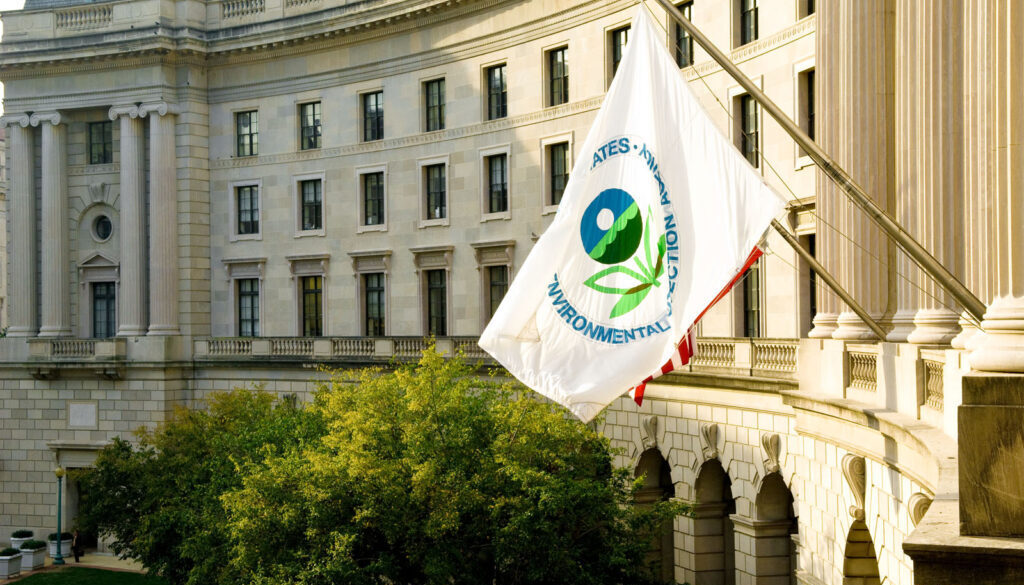
Featured Image: US EPA headquarters in Washington, DC. (Credit: US EPA. Public Domain, via Wikimedia Commons.)




January 12, 2026 @ 5:56 pm
I’d like to know if there is any legal documentation of asbestos removal at the White House demolition site. I read they were dumping stuff at a park in DC.
January 13, 2026 @ 8:28 am
John — thanks for reading and for writing in.
It looks like the Asbestos Disease Awareness Organization recently filed a lawsuit seeking records related to the asbestos disposal during the October 2025 demolition of the White House East Wing.
https://www.asbestosdiseaseawareness.org/newsroom/blogs/why-adao-filed-foia-lawsuit/
It also looks like the White House has been ignoring the previous FOIA requests (which is why ADAO filed suit). We’ll definitely be following this and I appreciate you bringing it to our attention.