
Top US lobby firms profit on both sides of the PFAS fight, report finds
Listen to the audio version of this article (generated by AI).
Several major US lobby firms that are working for chemical industry interest groups to fight against strict regulation of harmful “forever chemicals” in drinking water are also representing local governments wrestling with health and water quality issues stemming from the contamination, according to a new report.
The report, released Tuesday from F Minus, a nonprofit organization that tracks lobbyists, and the children’s health and climate justice organization Mothers Out Front, reviewed 2024 and 2025 federal lobbying disclosure forms and found that four lobbying firms that have chemical industry clients — Holland & Knight, CGCN Group, Mehlman Consulting, and Marshall & Popp — also represented several healthcare organizations and nonprofits that advocate on behalf of people dealing with cancer and other health problems that are linked to per- and polyfluoroalkyl substances, or PFAS. In addition to some cancers, PFAS have been linked to high cholesterol, decreased immune response to vaccines, liver damage, thyroid problems, reproductive issues and other health issues.
“We were astonished to see how successful some of the firms have been simultaneously representing chemical interests and then also representing local governments who are coping with the impacts of forever chemicals in their drinking water,” said James Browning, founder and executive director of F Minus.
“We were astonished to see how successful some of the firms have been simultaneously representing chemical interests and then also representing local governments.” – James Browning, F Minus
There is currently a patchwork of state regulations for PFAS in drinking water, which can directly impact local governments and their water utilities. At the federal level, the US Environmental Protection Agency (EPA) last month proposed dropping limits for four PFAS in drinking water established during the Biden administration, saying the changes were rushed and not in compliance with federal law. The American Chemistry Council (ACC), a client of multiple firms in the new report, had previously filed a joint lawsuit along with the National Association of Manufacturers against the EPA over the regulations.
The New Lede contacted all lobbying firms mentioned in the report and none returned requests for comment. However, F Minus published a similar report in March that focused on PFAS lobbying conflicts of interest in six states, and in response to that report, Holland & Knight told The Guardian that the firm follows “rigorous ethics and conflict-review procedures” and said the report was based on the false premise that assumes lobbying firms are advocating on clients’ behalf on every policy issue.
Browning and colleagues, however, say these conflicts of interest show that major US lobbyists are following the chemical industry’s playbook of opposing regulations to limit PFAS pollution, while also advocating for public funding to treat PFAS-contaminated water.
“Communities dealing with the economic and health impacts of PFAS face a perverse obstacle in the fight to regulate these chemicals: their own lobbyists, some of whom are profiting off both sides in the PFAS fight,” the report states.
The report alleges Holland & Knight has some of the most egregious client conflicts of interest. The firm represented The Chemours Company, Corteva Agriscience and the ACC, which has been one of the most vocal opponents of federal PFAS regulation.
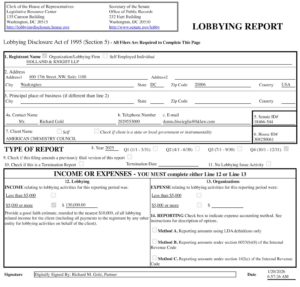 Holland & Knight received $520,000 from the ACC for work on issues related to “plastic and polymer composite intensive vehicles; lightweight plastic and polymer composite provisions,” according to its lobbying disclosure. Chemours paid Holland & Knight $380,000 for work on issues including the Clean Air Act and PFAS water regulations.
Meanwhile, the firm also represented 34 local governments, including three on issues related to water infrastructure and cleanup, including Savannah, Georgia, which is suing 65 PFAS makers; and Cincinnati, Ohio, which has been dealing with elevated PFAS levels in its water.
Other clients included 14 healthcare clients as well as several health-focused nonprofits such as the American Cancer Society Cancer Action Network and the Black Women’s Health Imperative, both of which work on PFAS-related cancers.
Holland & Knight wasn’t alone: In 2024, the lobbying firm Marshall & Popp lobbied on “issues related to EPA health advisory levels for PFOA and PFOS” — two notorious PFAS chemicals — for 3M, which is one of the original PFAS manufacturers. The firm in 2025 lobbied for biotech company Grail, Inc. on an early detection cancer screening bill.
Mehlman Consulting lobbied for the ACC in 2025 on “issues important to the chemical industry, including per- and polyfluoroalkyl substances.” That year the firm also lobbied for 24 healthcare clients.
Alcalde & Fay received $240,000 from the Sustainable PFAS Action Network, an industry group that has opposed federal and state bills aimed at regulating PFAS, and also represented several local governments — including Coral Springs, Palm Bay and Fort Lauderdale in Florida — in upgrading water and wastewater treatment, in part, to deal with PFAS pollution. Similarly, Ballard Partners lobbied for the ACC and 3M, in addition to local governments such as Winter Haven, Florida, and Martin County, Florida, both of which are facing rising PFAS treatment costs in 2025.
Craig Holman, a government affairs lobbyist focused on ethics, lobbying and campaign finance rules for Public Citizen, said the report raises serious conflicts of interest but “whether the conflicting services cross the law depends on who in the lobbying firms are actively involved.”
“If the lobbying firms establish a firewall between lobbyists working different sides of the same issue, then the firm is not necessarily breaking any legal obligations,” he said. “Nevertheless, it seems far more than likely that information is being shared among the lobbyists in the firm, and that … would violate the trust of the firm’s opposing clients.”
“If the lobbying firms establish a firewall between lobbyists working different sides of the same issue, then the firm is not necessarily breaking any legal obligations.” – Craig Holman, Public Citizen
Jenny Zimmer, the co-executive director at Mothers Out Front, said there’s a reason why “you don’t hire the same lawyer to prosecute and defend in a case and why you have a separate buying and selling agent in a real estate purchase.”
“Hopefully this report helps shine a light on that conflict of interest and supports our local leaders and advocates to choose lobbyists who are really on their side,” she added.
“Desperate for any kind of help”
Browning said local governments are often desperate for help in getting funding and these high-profile firms “have relationships with key people in Congress and at agencies like the [Environmental Protection Agency].”
“There’s a real danger that these local governments who are so desperate for any kind of help to cope with this problem, don’t necessarily have all the information they need to make a good decision here,” he said.
Zimmer said she acknowledges that organizations and local governments may seek top lobbyists with connections, but she cautioned that “access does not necessarily equal influence.”
“If we’re choosing that level of access over dedication to prioritizing our families and community’s health and safety … that’s a problem,” she said.
Featured image: A Michigan contractor collecting a raw water sample for PFAS analysis from a resident’s basement. (Credit: Department of Environment, Great Lakes, and Energy)