Groups cite potential “devastation” ahead of looming Supreme Court pesticide case
America could face foreign attacks, food shortages, and agricultural “devastation” if the US Supreme Court rules against Monsanto in a closely watched case over pesticide regulation that is set for arguments later this month, according to a series of legal briefs supporting the company.
In contrast, opposing legal briefs warn that if the court sides with Monsanto, consumers will be stripped of their rights to sue when they develop cancer or other serious diseases they attribute to exposure to dangerous chemicals. Companies will be able to hide product risks with little accountability, they warn.
The case in the Supreme Court spotlight centers on glyphosate – a widely used weed killing pesticide that has long been a favorite of farmers, but also has been scientifically linked to cancer in multiple studies.
The court’s task is to determine if federal law essentially preempts states labeling requirements for products that could cause harm.
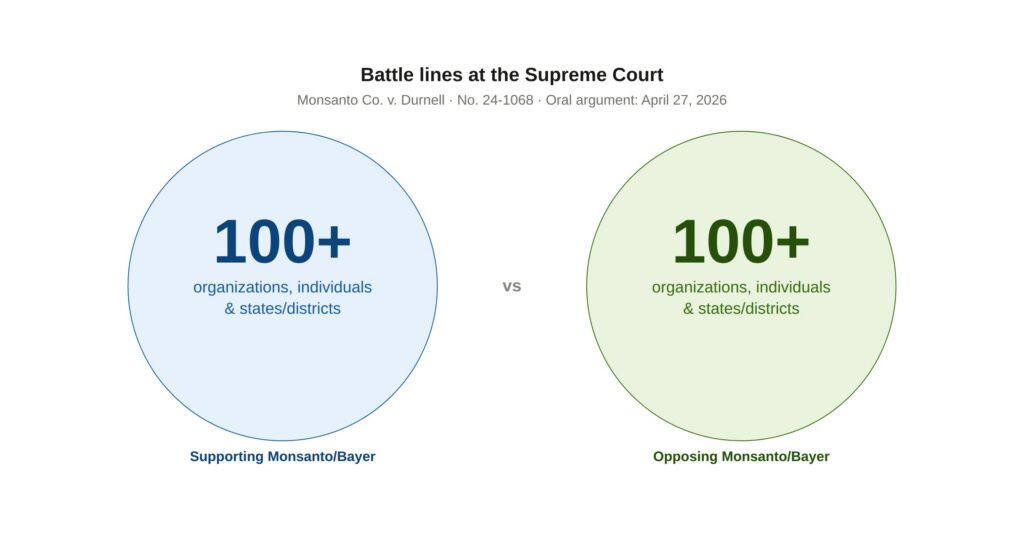
The issue is galvanizing people across the US, spurring arguments that cross political lines. Hundreds of organizations and individuals, including elected officials from dozens of states and former high-ranking federal officials, have filed lengthy legal briefs detailing arguments they hope will sway the court’s decision.
Many have also been vying – via a Supreme Court “lottery” – for a ticket to watch the April 27 hearing in person. And members of the Make America Healthy Again (MAHA) movement are planning a “People vs. Poison” rally outside the courthouse they hope will draw thousands of protesters.
 “It’s an important case,” said Allen Rostron, associate dean of the University of Missouri-Kansas City School of Law. “I’d characterize it as one significant battle in a much wider and longer war over these kinds of issues about how best to balance interests in public health and safety against other concerns.”
Core of the case
Monsanto, owned by the German conglomerate Bayer since 2018, believes a ruling in its favor would help put an end to lawsuits brought by people who say using Roundup herbicide and other glyphosate products caused them to develop cancer, and Monsanto failed to warn them of the cancer risk.
After losing multiple jury trials, the company has paid billions of dollars to resolve the bulk of the lawsuits and is proposing to spend another $7.25 billion toward a class action settlement as thousands of cases are pending.
The core of Monsanto’s case before the Supreme Court is its position that under the Federal Insecticide, Fungicide, and Rodenticide Act (FIFRA), it cannot be held liable for failing to warn of a cancer risk associated with its products if the Environmental Protection Agency (EPA) has not found such a risk exists and does not require a warning.
“EPA has determined that glyphosate and Roundup do not cause cancer and that a warning stating otherwise is neither required nor permitted under FIFRA,” the company states in its brief to the court. “An oversaturation of warnings for minor or non-existent risks will deter beneficial uses of the pesticide.”
In taking up the case, the court said it will specifically examine whether FIFRA preempts a “label-based failure-to-warn claim” when the EPA has not required the warning.
Citing precedent
More than 100 individuals and organizations have filed briefs opposing Monsanto’s position, arguing that federal law clearly carves out space for separate state labeling requirements, including for warnings of product risks.
They point to lower court rulings and a 2005 Supreme Court ruling on the issue. Establishing a new interpretation of FIFRA preemption would effectively immunize manufacturers of dangerous products from accountability, they say.
Attorneys General for the states of Texas, Florida and Ohio cited the 2005 case in a brief urging the court not to rule for Monsanto, and saying “preemption through federal agency action poses particular threats to state sovereignty.”
Many opponents also say in court filings that the EPA has a track record of failing to properly regulate chemicals found to be harmful to human health, and point out that the EPA’s most recent review of glyphosate safety was vacated by a federal court after the court determined the agency’s assessment was not scientifically sound.
The EPA “is a paradigmatic example of a captured agency, which has required decades of dogged public interest litigation to force it to comply with its most basic duties,” a brief filed by the Center for Food Safety and other public health groups states.
Eight high-ranking former EPA officials are also arguing against Monsanto’s position, as are a group of scientists, whose legal brief warns of health hazards they say are posed by glyphosate.
US Sen. Cory Booker filed his own amicus brief, telling the court that Monsanto is attempting to “pervert FIFRA by recasting the statute not as the one Congress actually wrote -a floor for what pesticide manufacturers must do to register pesticides with the federal government – but rather the one Petitioner wishes it had written: a … ceiling on consumer safety that bars state tort actions. Such a reading was neither contemplated nor intended by Congress,” Booker’s brief states.
Another group in opposition – Stand for Health Freedom – made a similar argument, stating in its brief that federal law treats regulatory approval of a product as the “beginning of a duty to warn, not the end.”
Multiple farmworker groups also weighed in, pointing to what they say are “significant gaps” in EPA requirements for scientific evaluation of pesticides.
“The agency is only beginning to assess the health risks to children from exposure to pesticide dust and vapors that move away from the fields to schools, homes, and playgrounds,” a brief filed by farmworker groups states. “EPA has, therefore, made registration decisions and accepted manufacturer labels without assessing potentially serious toxic effects and exposures that Congress directed it to address.”
Lawyers for plaintiffs in the Roundup litigation have also joined in, filing a joint brief with lawyers representing plaintiffs suing another pesticide company, Syngenta. In their filing to the court, the plaintiffs’ lawyers cite evidence that both Monsanto and Syngenta have withheld evidence of the danger of their weed killing products from the EPA.
“Accepting Monsanto’s position would allow manufacturers to invoke EPA’s silence as a defense, even when the manufacturer failed to disclose material safety information to the agency,” their brief states. “That concern is concrete here: Amici’s cases include evidence that Monsanto and Syngenta suppressed studies and withheld data from EPA, contributing to the absence of warnings on the labels they invoke as preemptive.”
Dire consequences
In contrast, many in the “pro-glyphosate” groups, as some refer to themselves, equate a loss on the labeling issue with forcing glyphosate from the market and argue that without glyphosate, the nation’s food production would be in jeopardy.
“To remove glyphosate from the market would pose an immediate, devastating risk to America’s food supply,” several farm groups warn in their legal brief.
Others cite what they say is a robust record of glyphosate safety, and say juries cannot penalize companies for failing to put warnings on their labels when the EPA doesn’t require them.
“After extensive study of the relevant science as part of multiple pesticide registrations and registration reviews, EPA has determined that the science does not support a warning that glyphosate causes cancer and has approved a pesticide label that intentionally omits such a warning,” Croplife America, a lobbyist for the agrochemical industry, said in its amicus brief. “Monsanto cannot modify that approved label without EPA’s prior approval.”
In addition to Croplife, supporters include the Atlantic Legal Foundation, the National Agricultural Associations, the Agricultural Retailers Association, and several other legal and business groups, including the US Chamber of Commerce and American Tort Reform Association, the American Chemistry Council and the Pharmaceutical Research and Manufacturers of America.
Attorneys General for 15 states also are urging the Supreme Court to side with Monsanto, saying “glyphosate safely increases their farmers’ crop yields because glyphosate is one of the least toxic herbicides currently available.” They cited “EPA’s repeated evaluation of glyphosate and its repeated conclusion that glyphosate does not pose cancer risk.”
Missouri Republican State Sen. Jason Bean filed a brief favoring Monsanto that represents over 30 other elected officials from Missouri, Kansas, North Dakota, Iowa, Kentucky, Arizona, and eight Missouri agricultural organizations.
Bean’s brief argues that glyphosate is “crucial to national security and defense, including food supply security”, and warns that lawsuits against glyphosate makers, such as Monsanto, could lead to “further reliance on a foreign adversary, namely China,” which leaves the United States “vulnerable to future attacks”.
Notably, US Solicitor General D. John Sauer also filed an amicus brief favoring Monsanto, citing “EPA’s considered judgments about what warnings are actually necessary to protect public health …” and a need for “uniformity” across the country with pesticide labels.
Sauer is asking for the US government to be allowed to participate in oral arguments at the Supreme Court hearing to be of “material assistance to the Court.”
Sauer’s position is backed by President Donald Trump, who issued an executive order in February citing glyphosate as a “cornerstone of this Nation’s agricultural productivity and rural economy” and ordering that production of the pesticide be protected.
Nora Freeman Engstrom, a professor at Stanford Law School, said political pressure should play no part in the Supreme Court decision.
“The Trump Administration has made clear how it wants the Supreme Court to rule—but the court is going to read FIFRA, and, pursuant to that reading, the court is going to conduct its own preemption analysis,” she said. “In some areas, the views of the federal government are entitled to special deference. This isn’t one of those areas. In this context, the federal government’s view carries no special weight.”
Featured image by Getty Images for Unsplash+.