
Drinking water systems cite struggles with costs and timelines for cleaning up PFAS
WASHINGTON — Communities across the US are struggling to cope with impending federal requirements for eradicating two toxic PFAS chemicals from their drinking water systems, utility leaders said at a water policy conference this week.
The US Environmental Protection Agency (EPA) last year announced a proposal to delay the deadline for utilities to comply with new regulation limiting toxic types of per- and polyfluoroalkyl (PFAS) chemicals in drinking water supplies. But even with the potential for a two-year cushion – compliance for meeting new standards may be pushed from 2029 to 2031 – utilities are faltering, industry experts said.
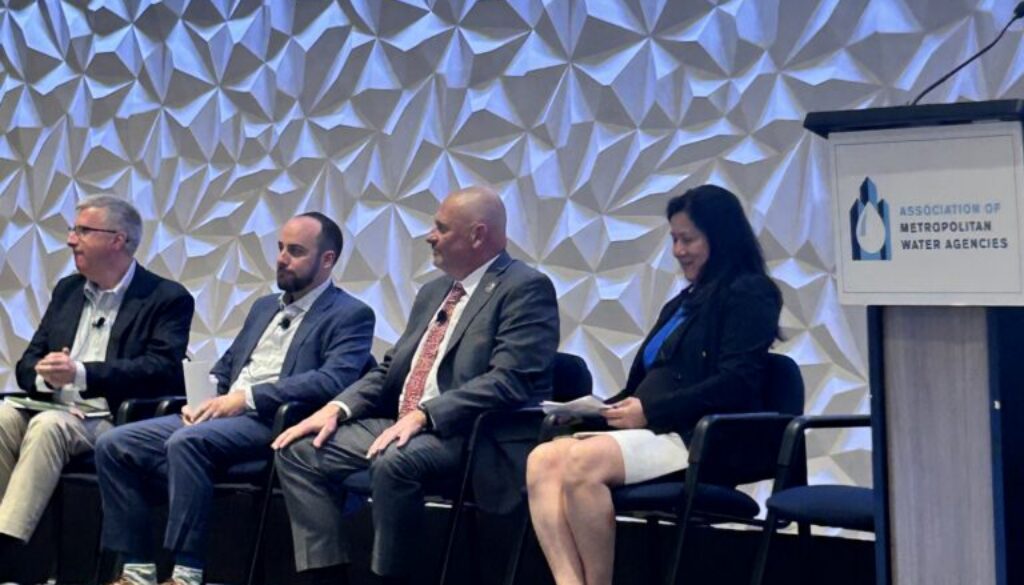
“I think a lot of utilities are feeling uncertain as to, if maybe not the levels, the timeline for compliance,” Mark White, who plans and upgrades water treatment facilities for the American engineering and construction company CDM Smith, said April 13 at an Association of Metropolitan Water Agencies (AMWA) water policy conference held in Washington, DC.
“Utilities are dealing with significant costs,” he added. “That’s at the same time utilities are also dealing with lead and aging infrastructure.”
“Utilities are dealing with significant costs. That’s at the same time utilities are dealing with lead and aging infrastructure.” — Mark White, CDM Smith
The Biden administration in 2024 finalized a rule that set enforceable drinking water standards for six PFAS chemicals, including a limit of 4 parts per trillion (ppt) for perfluorooctanoic acid (PFOA) and perfluorooctanesulfonic acid (PFOS).
PFOA has been classified as “carcinogenic to humans” and PFOS as “possibly carcinogenic to humans,” respectively, by an international cancer research group.
The rule requires utilities to test for PFAS chemicals and, if the contaminants exceed those federal limits, the utilities are required to take measures to come into compliance, which may include installing costly removal systems such as granulated activated carbon (GAC), which traps the contaminants so they can be removed during drinking water treatment.
The EPA is considering rolling back the limits for four PFAS chemicals as well as the two-year delay proposal for PFOA and PFOS — changes that are “finalizing their way through the interagency review process,” Jess Kramer, the assistant administrator for the agency’s Office of Water, said at the conference this week.
About 176 million people in the US drink PFAS-contaminated tap water, according to recent EPA data from US drinking water supply tests conducted as part of a federal testing program. Some PFAS chemicals, which are prevalent in the environment and are present in the blood of almost the entire US population, have been linked to certain cancers, high cholesterol, decreased vaccine effectiveness and other health issues.
A 2025 study by the nonprofit Environmental Working Group found most utilities lack advanced filtration systems for protecting the public from PFAS and other harmful contaminants in drinking water, with small, rural communities at the greatest disadvantage.
Tight timelines and financial challenges
In addition to making upgrades to their systems as needed to filter out PFAS, water systems utilities across the country are required to replace harmful lead pipes within 10 years beginning in 2027 – a Biden-era rule the Trump administration has indicated it will uphold.
“The ten years of lead and four to five years of PFAS is all coming at the same time,” Andrea Yang, executive director of Greater Cincinnati Water Works in Ohio, said at the conference. “It’s really difficult. That adds a big financial challenge to an already difficult technical [challenge].”
Treated water from the Greater Cincinnati Water Works’ primary facility, which relies on the Ohio River and serves over 80% of the utility’s customers, does not have detectable levels of PFOA or PFOS. However, the utility’s smaller groundwater plant has tested at PFOA levels as high as 4.7 parts per trillion (ppt) and PFOS levels up to 6.1 ppt – both above the 4ppt level put in place under the Biden administration in 2024.
The utility is preparing to install an updated filtration system to clean the PFAS chemicals out of its groundwater plant, but struggling with the costs of around $100 million in upgrades and the timeline, even with a two year delay, said Yang.
“Now I guess the deadline might be changing, which is really helpful, but even with that extension I think we’re looking at 2031,” she said. “It’s still very, very tight. The timing of this is just so difficult because our city government systems are just not built to do this kind of scale and speed of projects.”
Yang’s water system participated in multi-district litigation against PFAS manufacturers that resulted in a $12.5 billion settlement with the company 3M and a $1.185 billion settlement with DuPont and related companies in 2023.
Greater Cincinnati Water Works will receive a payout of about $30 million, which is “really good to have,” she said. Still, the utility is about to go through the process of increasing its rates to help finance its PFAS removal efforts, she said.
“It’s hard because it comes at a time when affordability is the big conversation, politically,” said Yang.
Chris Moody, chief of Water Supply and Treatment Programs at Fairfax Water in Virginia, said his community has struggled to keep up with rapid changes in PFAS health advisories, with the non-enforceable advisories for PFOA and PFOS set at 400 ppt and 200 ppt in 2009, then falling to 70 ppt in 2016 before they plummeted to the finalized enforceable level of just 4 ppt. This rapid development, plus “having a rule that kind of suddenly can drop in on you,” is “hard to plan for,” said Moody.
Moody’s Fairfax water system hopes to avoid what he says would be a nearly $400 million project to install a GAC filter by installing a less costly powder-activated carbon system and investing in efforts to understand PFAS sources upstream.
“Our city government systems are just not built to do this kind of scale and speed of projects.” — Andrea Yang, Greater Cincinnati Water Works
John Kmiec, director of Tucson Water in Arizona and a board member of the US Water Alliance, said his community has a long history of dealing with drinking water pollution. In the 1980s, they discovered harmful trichloroethylene (TEC) in their groundwater system, followed by the industrial solvent 1,4 dioxane in the early 2000s. Now, after having long treated their water for both contaminants, Tucson Water has a PFAS problem.
“It’s not going anywhere, it’s not getting lower,” said Kmiec. “In fact, it’s getting higher as the aquifer continues to rinse from whatever pr-existing use was into the groundwater table.”
So far, the main mitigation strategy used by Kmiec’s water system has been taking wells out of commission. To date, Tucson Water has removed more than 40 wells from its over 240-well system, he said.
The desert utility is also making “lemonade out of lemons” by preparing to shift towards treating its wastewater to meet drinking water standards with an advanced water purification program, a facility expected to cost over $86 million and set to begin operating in the early 2030s.
“Without a PFAS issue, we wouldn’t have to pivot in that direction so early in the process,” said Kmiec.
Ultimately, Kmiec said the Tucson community and area elected officials want to get to a point where polluters responsible for the PFAS contamination in the local aquifer “are going to eventually have to come to the table and start to clean this up,” he said. “We know that takes years, that takes decades in some cases, but we are on that pathway.”
Enough federal assistance?
Earlier this week, the EPA announced $30 million in grant funding to support technical assistance and training for small and rural drinking water and wastewater systems more generally, noting that over 90% of US drinking water systems serve less than 10,000 people.
And at the AMWA conference on April 14, Kramer announced the launch of a new EPA initiative the agency says will help connect US communities with information on funding and technical assistance to help them address drinking water contamination with harmful PFAS chemicals.
“The ‘PFAS OUT’ initiative is geared to help fill the gap for those who are going to be facing potential capital improvements or compliance challenges,” said Kramer.
The initiative is set to reach about 3,000 drinking water systems across the country struggling with PFOA and PFOS the EPA said in a statement.
Kmiec praised the EPA in a statement for developing a program to assist local utilities overburdened by PFAS pollution.
Still, the EPA initiative falls short of what is needed, according to Sarah Alexander, executive director of the Maine Organic Farmers and Gardeners Association, which is involved in combatting PFAS contamination in Maine.
“Far too many communities around the country are dealing with PFAS chemical contamination without the financial resources necessary to remove PFAS from the water supply, she said. “While EPA’s PFAS OUT initiative sounds positive, it doesn’t seem to be providing any new resources to communities dealing with contamination. The EPA largely seems to be doing marketing campaigns with this effort.”
Although PFAS OUT is “a piece of the puzzle,” public water systems need more support to help them meet the new drinking water standards, said Dan Hartnett, AMWA’s chief policy officer.
“What water systems need most is clarity on which regulations they must be prepared to comply with, and funding assistance to help them complete the job,” said Hartnett.
Featured image: Water utility leaders spoke April 13 on a panel at the AMWA policy conference in Washington, DC. (Credit: Shannon Kelleher/The New Lede)