
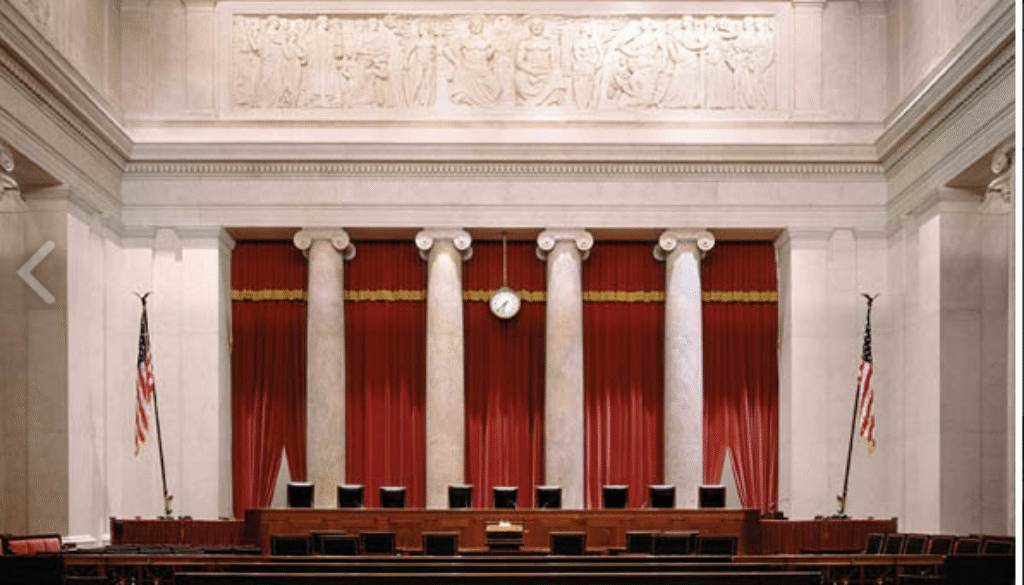
Bayer cites Trump support in Supreme Court Roundup battle
Listen to the audio version of this article (generated by AI).
In an opening salvo aimed at convincing the US Supreme Court to curtail costly Roundup litigation, Bayer is citing support from President Donald Trump and US regulators while renewing a threat to stop sales of glyphosate-based herbicides to farmers if it does not prevail with the justices.
The Supreme Court agreed in January to hear Bayer’s arguments that federal law preempts lawsuits claiming that the company failed to warn users of a cancer risk associated with its weed killers because the US Environmental Protection Agency (EPA) has not required such cancer warnings. The court said at the time it would limit its review to only that question.
But the company’s Feb. 23 opening brief makes not just a legal argument, but also economic arguments, telling the Supreme Court that “there is no such thing as a no-risk pesticide,” and that “exhaustive state-court litigation” is a disincentive for companies to engage in “exhaustive research and development” of new products.
“Congress created the right incentives by empowering EPA to strike a balance between meeting the needs of farmers and managing inevitable (but not unreasonable) risks, including through labels that neither under- nor over-warn,” the company states in its court filing.
George Kimbrell, legal director of the Center for Food Safety, said the company’s policy arguments are “irrelevant” to the precise legal issue before the court.
“They are going for the broadest possible home run swings … despite the court’s admonition that its review will be narrow,” he said.
The Center for Food Safety and a coalition of other organizations plan to file a brief in opposition to Bayer’s position next month, Kimbrell said.
“Ill-equipped” juries
Bayer has been fending off over 100,000 lawsuits since buying Roundup maker Monsanto in 2018 and so far has paid more than $11 billion in settlements and jury verdicts to tens of thousands of people suffering from non-Hodgkin’s lymphoma (NHL) they blame on exposure to Roundup and other Monsanto glyphosate-based herbicide brands. The company recently announced a proposal to spend another $7.5 billion to settle cases that remain, along with future cases that could be filed.
Several scientific studies have linked glyphosate-based herbicides, including Roundup, to cancer, and the core claims of those lawsuits are that the company failed to warn users of the risks. Internal company records revealed through the litigation showed that Monsanto engaged in a range of secret tactics to try to discredit or otherwise manipulate the scientific record, leading to hefty punitive damage awards by some juries.
Bayer maintains its glyphosate herbicides do not cause cancer. And in its Supreme Court filing, Bayer argued that juries are “ill-equipped to understand” the complexities of varying scientific assessments and said that jury members in trials over Roundup cancer claims see “only an injured plaintiff suffering an awful disease, albeit one that befalls countless Americans with no exposure to glyphosate. That jury does not see the countless farmers who benefit from using Roundup and desperately want it to remain available.”
Kelly Ryerson, a glyphosate critic and leader in the Make America Healthy Again (MAHA) movement who has developed a large social media following as “Glyphosate Girl”, said the Supreme Court should reject Bayer’s arguments.
“As someone who sat in the courtroom during each of the first three glyphosate cancer trials, this brief reeks of the same misinformation and manufactured doubt that Monsanto/Bayer has perpetrated for decades,” she said.
An EPA letter
At the heart of Bayer’s appeal to the Supreme Court are arguments that provisions within the Federal Insecticide, Fungicide, and Rodenticide Act (FIFRA) preempt the “failure-to-warn” claims being made in the lawsuits under state laws.
“For decades, EPA has assessed the carcinogenic potential of glyphosate and consistently approved both glyphosate and Roundup’s labeling without a cancer warning,” the company states in its new court filing. The EPA considers any warning that glyphosate is carcinogenic “to constitute a false and misleading statement” that violates FIFRA’s prohibition against “misbranded” substances,” Bayer states.
Bayer told the court that it has a letter from the EPA stating it would not approve glyphosate labeling containing a warning that glyphosate causes cancer.
“Through enactment of FIFRA, Congress established a uniform federal regulatory framework for pesticide labeling designed to promote the development and availability of safe and effective pesticides that are vital to American agriculture and innovation,” the company states in the filing.
“Allowing a patchwork of state regulatory regimes and empowering state-court juries to second guess the balance struck by EPA in registering pesticides undermines those critical congressional objectives,” the company argues.
Multiple courts have rejected Bayer’s argument, including two appellate courts, ruling that FIFRA does not preempt failure-to-warn claims, though one appellate court – the Third Circuit Court of Appeals – found in favor of Bayer.
Citing Trump order
The company also pointed the Supreme Court justices to an executive order signed last week by President Trump protecting production of and providing “immunity” for glyphosate-based herbicides. The executive order cited glyphosate as a “cornerstone of this Nation’s agricultural productivity and rural economy.”
Bayer said in its court filing that while it continues to sell glyphosate herbicide for commercial and agricultural purposes “for the time being,” the “economics of continuing to market the product remain in substantial doubt.”
Eliminating glyphosate herbicides “would be devastating for the agricultural economy,” Bayer writes in the court filing. “Indeed, just recently, the President underscored that the ‘reduction or the cessation of domestic production’ of ‘glyphosate-based herbicides would … hav[e] a debilitating impact on domestic agricultural capabilities.’”
The Supreme Court has set a hearing in the case for April 27.
The Atlantic Legal Foundation, a public interest law firm, filed an amicus brief with the Supreme Court siding with Bayer. “There is no disagreement that Monsanto’s Roundup label included all of the information that EPA required, and that EPA did not require, indeed rejected, the cancer label warning on which Roundup plaintiffs’ damages suits are based,” the foundation states in its brief.
Featured image source: US Supreme Court