
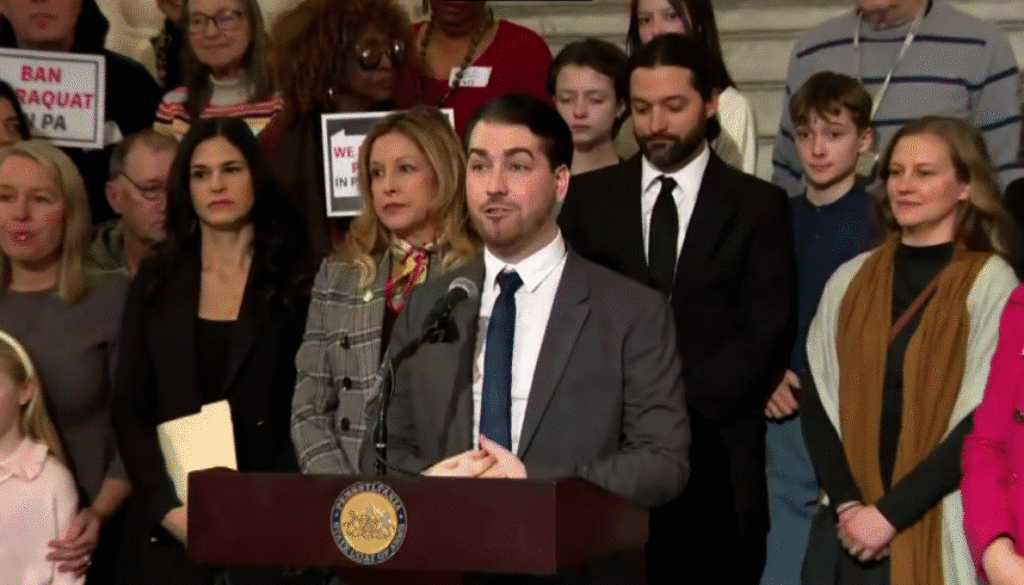
Citing Parkinson’s risk, Pennsylvania lawmakers push for paraquat ban
A contingent of Pennsylvania lawmakers and Parkinson’s disease research and support groups on Wednesday called for the state to move quickly to ban paraquat, a weed killing chemical commonly used by farmers that scientific research links to the incurable brain disease.
The move adds to growing calls around the country for action on the pesticide.
“The evidence linking paraquat to Parkinson’s disease is clear,” Pennsylvania state Sen. Devlin Robinson said in a press conference. “Studies show that working in fields where paraquat has been sprayed or even just living near fields or golf courses where it has been sprayed significantly increases a person’s chances of developing Parkinson’s disease,”.
Citing other human health risks he said are tied to paraquat, including non-Hodgkin lymphoma and childhood leukemia, Robinson said the “dangers of paraquat to human health are well established through numerous scientific studies.”
Robinson circulated legislation last month that would ban paraquat use in the state in what he and other lawmakers said is a broad, bipartisan push that includes companion legislation introduced in the Pennsylvania House last year by state Rep. Natalie Mihalek. Both Robinson and Mihalek are Republicans.
New legislation seeking bans on paraquat were introduced in January in Missouri and Vermont, and similar bills have been introduced in other states over the last two years. At least nine states are now considering partial or full bans, according to the Environmental Working Group (EWG). Many federal lawmakers have also been calling for a ban on paraquat.

The Michael J. Fox Foundation for Parkinson’s Research as well as state Parkinson’s support groups have weighed in with support for such bans, as has EWG and other health and environmental advocacy organizations.
“We have created an environment that is friendly to Parkinson’s disease because we have also created an environment, a regulatory environment, that is friendly to toxic chemicals,” Mihalek said in the press conference. “Paraquat will kill the neurons in your brain. Paraquat exposure doubles your risk of developing Parkinson disease.”
She and other speakers at Wednesday’s event pointed out that Syngenta, a longtime key global provider of paraquat, is owned by the government of China, where paraquat is banned. Syngenta manufactures paraquat in Europe, which also bans use of the pesticide.
“This legislation is about choosing people over profit,” Mihalek said. “And it is about refusing to accept a system where chemicals banned across the globe are still poisoning Americans here at home.”
Pennsylvania was to be the site of a bellwether trial for thousands of US plaintiffs suing Syngenta, alleging the company should have warned them of risks that paraquat exposure could lead to Parkinson’s. But the day before the trial was to begin last month, the parties agreed to a settlement.
Paraquat has been used in the United States since 1964 as a tool to kill broadleaf weeds and grasses. Despite growing awareness of both acute and chronic risks associated with exposure, it remains popular with US farmers for use in growing soybeans, cotton, and corn as well as in growing grapes, pistachios, peanuts and many other crops.
The chemical is known to be extremely dangerous to anyone who ingests even a small amount, and regulators have issued warnings and placed restrictions on its use because of poisoning risks. But whether or not it causes Parkinson’s disease is a matter of fierce debate. Syngenta maintains that there is no credible evidence of a connection between the disease and its weed killer.
A trove of internal corporate records that date back several decades show that Syngenta and its predecessor corporate entities have wrestled with concerns about paraquat links to Parkinson’s and other chronic health issues for decades.
The New Lede, in collaboration with The Guardian, revealed many of Syngenta’s internal files on paraquat in 2022 and 2023. The files show the company employed an array of secretive tactics to hide or downplay research linking its chemical to the disease, discredit independent research and mislead or otherwise influence regulatory decisions to protect paraquat sales.
Featured image is from the a Pennsylvania legislative livestream event held Feb. 4, 2026.