
Listen to the audio version of this article (generated by AI).
Farmers across the US are leaving potential energy lying on their fields, and have the ability to reap billions of dollars in revenue by turning animal manure, crop and food waste into natural gas, according to two industry reports released this month.
The reports point to vast, untapped potential in anaerobic digesters that use bacteria to break down large amounts of waste and turn it into biogas, which can be used for electricity or further refined into renewable natural gas (RNG) that can be used in some vehicles and as a natural gas substitute.
The reports call for federal policies and investments to promote the spread of digesters, which they say help drive down greenhouse gas emissions from large farms.
This push for a massive scaling-up comes, however, as such projects are under scrutiny by the federal government for financial delinquency and underperformance, and as environmental and health advocates criticize such projects as incentivizing larger, more concentrated farms and contributing to air and water pollution.
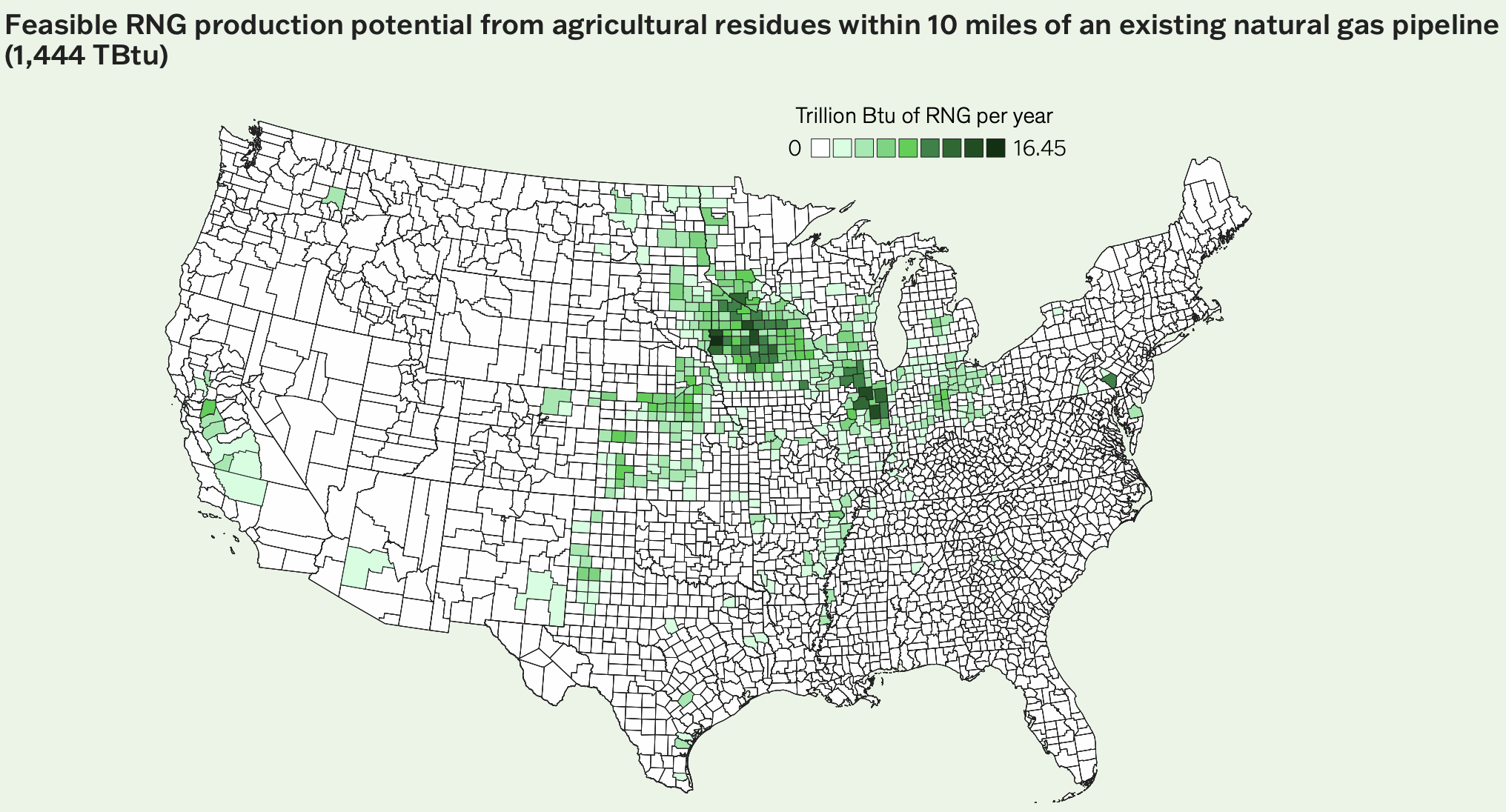
The first report — from waste-to-energy company Vanguard Renewables, which is owned by the large investment company BlackRock and operates nine farm digester projects — analyzed the availability of crop residues (plant materials such as corn stalks left in fields after harvesting), animal manure and food waste across the Midwest US that are within 10 miles of a natural gas pipeline.
The report found the potential for an additional 1,580 trillion British Thermal Units (BTUs) of energy from collecting the gas from animal manure, crop residue and food waste near these pipelines — enough to power roughly 20 million US homes annually.
This additional capacity would represent 4.3% of total US natural gas consumption and is more than eight times the current US RNG market. Capturing this gas could bring American farmers an estimated $1.1 billion to $2 billion per year, according to the report.
A second report released Feb. 24 from the American Biogas Council, which is the trade association for the biogas industry, similarly found massive potential for extracting gas from farm waste — including the potential for more than 11,000 additional systems on farms.
The report estimates there are currently 631 biogas capture systems at farms in the US, accounting for 25% of all RNG produced last year.
Patrick Serfass, executive director of the American Biogas Council, said only about 10% to 20% of the organic material from farms is currently recycled.
“That’s really where the opportunity is,” he added. “I think the question is, if we don’t do anything, are we happy with that?”
“I think the question is, if we don’t do anything, are we happy with that?” -Patrick Serfass, American Biogas Council
Kevin Fingerman, a researcher and professor of energy and climate at the California State Polytechnic University, Humboldt, said the reports’ underlying message of biogas potential in farm fields is “uncontroversial” — but “under what circumstances is it a good idea and what unintended consequences may end up happening?” he said.
“Our research has shown that these digesters are only profitable for relatively large-scale facilities,” he said. “It creates a revenue stream on the literal tail end of the cow that is only available to the largest and, historically, most polluting operations.”
Chris Hunt, a deputy director for the Socially Responsible Agriculture Project (SRAP), said once farms add a digester there’s an incentive to create more gas, “which means you need more feedstock and to add more animals.”
Hunt pointed to a 2024 report that SRAP published with Friends of the Earth US that found US dairy farms with manure digesters grew 3.7% year-over-year — vastly outpacing the growth of dairy farms without digesters.
“More animals equals exacerbating the existing problems at these facilities,” he added.
Calls for biogas-supportive policies
In its report, Vanguard Renewables argues for more government support for RNG, specifically advocating for the bipartisan Renewable Fuel for Ocean-Going Vessels Act that would allow biofuels like RNG used in ocean-bound ships to qualify for the Renewable Fuel Standard program.
“Passing the Renewable Fuel for Ocean‐Going Vessels Act would immediately expand market access and create parity for maritime fuels,” said Mike O’Laughlin, CEO of Vanguard Renewables and author of their new report.

O’Laughlin estimates that it would take between “$120 billion to $220 billion of investment in production capacity and delivery infrastructure” for RNG to fuel ships, and encouraged public-private partnerships to make it happen.
Serfass said other policies would boost the RNG market as well, including incentivizing the use of biogas to produce electricity. “There’s a need for clean, reliable 24-7 power, especially for data centers, but also just for the country in general,” he said. “We’re hoping to see more of a shift to electricity production from biogas projects.”
Fingerman said existing policies — including California’s Low Carbon Fuel Standard, where a lot of biogas emissions reductions are sold — amount to a large subsidy to CAFOs “for cleaning up a point-source of emissions that a lot of people would argue shouldn’t have been there to begin with.”
Hunt said such policies also “further entrench the US in oil and natural gas.”
“Those scarce public resources would be better put toward other solutions, such as solar, that don’t come with public health threats,” he said.
Federal scrutiny of anaerobic digesters
The industry reports come a month after the US Department of Agriculture (USDA) announced a 90-day pause on agency loans for anaerobic digester projects, citing underperformance, loan delinquency and operational failure.
An analysis of USDA data from The New Lede found four anaerobic digester loans in delinquency that total $102.6 million — with $100.1 million of the delinquent loans belonging to the Wisconsin biogas project called BC Organics, via two loans awarded in 2021 during the Biden administration. The only other USDA loans for anaerobic digester projects in delinquency are $891,179 for Dovetail Energy LLC in Ohio, and $696,492 for Ringler Energy LLC in Ohio, according to the USDA’s Lender Lens portal.
Serfass said the loan USDA pause is “not related” at all to the ongoing viability of biogas projects. “The USDA took a massive spotlight and shined it on a couple projects that had some problems,” he said.
O’Laughlin said Vanguard Renewables views “strict oversight of federal funding as positive for the industry.”
“Our understanding is that recent delinquency issues are concentrated in specific manure-only projects associated with large CAFOs, along with a smaller number of other manure-based digesters,” he said. “Our research shows that the manure-derived [anaerobic digestion] market has begun to slow … co-digestion projects that pair food and beverage organics with agricultural feedstocks can serve a much broader set of end markets.”
In addition to loan delinquency, there is disagreement about digesters’ environmental benefit. Biogas advocates say such digesters are a climate-win, reducing methane emissions and manure land applications. Manure digesters reduced greenhouse gases by more than 13 million metric tons in 2023, according to the most recent data available from the US Environmental Protection Agency (EPA).
But critics question the purported environmental benefits. Last year Johns Hopkins University researchers reviewed the literature on manure digesters and found that, when spread on fields, digestate — the leftover materials after gas is extracted — can contaminate local waterways with phosphorus, nitrogen and pathogens.
“Digesters haven’t addressed all the pollution associated with large-scale factory farms,” Hunt said. “If anything they’ve increased it because digestate has a higher pollution concentration than ordinary manure.”
Featured image: Getty Images/Unsplash +