USDA spotlights dairy sanctioned for animal welfare violations in its “regenerative” push
Listen to the audio version of this article (generated by AI).
When Agriculture Secretary Brooke Rollins announced $700 million in new funding for a regenerative farming pilot program this week, she highlighted one farmer in particular.
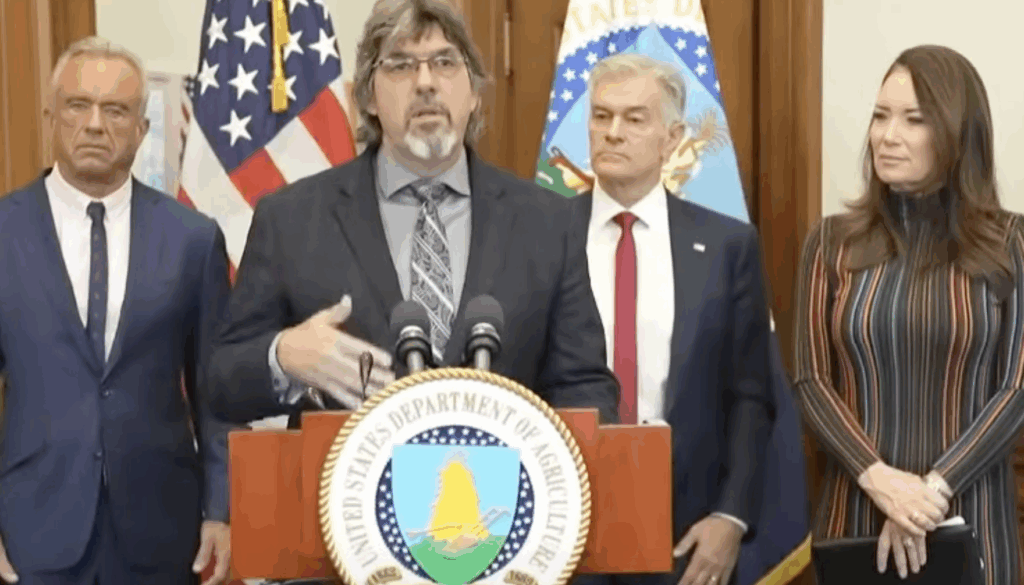
Dairy farmer Blake Alexandre, who runs Alexandre Family Farms in Crescent City, California, was introduced by Rollins during a US Department of Agriculture (USDA) press conference held Wednesday, sharing the podium with other high-ranking officials, including Health and Human Services Secretary Robert F. Kennedy Jr. and the Centers for Medicare & Medicaid Services Administrator Dr. Mehmet Oz.
Alexandre told those gathered that he is attempting to “help spread the message across the country” about the benefits of regenerative farming, noting his was the first US dairy farm to be certified as “regenerative organic.”
“Regenerative farming is simply farming in harmony with nature, with the way that God intended … making our planet a better place,” Alexandre said in the press conference.
“Regenerative farming is simply farming in harmony with nature, with the way that God intended … making our planet a better place.” – Blake Alexandre, Alexandre Family Farms
What neither Alexandre, nor the USDA noted, however, was that the Alexandre Family Farm was recently under investigation for a long list of alleged animal welfare violations and other complaints, agreeing to a two-year settlement program that provides for two years of “additional oversight and monitoring.”
“The administration chose as its poster child a dairy that markets itself as raising animals ‘in harmony’—even though a USDA investigation … confirmed multiple violations of organic and animal‑welfare standards,” Matthew Dominguez, US executive director for the animal welfare organization Compassion in World Farming, said in a statement.
“Systemic failures”
The USDA said in a 2024 investigation report that it substantiated some of the allegations and found “systemic failures” at the farm.

The animal treatment violations that Alexandre admitted to include dragging cows with hip clamping machinery, horn-tipping cows without pain relief, cutting the teat off a cow that suffered from mastitis, spraying a diesel fuel mixture on animals to ward off flies, animals going without feed, animals dying from trampling and other issues.
The inclusion of Alexandre in the USDA announcement was of note because improving animal welfare is one of the key pillars of the regenerative organic certification framework.
The USDA investigation was prompted by Farm Forward, an animal rights organization that alleged the violations and later received agency documents via a Freedom of Information request. Farm Forward documented the violations by speaking with whistleblowers, and visiting the farm and auctions. Andrew deCoriolis, the executive director of Farm Forward, called Alexandre’s inclusion in the USDA event “disappointing.”
“We’re, broadly speaking, very supportive of the USDA investing in better agricultural practices,” deCoriolis said. “But making Alexandre Family Farms a model for the future of regenerative is essentially saying it’s fine if you violate organic and animal welfare rules. You’ll be rewarded with a national spotlight.”
Alexandre has made several changes in the farm’s practices and procedures, including training staff, hiring an animal welfare consultant, the USDA investigative report said.
However, the Alexandre Family Farm still faces two lawsuits stemming from the violations, including a consumer class-action lawsuit that “seeks relief for consumers who have purchased and paid the requested prices for Alexandre Family Farm products bearing the ‘Certified Humane’ logo.
“These consumers have been misled to their detriment and in violation of the law,” states the lawsuit, which was filed in the US District Court Southern District of California.
The farm faces a second civil lawsuit over animal abuse allegations.
“Making Alexandre Family Farms a model for the future of regenerative is essentially saying it’s fine if you violate organic and animal welfare rules.” -Andrew deCoriolis, Farm Forward
In a response to the violations, Alexandre Family Farms sent a statement that said it is “committed to our mission: to farm in harmony with nature and to honor the Earth and all of the animals under our stewardship. Our commitment to upholding organic and regenerative standards and bringing healthy food to our customers is unwavering.”
Regenerative agriculture push
In its announcement the USDA committed $700 million to help farmers pursue “regenerative” practices. Rollins called it a “farmer first” program and would help “correct the chronic health problems that Americans face.”
Proponents of regenerative farming say it uses practices like no-till planting, cover crops and integrating livestock to build soil health and reduce pests, eventually cutting or eliminating the need for pesticides and fertilizers, which can curb climate impacts and water pollution, and improve food nutrition. The USDA did not return requests for comment on the inclusion of Alexandre Family Farms in its Wednesday press conference.
The Wednesday announcement appears, in part, designed to appease the “Make America Healthy Again,” or MAHA, coalition that has recently questioned the Trump administration’s moves on environmental and health policy. Health and Human Services Secretary Robert F. Kennedy Jr. attended the event and said that the new program “fulfills a promise” made in a September MAHA commission report.
“Among those promises … was to give [farmers] an off-ramp where they can transition to a model that emphasizes soil health,” Kennedy said.
DeCoriolis said “without robust efforts to ensure farmers and ranchers are implementing regenerative practices and actually improving soil or improving water quality – it seems these funds could just be bailouts for certain farmers.”
“Given the spotlight [of Alexandre] there are concerns about the USDA’s willingness to provide meaningful oversight that the funds go to farmers using humane and sustainable practices,” he said.
Editor’s note: The story was updated on 12/15 to include a response from Alexandre Family Farms.
Featured image: Dairy farmer Blake Alexandre, who runs Alexandre Family Farms in Crescent City, California. (Credit: USDA)