EPA adds another industry insider as the administration’s lobbyist ranks grow
Listen to the audio version of this article (generated by AI).
The nation’s main office for protecting Americans from harmful chemicals is welcoming its fourth prominent industry insider since President Trump took office, adding to an administration full of former lobbyists and corporate executives who are making environmental policy.
The US Senate confirmed Douglas Troutman as assistant administrator of the Environmental Protection Agency’s (EPA) Office of Chemical Safety and Pollution Prevention on Thursday. Troutman most recently served as an interim CEO and lobbyist at the American Cleaning Institute, an organization that represents that supply chain of cleaning products and frequently pushes back against the regulation of chemicals, and questions science that finds cleaning chemicals harmful to health.
In his role at the EPA, Troutman will be helping oversee the regulation of pesticides and harmful chemicals, including managing the Toxic Control Substances Act (TSCA). While he was leading the American Cleaning Institute, the organization criticized the EPA for imposing “overly conservative assumptions and data requirements” through TSCA and lobbied extensively for TSCA reform.
He joins Nancy Beck, a former chemical industry executive with the American Chemistry Council (ACC) and now the office’s principal deputy assistant administrator; Lynn Ann Dekleva, formerly with DuPont and the ACC, and now the office’s deputy assistant administrator for new chemicals; and Kyle Kunkler, most recently with the American Soybean Association, who joined the office as the deputy assistant administrator for pesticides in July.
The EPA is not alone in sharing a revolving door with industry: a recent report examined 37 of the administration’s nominees to the Department of Energy (DOE), EPA and the Department of the Interior (DOI) who required confirmation from the Senate and found 25 had ties to the very industries these agencies regulate.
Troutman pledged to bring “a reasoned approach” to chemical regulations during his confirmation hearing held by the Senate Environment and Public Works Committee on October 8.
“Economic prosperity and environmental protection are not mutually exclusive,” he said in the hearing.
“Economic prosperity and environmental protection are not mutually exclusive.” – Douglas Troutman, EPA
However, Senate Democrats said the Troutman confirmation was further pushing the EPA away from its mission of protecting Americans from harmful pollutants and pointed to multiple regulatory moves the agency has made that are in line with industry interests.
Troutman “has predictably spent his entire career, more than two decades, as a lobbyist for oil, gas and chemical interests,” Sen. Sheldon Whitehouse, a Democrat from Rhode Island, said during the hearing on Oct. 8. “Mr. Troutman will be one more industry proxy embedded at the polluter-captured EPA.”
Latest lobbyist to join EPA
Troutman’s confirmation marks the latest sign of the EPA under Trump allowing industry influence and adopting a pro-business, anti-regulatory approach. Records show Beck and Dekleva had dozens of meetings with industry lobbyists — including Kunkler in his former capacity at the American Soybean Association before he joined the agency — and nearly none with environmental or health groups.
“Revolving door dynamics in government are not a new thing,” said Toni Aguilar Rosenthal, a senior researcher with the Revolving Door Project, which co-authored the recent report on the backgrounds of administration nominees. “But something that does feel new is just how much free rein these corporate interests are being given.”
The EPA has rolled back multiple environmental regulations that industry has long railed against, including moving to drop drinking water limits on four types of PFAS, walking back a proposal to limit water pollution from meat and poultry plants, delaying stricter emissions rules at steel and coke plants, planning to eliminate its science research arm, rescinding the basis for greenhouse gas regulations, easing regulations on farmers using insecticides, among dozens of other planned rollbacks.
The New Lede found that during the first eight months of the Trump presidency federal agencies have acted on roughly 80% of regulatory requests sent by manufacturing groups to President Trump before he took office.
Troutman’s nomination was strongly supported by industry groups, including the ACC, which represents chemical manufacturers.
Chris Jahn, ACC’s president and CEO, said in a statement that Troutman’s “deep knowledge of chemical safety policy, combined with his extensive leadership experience, will be an asset to EPA as it carries out its important responsibilities under TSCA.”
Republican senators also praised Troutman’s background and said he would be key to improving TSCA and chemical regulation more broadly.
“I am confident that Mr. Troutman’s legal and regulatory experience has prepared him for this role,” Sen. Shelley Moore Capito, a Republican from West Virginia, who chairs the Senate Environment and Public Works Committee, said in her opening statements at the confirmation hearing. “The current chemical safety system buries new, often safer, innovations under years of scrutiny and restrictions.”
However, Democrats grilled Troutman over what they allege are EPA efforts to circumvent chemical safety standards in the name of expediency.
“You’re going to be under orders from [EPA] Administrator Zeldin to ‘get out of the way’ in terms of chemical safety,” Senator Edward Markey, a Democrat from Massachusetts, said to Troutman during the confirmation hearing. “Are you going to guarantee that there will never be a compromise of safety of toxics, even though the EPA administrator says that’s what he wants you to do?”
Troutman assured Sen. Markey that he will follow science and the rules that Congress has enacted.
Lobbyist revolving door
All federal agencies that make policy on energy and the environment have added industry insiders under the current Trump administration.
The report co-authored by Rosenthal, along with Alan Zibel, a research director at Public Citizen, released in October, analyzed the backgrounds of 111 executive branch nominees and appointees that work on energy and environmental policymaking. The report found 43 were former fossil fuel industry employees, 29 were former corporate executives, 14 were former corporate lawyers and six from utility companies or the nuclear energy industry.
“The job of the federal government is to protect public interest ..and when chemical or fossil fuel executives get to seat their preferred lackeys at the decision-making table, the inevitable result is that people will get poisoned for private profit,” Rosenthal said.
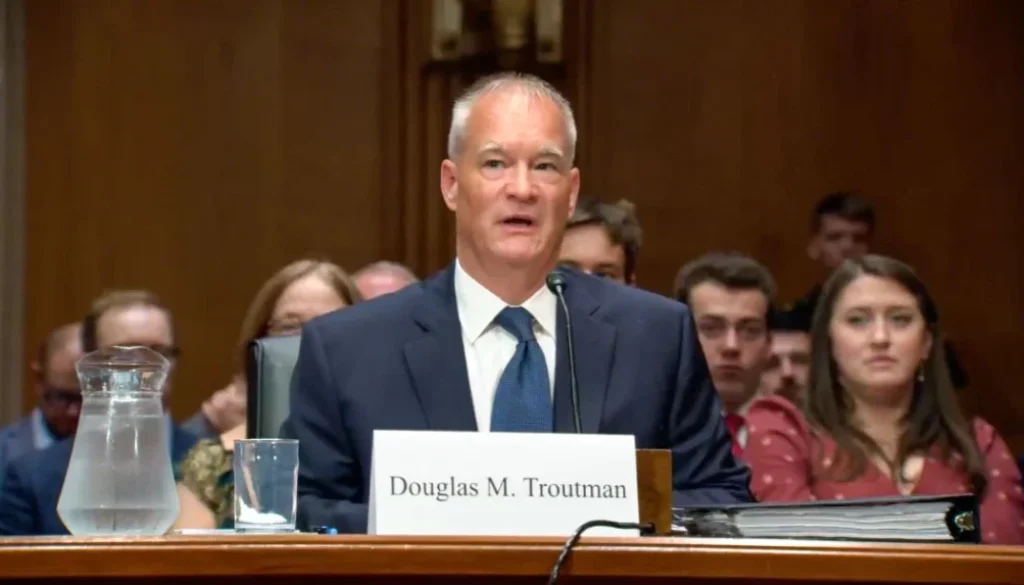
Featured image: Douglas Troutman testifies before the Senate Environment and Public Works Committee, Oct. 8, 2025. (Credit: Senate Environment and Public Works Committee)