
MAHA muscle: The rise of the mom-driven movement shaking up Washington
Kelly Ryerson never intended to become a food and health activist. The northern California married mom spent several years working in finance jobs before directing her focus to raising her two children. That changed in 2011, when debilitating bouts of odd illnesses sent her searching for answers.
Now Ryerson, 49, spends her time traveling between her home and Washington, DC, where she meets regularly with members of Congress and their staffers, and attends closed-door monthly social gatherings frequented by top US health officials.
Ryerson is one of a loose group of mothers, health and environmental advocates and wellness promoters leading the “Make America Healthy Again” (MAHA) movement that is muscling its way into the nation’s halls of power. The group is calling for radical changes in everything from how farmers grow food to how specific types of environmental chemicals are regulated and which foods should be on school lunch trays.
MAHA followers also cite concerns about vaccines, over prescription of medications, use of social media and mental health challenges as among key health threats.
“This has been very much in my opinion a women’s movement, women who are fed up with their kids getting sick,” said Ryerson, whose quest to understand her family’s health issues led her to believe pesticide residues in food were at the root of several health issues she and her children suffered.
What for years was a disjointed group of grass roots organizations and influencers is emerging as a bipartisan political powerhouse that polling shows is backed by millions of Americans. Though its impact has yet to be determined, the movement is garnering the time and attention of lawmakers and top regulatory officials.
An “awakening”
Advocacy work around food, health and wellness has a long history in the US, splintered among myriad groups and individual influencers. The various players have collectively spent decades calling for a range of changes to America’s food system, such as bans on synthetic food dyes and certain other additives, rejection of ultra-processed foods, and restrictions or bans on a range of pesticides and other chemicals used in farming that have been linked to diseases and health problems.
Some of the groups within the MAHA umbrella are concerned about health impacts of vaccines, questioning the safety of some recommended for babies and young children.
Many MAHA backers trace the recent explosion of support for a more cohesive movement to 2020-2021 when public confidence in official government health guidance plummeted during the COVID-19 crisis. Distrust over the COVID vaccines combined with what Ryerson called a “conservative awakening” created a climate where concerns about environmental toxics became a hot topic.
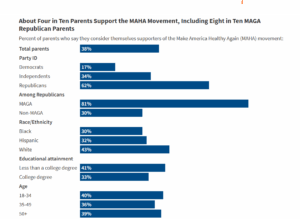
A recent poll by KFF, formerly the Kaiser Family Foundation, shows roughly four in ten White US parents say they are MAHA supporters, while roughly three in ten Hispanic and Black parents say they align with the movement. The strongest support came from Republicans, though 34% of voters identifying as Independents and 17% of Democrats support MAHA, according to the poll.
MAHA’s growing power in Washington was on display in mid-December when the group launched a petition calling for the firing of Environmental Protection Agency (EPA) administrator Lee Zeldin.
The group sees Zeldin as ineffective and ill-informed about the dangers of toxic chemicals in the environment, and sees the agency as captured by industry interests with many top officials appointed to regulatory oversight roles at the agency after working as advocates for the chemical industry.
Under Zeldin’s leadership over the last few months, the agency has greenlighted multiple chemicals of concern to MAHA, a fact Zen Honeycutt, a top MAHA leader and founder of the Moms Across America nonprofit health group, characterized in a New York Times article as what America’s enemies would write in a “plan on how to poison America.”
More than 14,000 people have signed the petition so far, and the action helped MAHA leaders score a Dec. 9 meeting with Zeldin and several other high-ranking EPA officials in which the group laid out their concerns and demands for EPA action. A key concern has to do with pesticides used in agriculture, including glyphosate – the world’s most widely used weed killer and the key ingredient in popular Roundup herbicide brands.
The chemical has been classified as probably carcinogenic by the World Health Organization’s (WHO) cancer experts, as has another commonly used farm chemical, atrazine.
Rather than showing concern, the EPA responded to the recent atrazine classification with contempt for the cancer scientists who made the assessment, saying there was no need for the agency to act quickly, a similar stance they have taken on glyphosate. The glyphosate cancer classification was issued by the WHO 10 year ago and the EPA still does not require any type of cancer risk warning on glyphosate products.
Both pesticides are linked scientifically to an array of human health problems and are widely found in food, water and the environment. MAHA wants to see glyphosate use, in particular, reined in. The chemical is sprayed directly over many crops, leaving residues in foods such as oatmeal, bread, snacks, cereals, and more.
Zeldin wasted no time responding to the MAHA effort to oust him, showing up at a recent MAHA evening social gathering in DC and publicly pledging action from the EPA on MAHA’s agenda items.
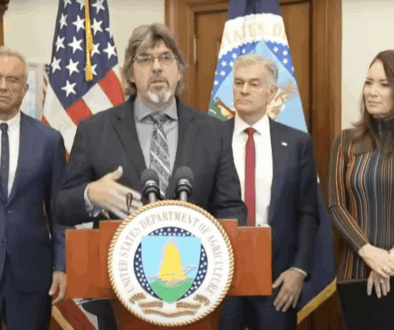
Health and Human Services (HHS) Secretary Robert F. Kennedy Jr., who is head of the Trump administration’s Make America Healthy Again Commission, said in a Dec. 10 press conference that he and other were in talks with Zeldin and were “very, very confident of his commitment to make sure to reduce toxic exposures to the American people.”
The RFK factor
Kennedy, a life-long Democrat, environmental lawyer and popular but controversial children’s health advocate, coined the “Make America Healthy Again” slogan when he ran a short-lived campaign for president in the 2024 election. Kennedy has enjoyed global prominence for many years as a champion for tighter controls on pesticides, food additives and other chemicals linked to health harms.
But he has courted controversy with some of his positions, including his efforts to force changes in the nation’s vaccine recommendations for children and assertions that vaccines could be behind rising rates of autism in America’s youth.
When Kennedy dropped his presidential run and aligned with Donald Trump’s presidential bid, he brought a vast following of child health defenders into Trump’s circle of support and his MAHA platform became a template for the formation of White House’s MAHA Commission.
Kennedy’s role in the administration and the elevation of MAHA has thus far produced a mix of only limited results, however, a fact some grassroots MAHA members have noted with dismay.
A key example of the checks on Kennedy’s influence was seen in the drafting of the first MAHA Commission report. The draft report issued by the commission in May blamed exposures to pesticides and other chemicals, ultra-processed foods and over-prescription of medications as among the factors contributing to a chronic disease in America’s children.
The report spotlighted the health harms of both glyphosate and atrazine pesticides and pointed to a plague of corporate influence, saying a “significant portion” of the research conducted to inform regulation of chemicals is done by the companies profiting from the chemicals, and that analyses of that research shows “potential biases.”
But after heavy agricultural industry lobbying, those points were erased from the final report, replaced with glowing praise for US regulators. The incident drove home the power industry holds over the administration.
“Frankly I’m pissed off about what is going on with the EPA. I feel duped by the EPA,” said Courtney Swan, a 41-year-old nutritionist and social media influencer who shares health advice with her more than 600,000 followers on Instagram. Swan is among the MAHA leadership and travels regularly to Washington from her home in Texas to push the MAHA agenda with government officials and lawmakers.
A “Trojan horse”?
While Kennedy enjoys widespread popularity – he has close to 6 million followers on X and 5.4 million on Instagram – he also has numerous detractors and has come under widespread criticism from prominent groups and individuals for a number of actions, in particular his controversial calls to eradicate Covid vaccine mandates and his espousing of the idea of “freedom of choice” regarding vaccines. His decision to campaign for Trump and then to join the Trump administration added to the outrage from his mostly Democratic detractors.
KFF polling found that 59% of Americans did not approve of his job performance at HHS and 62% were unhappy with his handling of vaccine policy. The majority of those critics identified as Democrats, according to KFF.
Kennedy has alienated even food and environmental organizations that share in his calls for more pesticide restrictions and removal of food dyes and other additives from store shelves.
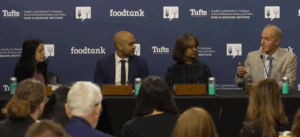
“If I thought there was any real value in what they were trying to do then I would be behind it,” said Danielle Nierenberg, president of the 12-year-old nonprofit organization Food Tank, which advocates for healthier food systems. The group recently held a Capitol Hill luncheon in Washington with the Food is Medicine Institute at Tufts University focused on reducing consumption of ultra-processed foods.
“This has been my life’s work, working with different administrations on these issues. But … I think they (MAHA followers) have been bamboozled,” Nierenberg said. “Nothing is really going to happen or change. You can call it a Trojan horse. It’s like ‘look over here while we talk about chronic disease and food dyes … while we’re doing all this not so great stuff over here whether it’s with vaccines or the administration as a whole.’”
Kelly Anderson, who runs the Clean Food Forum and works to help food companies replace synthetic chemical dyes with natural dyes in their products, understands the dilemma. She is not a Trump fan, “not MAGA”, but she’s solidly behind the movement “to get a cleaner food system.”
“This is a fight that parents have been trying to raise for a long time,” Anderson said.
With the approach of a new year, Swan, whose MAHA leadership focus is on pesticide issues, said even though pesticide protection work seems to be going in the wrong direction now, she is hopeful that will change. She had a “great call” with EPA staffers shortly before Christmas in what she sees as a very positive sign.
“We were all MAHA before there was a MAHA,” said Swan. “We were all in our own silos. But now we’re all coming together and we have this more cohesive group to push things forward. That gives me hope … we might actually be able to change something.”
Featured image: Clip from Robert F. Kennedy Jr. presidential campaign video.